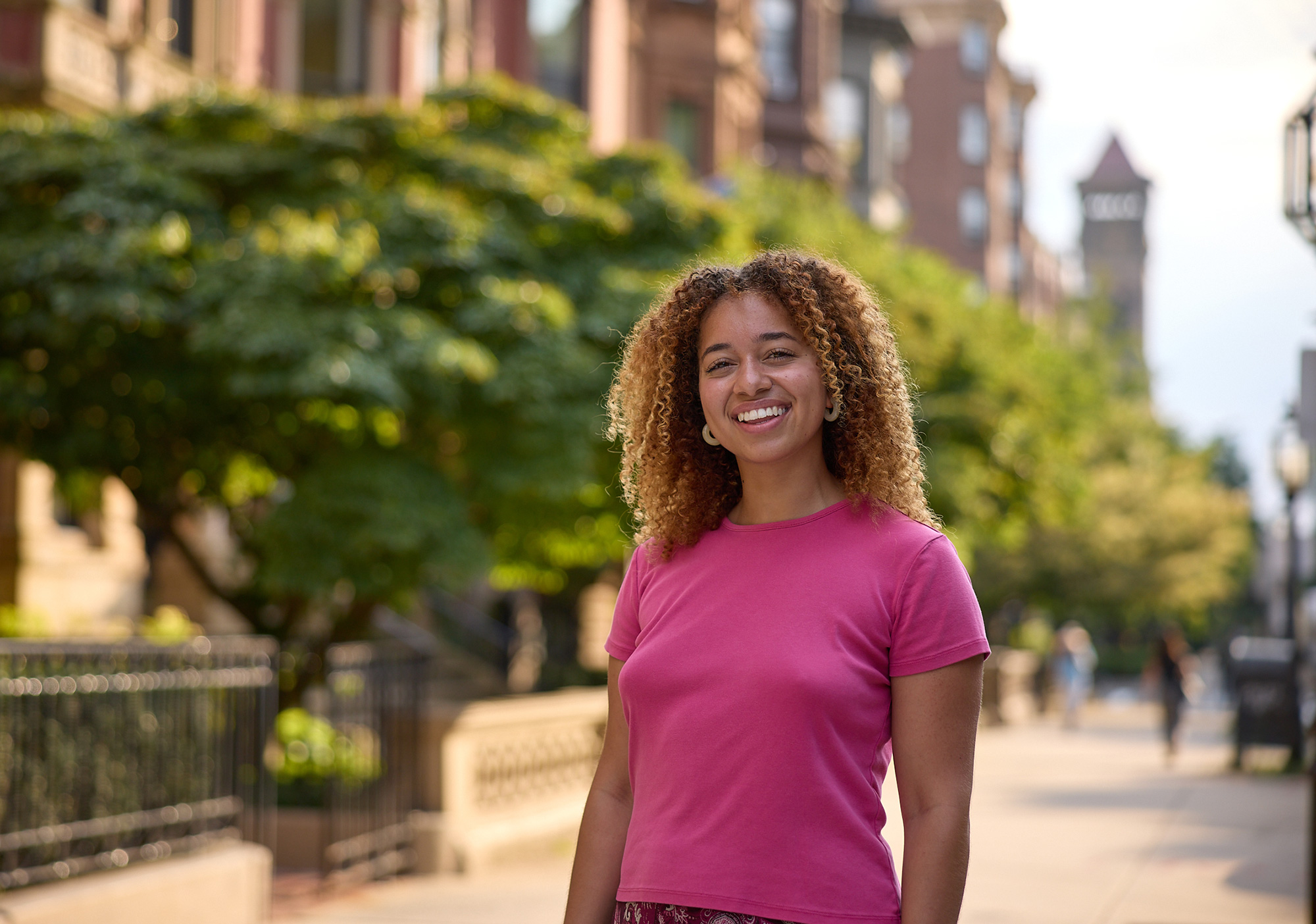
PHOTO: KEN RICHARDSON
She began taking engineering courses in middle school, and by high school had access to the MIT OpenCourseWare class How to Make (Almost) Anything, taught by physicist Neil Gershenfeld, director of the MIT Center for Bits and Atoms and founder of the global Fab Lab Network of digital fabrication labs and educational programs. “If you have a Fab Lab node, anywhere in the world, you can take the class,” she says. “As a sophomore in high school, I was able to take it because our engineering lab was just that good.”
Originally planning to study mechanical engineering in college, Coston instead became fascinated by architecture during an online summer camp offered by the University of Michigan. At MIT, she chose Course 4 in the School of Architecture and Planning (SA+P), graduating in 2026 with a degree in architecture.
Coston received financial support from the Turner Fund, established by former MIT Alumni Association President Gregory Turner ’74, MAR ’77, who received both his bachelor’s and master’s degrees in architecture from MIT. “I would never have been able to go to MIT without the scholarship,” Coston says. Turner established the fund in 2014 to support and encourage undergraduate architecture majors.

In academic year 2024–2025, 57% of undergraduates were awarded an MIT scholarship.
Mentorship and UROPs
Coston began participating in the Undergraduate Research Opportunities Program (UROP) during her first year, working with the MIT Museum to develop and test K-12 curriculum for drop-in workshops at the museum’s Maker Hub. On this project and others, she was supervised by Rosa Weinberg, an educator, artist, and architect who is the K-12 design education lead at MIT’s Morningside Academy for Design. Coston particularly enjoyed conducting an interview series with designers all over the world. The team’s goal was to identify design principles and translate them into curriculum. “We began each interview with the question, “If you were to make a three-step formula for design—this-plus-this-plus-this-equals design—what would that look like?”
Another of Coston’s advisors was Associate Director of Undergraduate Programs Paul Pettigrew MAR ’88, founder of Paul Pettigrew Architect and Products in Space, a design and fabrication practice based in Chicago and Cambridge. Coston worked with Pettigrew on a research project that allowed her to interview more than 50 graduates of MIT’s architectural program about where their education had led them. Coston spoke with some alumni who work in the field and discovered that other graduates went on to other fields: “Some people had stayed adjacent to architecture; others had left it.” Virtually all described the transferable skills gained at MIT and how those skills served them across many industries.
New interests
Over her four years at the Institute, Coston found that her interests evolved and changed direction. Having thought of herself as STEM-focused, she was surprised by how much she enjoyed her music and language classes in the School of Humanities, Arts, and Social Sciences. “MIT is known for STEM, but the humanities departments deserve more attention—they really do contribute to a more well-rounded perspective,” she says.
Coston found a new direction for her studies in a surprising place: When her first and second choices for a required physical education and wellness class were unavailable, she enrolled in PE05.12 Fitness/Nutrition. Now, she says, “I am the number one defender of MIT requiring us to take PE classes. I wanted to get into tennis, wanted to get into sailing. They quickly filled, so I took the nutrition class and absolutely loved it.”
As she developed a strong interest in health and health care policy, she noticed stark differences between US policies and those of Switzerland, where she studied abroad during her junior year. Returning to the Institute, she took classes in health, education, and social policy, and was particularly inspired by 17.315 Health Policy, taught by political science professor Andrea Louise Campbell, the Arthur and Ruth Sloan Professor of political science. Coston now plans to pursue a law degree and career focused on health policy.
SUPPORT SCHOLARSHIPS AT MIT
At MIT, impact begins with people—and recent graduates like Alexandra Coston are an integral part of that story. MIT graduates go on to make a difference in every field, applying the Institute’s hands-on approach to solving problems that matter. By supporting scholarships, you help ensure that every student who accepts an offer of admission has the resources and support to thrive at MIT and contribute their talents wherever they can have the greatest impact. Make your scholarship gift.
Opportunities abroad
First, however, she will spend a year as a Fulbright Fellow in Senegal. John Ochsendorf, the associate dean of SA+P (and a former Fulbright recipient) and the Class of 1942 Professor, suggested that she leverage her fluency in French by applying for a grant to teach in West Africa.
Coston is no stranger to international teaching and learning experiences, having taken advantage of many undergraduate opportunities to explore the world outside MIT. In addition to her semester abroad in Switzerland, she used Independent Activities Periods to participate in a Global Classroom in the United Arab Emirates and a Global Teaching Lab in Scotland.
Now preparing for her nine months in West Africa, Coston reflects on her years as an undergraduate, noting that she especially appreciated MIT’s libraries. “I have spent so many hours in Rotch and Hayden, specifically because of their 24/7 access!” she says.
Coston notes that the MIT alumni community is warm and encouraging to current students; she reached out to many for the interview series and when searching for summer internships. “So many of them got back to me and had Zoom calls with me. Having alumni willing to talk to people about their own stories and any advice they have for you has been so helpful for me.”