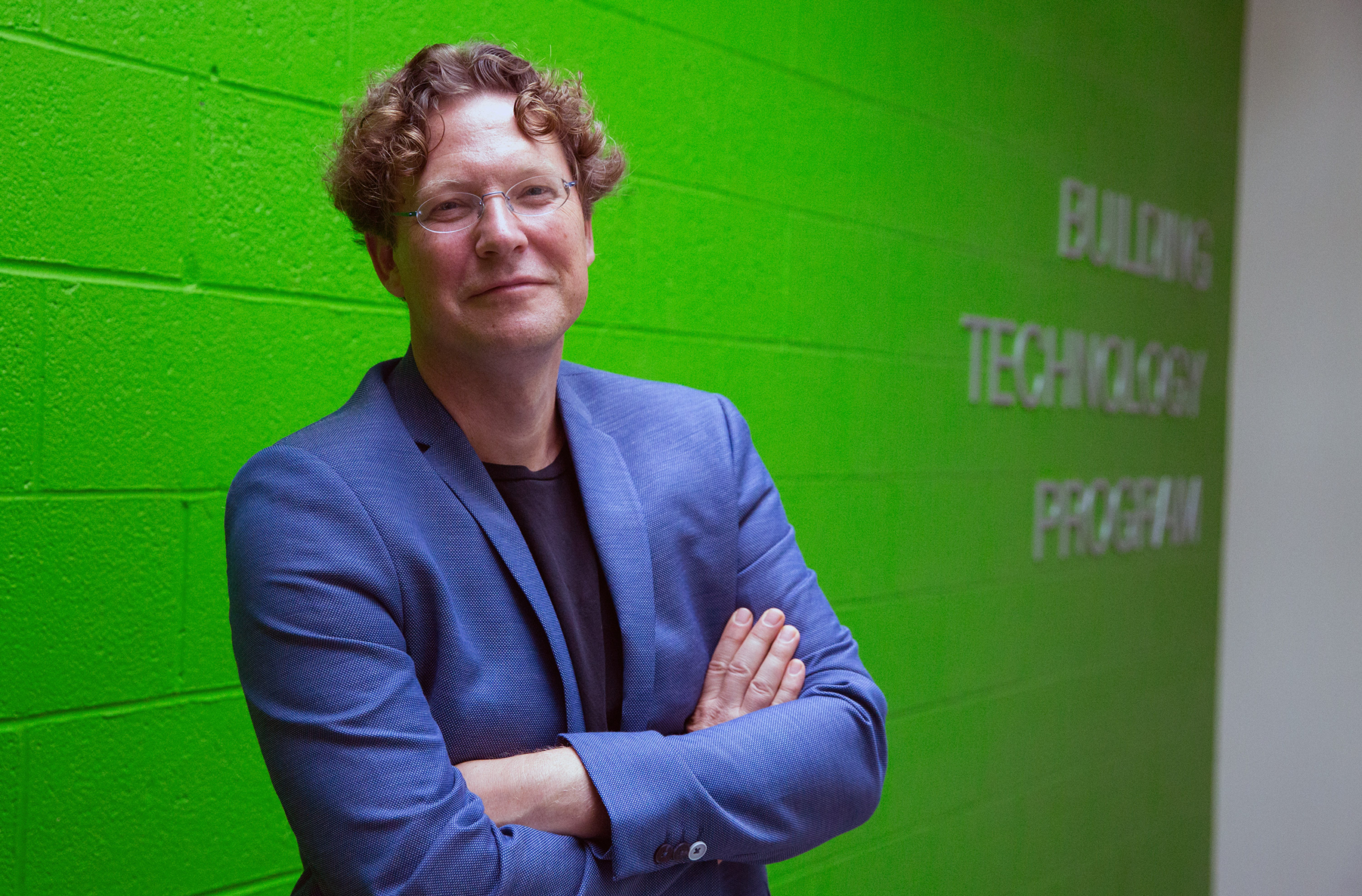
PHOTO: KELLEY TRAVERS
But our homes impose far greater burdens than these routine expenses, according to Christoph Reinhart, the Terri and Alan Spoon Professor of Architecture and Climate at MIT.
“Buildings make an enormous impact on human health and climate,” says Reinhart, who leads the Sustainable Design Lab (SDL). Our built landscapes are responsible for a startling 40% of human-caused carbon emissions. As climate-driven heat waves grow more common, many buildings become heat traps. The World Economic Forum warns that by 2050, the effect of extreme weather events (heat waves, floods, and droughts) may lead to 1.6 million premature deaths, with the elderly and the very young most vulnerable.
Given such sobering statistics, Reinhart is committed to acting as “a responsible steward of the built environment and those who inhabit it.” His mission is to equip individuals, cities, and policymakers with the knowledge required to make buildings safer, reduce carbon emissions, and pursue informed, climate-smart investments.
Delivering data for smart environmental design
After a decade of development, Reinhart and his team have produced a powerful tool for accomplishing just this: the Global Building Inventory (GloBI). As Reinhart puts it, “Our vision is to generate free, public, actionable climate data on buildings all over the world.” This digital platform is designed as a searchable database where anyone can enter an address to learn about a building’s safety during heat waves and receive upgrade options, including cost analyses, payback periods, and carbon reduction impacts. “It’s like a Google for buildings and their environmental performance,” he says.
A physicist by training, Reinhart believes new buildings can be designed to incorporate tough, low-carbon standards while maximizing comfort and human safety, and that older structures can be upgraded with the same goals in mind.
To construct GloBI, SDL researchers pioneered a suite of methods they call urban building energy modeling. They used global weather data sets, three-dimensional shapes, ages, and types of buildings as model inputs. Training AI based on physics-based models, the group then created standardized simulation workflows to characterize energy performance and overheating risk, enabling evaluations for structures in nearly any location.
Additionally, the SDL team devised web applications so users could intuitively explore how to optimize buildings or even entire neighborhoods for energy efficiency and sustainability. The Urban Modeling Interface (UMI) was one of their first tools, quickly adopted by urban planners eager not only to assess city energy use but also to promote walkability, access to daylight, and even urban food production.
Advancing tools for global use
Now, Reinhart and his team are expanding GloBI’s reach and impact. Early adopters include cities as varied as Cairo, Egypt; Florianopolis, Brazil; and Middlebury, Vermont. Dublin, Ireland, deployed GloBI to consider retrofitting architecturally significant Georgian-era homes, and Kiel, Germany, used it to plan a transition away from natural gas. A 2023 study published by Reinhart and colleagues in Nature Communications demonstrated that the majority of these first-use cities are following through on implementing carbon reduction plans based on GloBI insights.
Reinhart also highlights a project close to home: the Massachusetts Building Inventory (MABI). The SDL is developing this platform in partnership with the state, which wants to make it easier for building owners to lower energy costs and reduce carbon emissions in existing buildings.
Historically, adding insulation, solar panels, or heat pumps has held little charm for residents who fear both the cost and disruption of altering their homes. To help address this reluctance, Reinhart’s group will be monitoring responses to the MABI interactive app, which invites residents to “See how much you can save,” with the goal of providing data to the state on what incentives move people to act.
Reinhart’s ambitious goal: increase the state’s retrofitting rate from 1% to 5% per year. Using Massachusetts as our test case, he says, “we want to extend this approach across the United States, to millions of buildings.”
Global partnerships are also underway, with the UK, Norway, Portugal, Kenya, India, and Brazil interested in exploiting satellite datasets of residential and commercial buildings. These collaborations aim to replicate GloBI’s success in diverse urban contexts, adapting the platform to local building codes, climate conditions, and energy goals.
“We know that to meet carbon reduction targets worldwide, we need to dramatically increase the number of people that retrofit their homes,” Reinhart says.
SUPPORT THE CLIMATE PROJECT AT MIT
The Climate Project aims to accelerate and scale up climate solutions while generating new tools and policy proposals. It is organized around six Missions where global progress is urgently needed and where MIT can marshal a critical mass of talent and resources. Give now.
Leadership in climate action
Reinhart has always been drawn to problems of climate, energy, and sustainability. At the start of his career, he worked in the field of solar photovoltaics. But he began wondering, “Why am I making a solar cell more efficient when what drives people to actually put them on the roof is a bigger question?” Reinhart soon realized, “I needed to be where the decision-makers are,” he says.
Today, he has landed exactly where he wished to be: influencing policy decisions in cities around the world; creating scientific and technological solutions that empower citizens and governments to take concrete action on decarbonization; and educating a cohort of MIT students to design healthier, energy-efficient buildings.
As outgoing director of Designing Resilient and Prosperous Cities, one of the six Missions MIT is pursuing as part of its Institute-wide Climate Project, Reinhart hopes “to find synergies among research groups engaged not just with energy efficiency, but with transportation and other matters.” The goal: to offer decision-makers a set of solutions that will make urban life sustainable in the face of climate pressures.
“These are the ideas where MIT takes a clear leadership role and delivers meaningful impact,” Reinhart says.