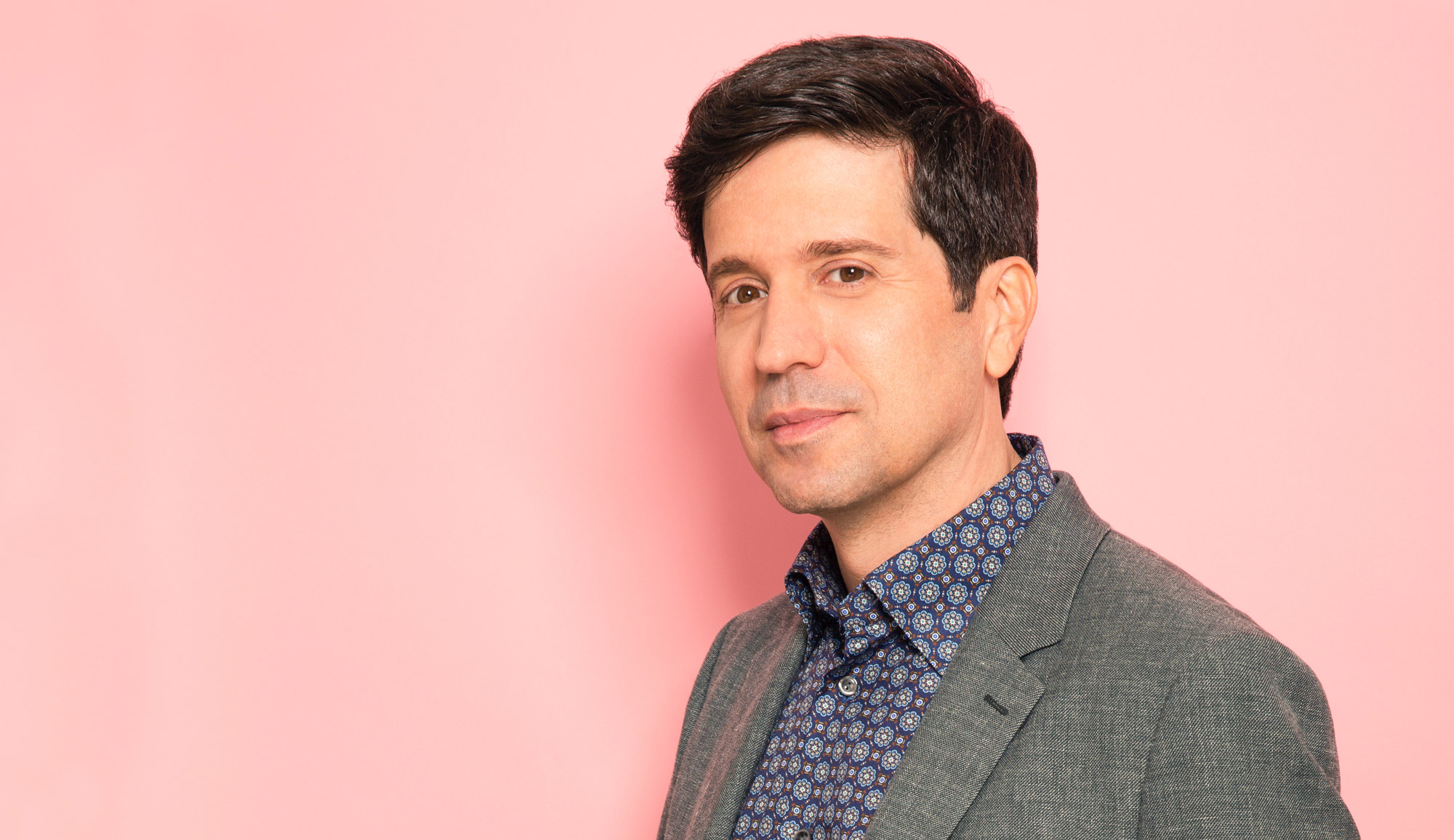
“By the time we got to the 20th century, technology was moving so fast that every decade in popular music brought you something new and exciting: the electric guitar in the fifties, multitracks in the sixties. In the seventies, technology gave us disco and synthesizers.”
Technology’s impact on music motivated him to support the new Music Technology and Computation Program, explains Piscitello, a composer, music producer, bass player, and pianist. The graduate program is a collaboration between the School of Humanities, Arts, and Social Sciences and the School of Engineering. “There’s an interesting side effect that’s happened with all this technology over 30 years,” says Piscitello. “We have so much music that it has to really catch your attention or the listener is onto the next thing.”
“The problem now is that music is getting more and more busy in order to hold our attention. What does that do to our ability to listen to music that takes a little bit more time to develop? What I’m interested in is how we get to new experiences, new musical ideas and capabilities, new kinds of expressions that we haven’t heard before? I think the Music Technology Program can do that.”
The first student beneficiary of the John Piscitello Music Technology Fund is Claire Southard ’25, and Piscitello is intrigued by her research objectives. “Claire is looking at a new kind of expression: whether people can express themselves musically with their minds—if they’re making up for a disability or simply finding a new way to express musical ideas that will lead to new art.”

Life as a musical student at MIT
Music has always played a significant role in Piscitello’s life, and his years at MIT were no exception. “I played string bass and that got me into just about any group I wanted to be in,” he laughs. “I was recruited to play, whether it was students with their own rockabilly band or new wave band—or if it was the Concert Jazz Ensemble or the orchestra.” He also joined a band and recalls playing “every party we could” and practicing on the stage of Kresge Auditorium.
Only one group eluded him—the Festival Jazz Ensemble run for several years by Jamshied Sharifi ’83, a performing artist and composer who had a long association with the Institute. Unfortunately for Piscitello, the group already had a bass player, but Sharifi, who died in August 2025, “really impressed me. Challenging the whole idea of MIT as just a STEM school—even back then there was this wonderful composer running Festival Jazz Ensemble… and doing his own kind of sound. So that was definitely inspiring to me.”
A career of innovation
After earning his bachelor’s and master’s degrees at MIT, Piscitello went to work for a Cambridge music technology company, MOTU, then moved on to Sun Microsystems, Alta Vista, and Google. Innovation was never far from his mind. “The theme in the early days of Google was enabling people to do things that you couldn’t do before,” he reflects. “What all technology platforms do is enable new kinds of experiments to be done more rapidly. That leads to new types of experiences and art that wouldn’t have been created otherwise.”
Eventually Piscitello wanted to build a full-time music career. “It was very hard to pursue the work that I was doing in Silicon Valley and have any kind of meaningful musical development, so I decided to go back and study all the things I needed to learn.” He became a student again, first at San Francisco Conservatory, then in the Screen Scoring Program at the University of Southern California, Los Angeles.
Thirteen years later, Piscitello has scored several comedy and documentary films and series, including Hulu’s Too Funny to Fail: The Life & Death of The Dana Carvey Show, CNN’s Unseen Enemy, and No Place on Earth. He has also been successful in the video game genre, and is particularly proud of his work, in collaboration with Aalok Mehta, on DesiQuest, an example of the “actual play” game genre, in which performers play games for an audience, either in large venues or online.
Looking to the future
Piscitello is thrilled that MIT students have access to the new Edward and Joyce Linde Music Building, both for research and for live performance. “It’s a great venue and cities need venues like that. Getting people to show up for live experiences is what music was for many, many hundreds of years, before we had recording. One of the things I’m very concerned about is algorithms and AI dulling our experience with music. You want to people to have deep experience with music,” he remarks.
“In every decade since World War II, popular music has turned over completely, and that was always driven by technology,” he observes. “It’s good that MIT has people who care about the arts, and my experience was that professors there are serious artists and looking to stretch boundaries. MIT has depth everywhere you look, and the arts are included as part of that.”
SUPPORT MUSIC TECH AND GRADUATE STUDENTS AT MIT
Music Technology and Computation is giving MIT students the technical and artistic ability to thrive in this fast-growing field. Give to music tech. You can also provide financial support for MIT’s graduate students, who drive research discovery and exploration forward, contribute to undergraduate teaching and mentoring, and deeply enhance campus life and community. Here’s how.

THE HUMAN ELEMENT
Music and Technology Intertwined
Graduate program in music technology and computation brings new dimension to interdisciplinary offerings

THE HUMAN ELEMENT
Mens et Manus et Music
A tour of the new Edward and Joyce Linde Music Building at MIT