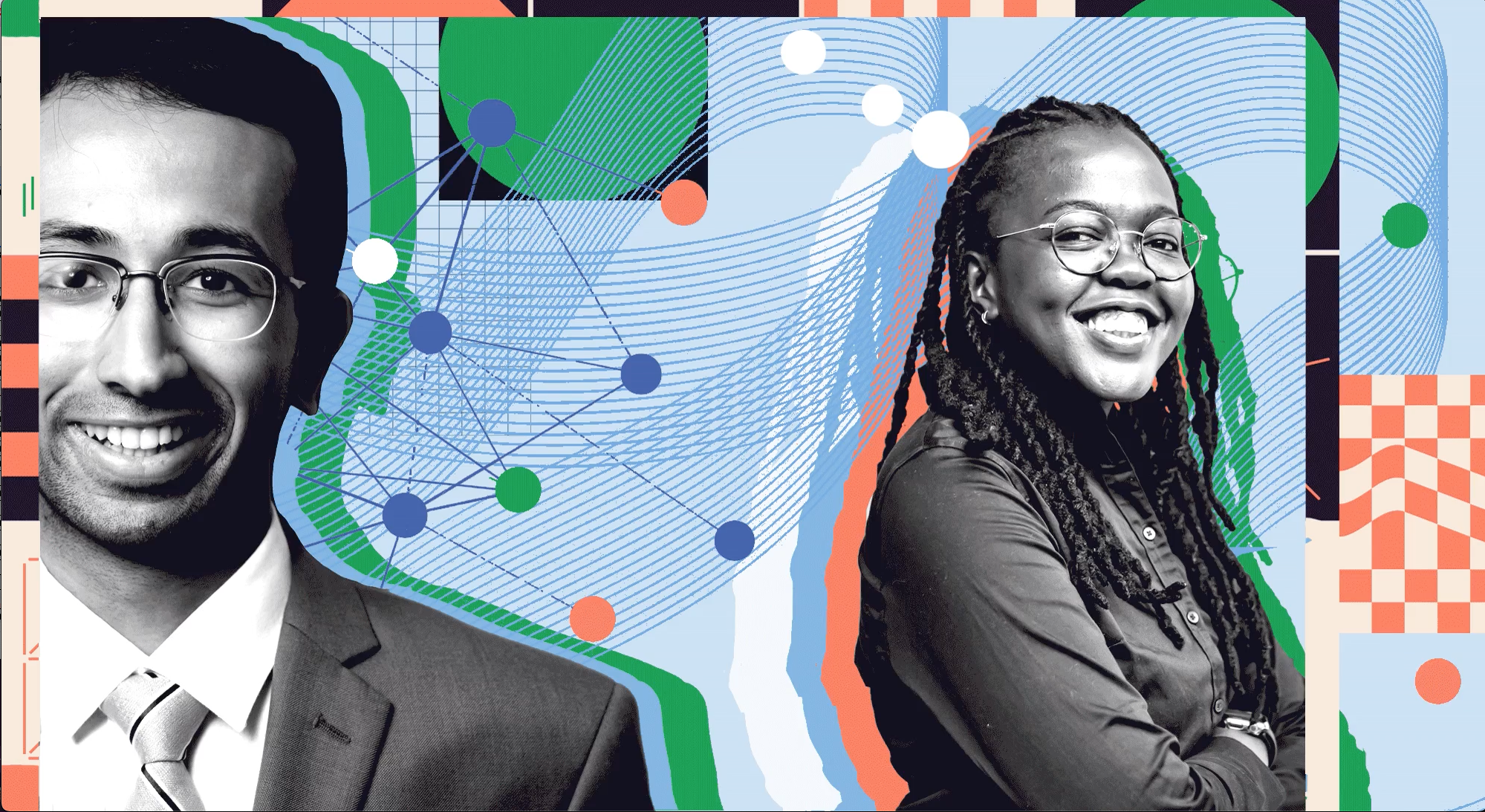
ILLUSTRATION: ANDREA D'AQUINO
His dreams were soon tempered by reality; he learned early on that economic progress can come at an ecological price.
“My journey began in Surat, India’s hub for diamonds and textiles, where I grew up surrounded by a culture of hustle and entrepreneurship,” he recalls. “At the same time, living near a booming chemical manufacturing belt made me acutely aware of the environmental and health costs of industrial growth. That contrast between opportunity and its costs inspired my commitment to developing technologies that promote growth while being sustainable.”
This commitment led him to MIT. After studying chemical engineering at the Indian Institute of Technology in Mumbai, he arrived in Cambridge mid-pandemic, when public health challenges felt insurmountable. The timing mattered: Shah wanted to launch a company that tackled urgent public health issues in under-resourced areas, and he appreciated MIT’s strong global focus.
“I knew I wanted to build a business that used science to do something impactful and to solve a real problem. And I really loved that the focus [of the center] was not just the US but that it was also focused on growth economies. The delta of change you can bring on within some of these areas, including India and Africa, can be immense,” Shah says.
That idea blossomed during his fellowship at the MIT Kuo Sharper Center for Prosperity and Entrepreneurship at the MIT Sloan School of Management, formerly the Legatum Center for Development and Entrepreneurship. MIT Sloan announced the renaming of the center in April 2025, made possible by a gift from Sayuri Sharper ’81, SM ’82, CEO of Kuo Sharper Initiative and president of KSF Impact, and Craig Sharper SM ’80. The gift has enabled the center to reaffirm its commitment to amplifying the ambitions of entrepreneurs dedicated to solving some of the world’s most pressing challenges by leveraging cutting-edge science and innovation.

Since its founding in 2007 and with the support of the Legatum Foundation, the center has provided nearly $10.5M in tuition support for over 400 fellows from 67 countries.
A passion for problems
Shah aimed to create a company that removed contaminants such as PFAS, lead, iron, and copper from water. It was an ambitious notion, both in science and in scale.
“They’re extremely hard to remove from water, mainly because of their chemical diversity but also because they’re present in very low concentrations, akin to dropping an aspirin tablet in an Olympic-size swimming pool. In my lab at MIT, researchers developed materials, similar to boba beads, that help to remove contaminants in a more effective manner. As a fellow, I was able to explore applications for these materials for use across industries,” he says. Shah worked on this project with his PhD advisor, Patrick Doyle, the Robert T. Haslam Professor in Chemical Engineering, as well as Devashish Gokhale SM ’22, PhD ’24 and Luca Mazzaferro.
Mentors at the center helped him to refine an ideal customer profile. He reworked the idea to launch a bioprocessing purification startup, Drosera Bio, pivoting from water to the more commercially viable, scalable targets of therapeutic biologics and, someday, food proteins.
“Up to one in three late-stage drug failures are due to manufacturing, not the science,” he says. “The impact we will have on the world will be to make therapeutic drugs cheaper and more accessible and bring them to market faster, so that not only people in the US or other developed countries can afford them. [We will also] take them to countries where affordability is a huge concern,” he adds.
At the MIT Kuo Sharper Center, Shah was part of a 15-fellow cohort with students from around the world. Each had eclectic ideas, but all had one thing in common: a passion for the problems they want to solve, grounded market knowledge, and a commitment to principled, systems-level entrepreneurship.
Fellows receive up to $15,000 in tuition support, along with access to additional funds to conduct market research, pilot solutions, and build insights through hands-on fieldwork in their target growth markets in more than 65 countries.
“What makes our student fellows unique is their incredible commitment to impact,” says Dina Sherif, the MIT Kuo Sharper Center’s executive director and a senior lecturer at MIT Sloan. “They stand strong in their purpose and are determined to use private enterprise to create change and opportunity across growth markets.”
SUPPORT THE MIT KUO SHARPER CENTER
To learn more about supporting the MIT Kuo Sharper Center for Prosperity and Entreneurship, contact Dena Patterson.
On the agenda: business ideas—and life
While Shah treasured this professional support and global focus, he was also galvanized by the center’s humanity.
“Those are some of the warmest people I met on campus. MIT taught me the human side of entrepreneurship,” Shah says.
Through the fellowship, he learned how to scale a business while also retaining a sense of self and purpose as a CEO, he says.
“The journey of a CEO can be extremely lonely. You’re always challenged; you’re learning on the job. You’re the one making the decision or calling the final shot without having done any of that before,” he reflects. “There’s a lot of imposter syndrome and vulnerability. The center gave us some of the tools, or I would say mantras, to succeed.”
As a student, Shah regularly met with Sherif, who remains a close mentor. They discussed business ideas, but also talked about life.
“There were times when I would come to her with a long list of problems and hard questions: ‘I’m having trouble with this; I’m not doing well here. When I build my business, what will I do if I hire the wrong person?’ She helped me prioritize,” he recalls. “Now I ask myself when I’m feeling stressed about a certain situation: Is this a problem for the future? Is this something that I can control?”
“How am I changing the world?”
This human touch also inspired Perseverance “Persy” Patsika MBA ’25, an MIT Kuo Sharper Fellow who cofounded Moms Are Geniuses, a social enterprise project in Zimbabwe that provides a revolving fund for startup capital to women-run businesses.
“Our goal is to attract search fund investors who will work with and invest in businesses run by these women,” she says—women with potential who simply need a chance.
Patsika grew up in Zimbabwe and was drawn to the MIT Kuo Sharper Center’s sense of what she calls Ubuntu, a Southern African philosophy emphasizing interconnectedness, community, and shared humanity.
“It’s a term that’s very common back home, where we say: ‘I am because we are.’ I wanted a school where I could be part of something, and that’s what I found at MIT and at the center, especially. This is a place where people go to create real impact in the world,” she says. “In my work, I want to close that gap between people having access to those resources and people living up to their potential and dreams.”
It’s an audacious goal, but one she felt equipped to tackle with support from the center. Here, she says, ambition is normalized; dreaming big is encouraged.
“Every day I wake up with this drive to say, ‘How am I changing the world?’ At the center, I saw my peers working tirelessly, trying to make communities and people’s lives different. I thought, ‘How can I end up being at the forefront of this change?’” she says.
“The center makes you dream like we used to dream when we were kids. When we grow older, we become more cynical and skeptical. But at the center, there’s a level of vulnerability. You share an idea or a dream and discuss how it can be made into reality. People who change the world don’t let the noise get to them. At the center, like-minded people help each other stay on the road to creating.”
Sherif is inspired by fellows like Shah and Patsika as she leads the MIT Kuo Sharper Center. “Watching them grow, wrestle with hard questions and build ventures that reflect who they are and what they care about, has been one of the greatest privileges of my career. Their journeys reaffirm my belief that entrepreneurship, at its best, is a profoundly human act—one rooted in empathy, hope, courage and a deep desire to leave the world better than we found it.”
Redoubling Efforts Under New Name
The MIT Kuo Sharper Center for Prosperity and Entrepreneurship, formerly the Legatum Center for Development and Entrepreneurship, seeks to advance prosperity through innovation across global growth markets. With generous support from Sayuri Sharper, SB ’81, SM ’82, and Craig Sharper, SM ’80, the center will accelerate its efforts to support more entrepreneurs and strengthen innovation ecosystems.
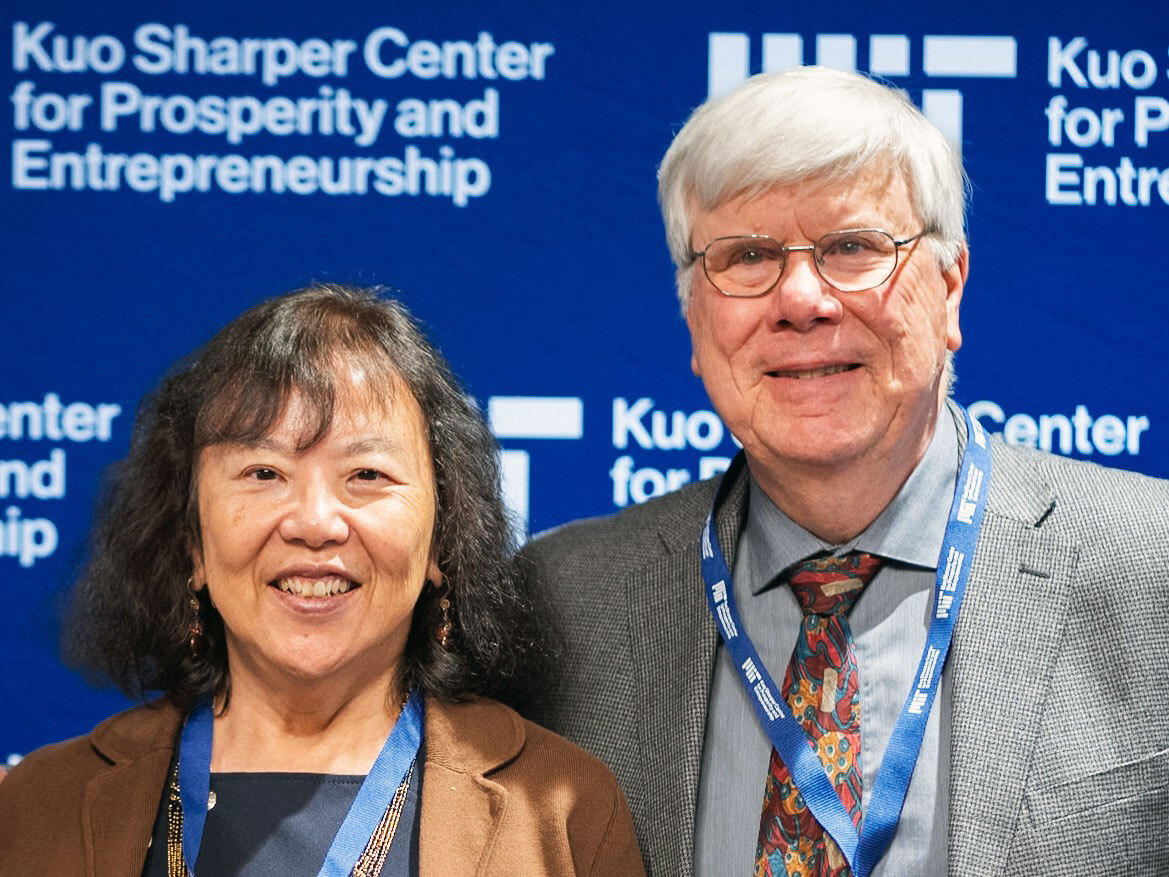
“As an individual, you may feel like there’s not too much you can change,” says Sayuri Sharper, CEO of Kuo Sharper Initiative and president of KSF Impact, “but I find that there are actually a lot of us who are trying to make life better for the next generation. I am very honored to have this opportunity to work with the center.”
The center will continue to expand flagship programs such as the competitive MIT Kuo Sharper Center for Prosperity and Entrepreneurship Student Fellowship Program, which accepts a cohort of 10–15 aspiring entrepreneurs each year. Fellows are provided with tuition, travel, and prototyping support, as well as access to professional advisors, special seminars, and other cross-campus resources.
The center’s new name “is a reaffirmation of our commitment to our values and to our ever-growing community,” adds Dina Sherif, executive director of the MIT Kuo Sharper Center and a senior lecturer at MIT Sloan. “We are not waiting for the future—we are shaping it now.”