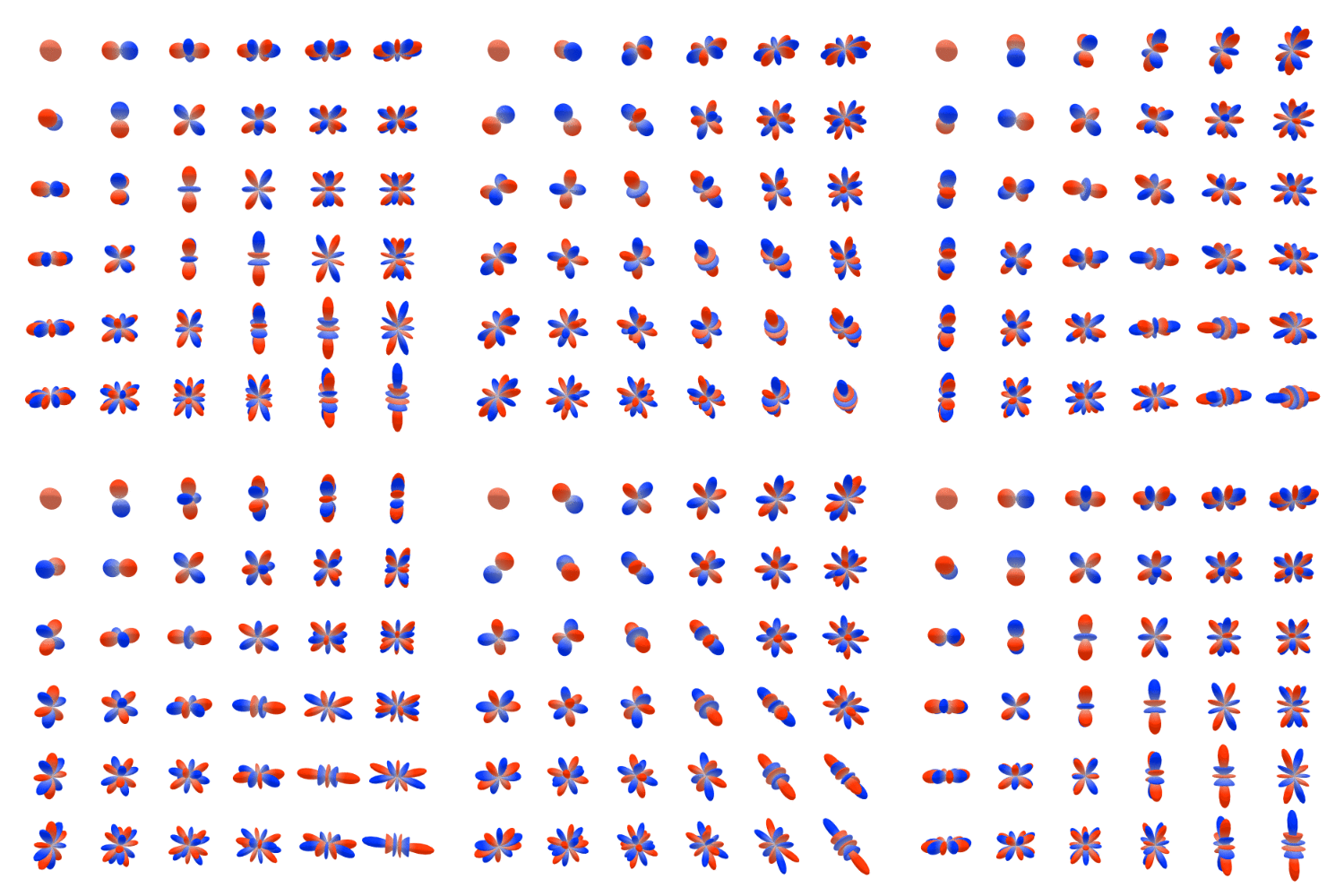
Rotations of spherical harmonics, shown here in increasing complexity. These functions describe how patterns can form around a central point in three dimensions. They’re the same math used to model the shapes of electron orbitals in atoms, and in modern AI research they help build neural networks that respect 3D symmetry.
IMAGES: COURTESY OF TESS SMIDT
Researchers can, for example, dedicate their careers to worthy causes, such as finding cures or better treatments for cancer and other diseases. Tess Smidt ’12, an associate professor in MIT’s Department of Electrical Engineering and Computer Science (EECS) in the School of Engineering and the Schwarzman College of Computing, is taking a different approach. Rather than fixating on a specific problem, she hopes to have a broader impact by developing computational tools and methods that can be used to address a range of challenges, such as designing stronger and lighter materials; inventing new, more effective pharmaceuticals; and improving medical imaging and climate modeling.
As Smidt recalls learning from her woodworking experience building a “Lasagna Desk” in MIT’s Hobby Shop, “Sometimes the thing that makes or breaks the ability to execute a really novel idea is having exactly the right tool.”

Inspired by fictional starships
Smidt decided to go into particle physics at the age of 13, after watching reruns of Star Trek: The Next Generation. (Matter-antimatter reactions propelled the fictional starship in that series.) She stayed true to that early fascination at MIT, becoming a physics major with a minor in architecture. For three years, she conducted research in the group led by physics professor Janet Conrad, with a primary focus on neutrino experiments. After graduating in June 2012, she spent part of the summer at the Large Hadron Collider, the world’s largest and most powerful particle accelerator, near Geneva, Switzerland. There, she investigated the Higgs boson, an experience she called “a nice completion of a childhood dream.”
That same year, Smidt became a graduate student at the University of California, Berkeley, where she transitioned to materials physics, a decision influenced by the appreciation for architecture she had acquired at MIT. She became enchanted with the design process, she says, “taking ideas from my head, making a computer model, and then bringing that into the physical world.” The key lesson she brings to her current research at the intersection of physics and computer science (neural networks, in particular) is that “if the process is good, the outcome will be good.”
Identifying the limitations of neural networks
In 2017, while working on AI image recognition, she came across a serious shortcoming in the available technology: While a standard neural network could, for instance, identify an image of a rabbit in one orientation, it could not pick out that same rabbit if it had been slightly rotated, unless the network had previously been trained on many images with different orientations. Smidt, who is fond of rabbits, often references them as teaching examples. Her two black tortoiseshell lionhead rabbits, named after the physicists Mildred Dresselhaus and Emmy Noether, are the star attractions of her Instagram account, @physicsbuns.
For a 3-D object, the network might need to be trained on hundreds or even thousands of differently configured images. “Scientists are uncomfortable with the idea that if I run my simulation slightly rotated, I am going to get a different answer,” Smidt says. She presented a way around this problem with a series of papers written with several coauthors. They introduced a new approach called Euclidean neural networks (ENNs)—so-named because they understood geometry, recognizing that a rabbit is a rabbit regardless of how it’s situated in space.
A breakthrough in materials science
The advent of these networks has been a boon to materials science. Smidt and MIT Associate Professor of Nuclear Science and Engineering Mingda Li used ENNs to design materials for energy storage devices that could complement solar energy systems. Because the networks comprehend geometry, they can outperform conventional networks trained on hundreds of times more data, Smidt says. She has also collaborated with Harvard materials scientist Boris Kozinsky to facilitate the design of drugs and other substances. In addition, ENNs have proven helpful in MRI brain imaging due to their ability to detect tumors or hemorrhages in various orientations.
Last year Smidt, who leads the Atomic Architects research group, collaborated with Abigail Bodner, an assistant professor in the Department of Earth, Atmospheric, and Planetary Sciences. Bodner holds an MIT Schwarzman College of Computing shared position with the Department of Electrical Engineering and Computer Science, which is housed jointly in the college and the School of Engineering. The pair obtained a research grant to develop more accurate simulations of ocean turbulence through the use of ENNs. A better understanding of how turbulence mixes the oceans could lead to better predictions of the path a given hurricane will take—along with more reliable climate predictions in general.

Smidt’s modus operandi is to concentrate on method development, while working with “domain experts to take care of the use cases,” she says. “There are a lot of problems that need solving. If I can provide tools that 10, 100, or even more people find useful, that could lead to a force multiplier effect. If I end up just being a tool builder who helped others bring their ideas into reality, that would be pretty satisfying. I also build the tools that I want myself but seem to be missing…Good tools often lead to better ideas, it’s a two-way street.”