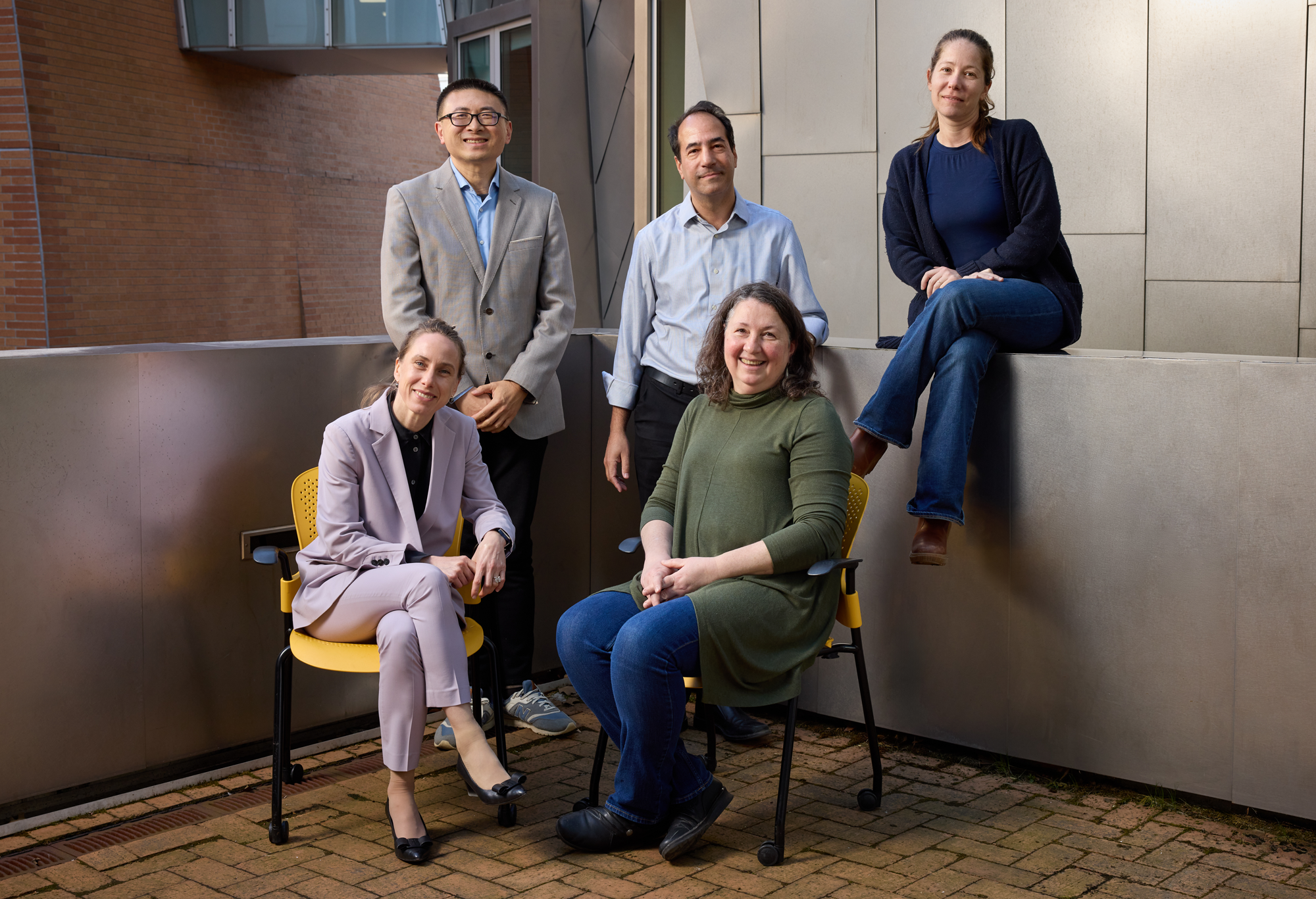
Clockwise from bottom left: Polina Anikeeva, Xuanhe Zhao, Alan Jasanoff, Tal Cohen, Polina Golland.
PHOTOS: KEN RICHARDSON
Concerned, she might rush to a doctor’s office where both the fetal movements and heart rate can be assessed in an ultrasound exam that lasts a few minutes or maybe half an hour. “But in cases of high-risk pregnancy, it could be helpful to have continuous monitoring that can detect complications when they first arise, rather than waiting until things escalate to a more urgent level,” says Polina Golland PhD ’01, the Sunlin (1966) and Priscilla Chou Professor of electrical engineering and computer science.
Similarly, Golland adds, uterine contractions, which squeeze blood out of the placenta, can occur long before the mother goes into labor, yet their purpose is not well understood. Because they are intermittent, the contractions may not be observed at all during a medical appointment. However, Golland says, “with continuous measurement sensors unobtrusively fitted to the mother, we could study the contractions, and the interaction between the placenta and fetus, in far greater detail.”
Interdisciplinary team focuses on maternal health
These are just two examples of avenues that Golland is exploring alongside four other principal investigators (PIs) supported by a Breakthrough Grant from the MIT Health and Life Sciences Collaborative (HEALS) Seed Program.
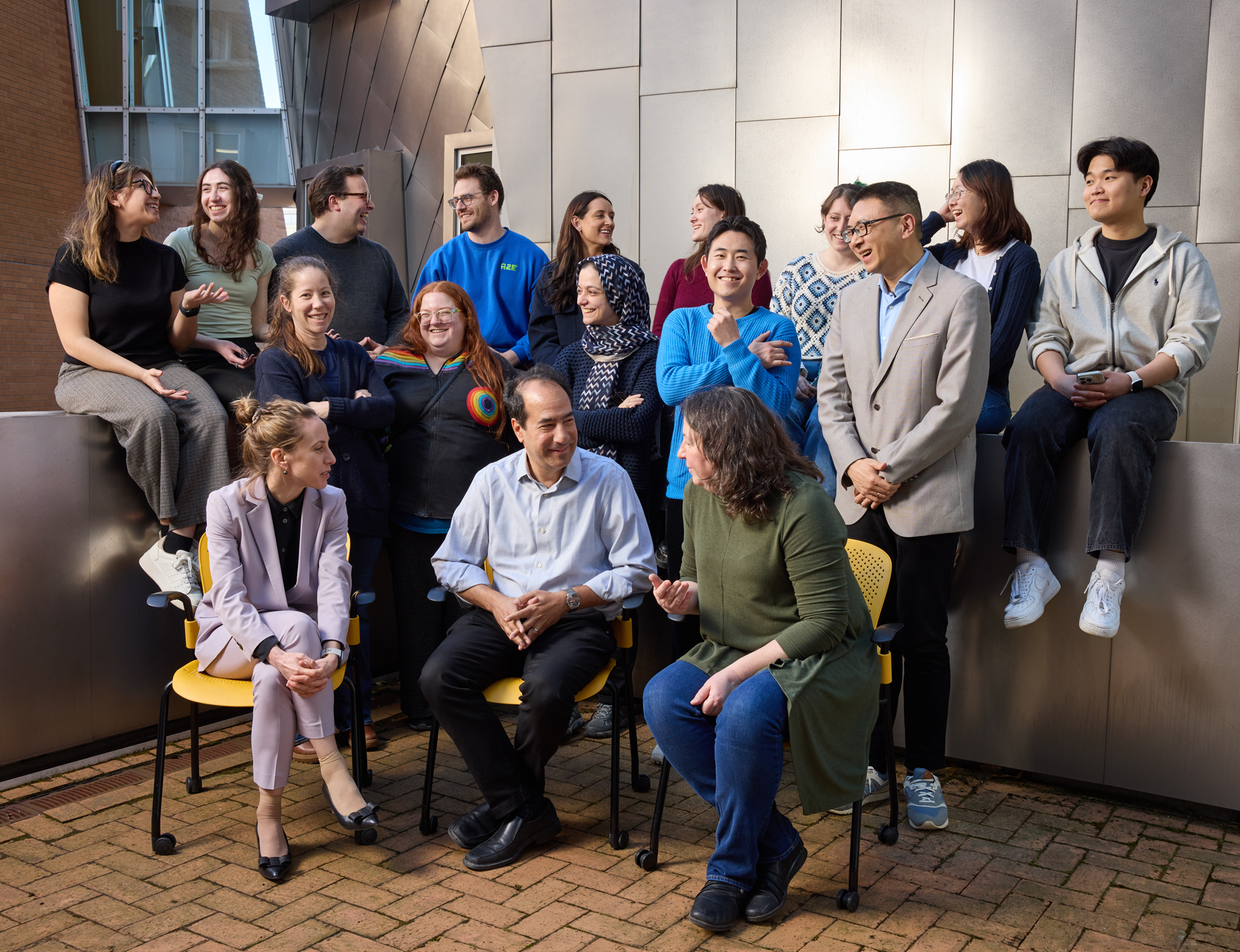
Golland is joined in the maternal health project by Polina Anikeeva, the Matoula S. Salapatas Professor of Materials Science and Engineering and professor of brain and cognitive sciences; Tal Cohen, associate professor of civil and environmental engineering and mechanical engineering; Alan Jasanoff, the Eugene McDermott Professor in Brain Sciences and Human Behavior; and Xuanhe Zhao, the Uncas and Helen Whitaker Professor of Mechanical Engineering and Civil Engineering. While Golland has worked for about a decade on imaging various aspects of pregnancy, her co-PIs have expertise in complementary areas, including sensor technologies and modeling techniques. By combining the talents of these professors, along with those of the students and postdocs in their research groups, Golland says, “we aim to completely change the way that pregnancy is studied and supported.”
To this end, the team is developing a suite of noninvasive surface sensors. For example, a commercially available ultrasound sensor (or transducer) can be embedded within a biogel patch invented by Zhao, which can, in turn, be comfortably attached to a pregnant woman’s belly. With this approach, Golland says, “you can collect clinical quality ultrasound data over the course of several days,” which was not practical before.
A different kind of surface sensor, designed by Anikeeva, will also be packaged inside biogel patches to count the number of baby kicks and measure contractions and other motions of the uterus that could be of clinical significance.
In addition, two kinds of invasive sensors are being studied by the team. One, devised by Anikeeva, has been implanted in mice to measure motions of the gut. The next stage will be to design similar sensors to analyze uterine contractions in pregnant mice. The objective is to learn, among other things, how those contractions affect blood supply in the placenta and to then translate those findings to processes in human pregnancy.
Another measurement device, under development by Cohen, is a biopsy-like needle that can be briefly inserted into an animal subject to probe the biomechanics of uterine contractions. These experiments, Golland says, can provide precise information about “how the contractions propagate through the uterine muscle and affect the placenta”—information that should be relevant to human patients as well.
New insights from MRIs
MRI scans, which can be used to look for potential abnormalities during high-risk pregnancies, afford high-resolution, three-dimensional views of the fetus, uterus, and placenta, as well as functional images that reveal the dynamics of these and other organs over time. Members of the maternal health team are using MRI to study how contractions and blood flow changes in and around the uterus relate to brain activity—potentially leading to insights about the biological origins of neurocognitive phenomena that accompany pregnancy. The team is also investigating the relationship between the measurements captured by their noninvasive sensors and those provided by MRI. “The MRI scans will serve as a source of ‘ground truth’ data that can validate what we’re seeing with our new sensors,” Golland says. “We want to find out how close we can get to MRI-based measurements using these noninvasive sensors.”
She and the other project PIs are building models—some of which rely on artificial intelligence—designed to bridge the information gap between the noninvasive sensors they’re creating and the data available from MRI and animal studies. Aided by these models, the researchers hope to discern the subtle correlations between uterine contractions, fetal movements, and brain activity.
The group has received two years of funding through their MIT HEALS grant, but they’re already looking to extend that timeline with outside funding. They hope to introduce novel measurement tools that can illuminate the dynamics of pregnancy with far greater clarity than has been possible before. That knowledge, in turn, will hopefully provide novel biological insights into dynamical processes during pregnancy, enabling physicians to offer better care for their patients. The team’s collective effort, Golland says, “fits really well with the spirit of MIT HEALS, which is to bring together researchers from different fields and let the sparks fly in unexpected ways.”
SUPPORT THE MIT HEALS SEED PROGRAM
The MIT HEALS Seed Program unlocks ideas that cannot yet be funded elsewhere but often define what comes next in health and life sciences. Sustained philanthropic support is essential to maintaining this catalytic innovation engine. Your gift enables interdisciplinary teams such as the maternal health project to pursue bold ideas, generate transformative breakthroughs, and accelerate impacts on human health.
Make your gift.