Finding the Right Fit: A Planned Giving Strategy for Lasting Impact Through a charitable remainder unitrust and donor-advised fund, Bonnie Biafore ’76 is supporting work that matters
Bonnie Biafore ’76 loves the smell of freshly poured concrete. In some ways, it’s what led her to a degree in architecture at MIT. The daughter of a concrete contractor, Biafore was drawn to a field that was both embedded in the familiar world of construction and appealed to her engineer’s mind.
But after graduation, while working as a server at Ken’s Pub in Cambridge, Biafore realized she wasn’t much of a designer and that a career in architecture wasn’t the right fit. She headed to Columbia University to earn a master’s in structural engineering and then took a job at an architecture, engineering, and construction firm. That didn’t quite fit either.
One day, a partner at the firm asked her to manage a project to implement a computer-aided design system, and Biafore discovered a job that was just right. “That’s how I found out that I was meant to be a project manager,” she says.
She’s since started her own company, Montevista Solutions, and written the book, as it were, on project management—35 of them, in fact. They cover the basics of the subject but also specialty software topics such as Microsoft Project and QuickBooks (her QuickBooks guide was, at one point, Intuit’s official guide). Moreover, she’s created dozens of courses on the topic for LinkedIn Learning. Her course Project Management Foundations has been taken by more than 2.5 million people and has ranked among the site’s 10 most popular offerings since 2018.
What if we could move the Earth?
Through her books and video courses, Biafore has spent more than three decades teaching others. “But a lot of that, and my ability to teach people things, comes because MIT taught me how to learn,” she says. At MIT, she saw the instructive power of trying things out, and of working collaboratively to see how others solve problems.
Biafore recalls an assignment to build the lightest possible bridge from balsa wood. “I completely overdesigned it, so it held the load, but it was not very light.” But she noticed how other people approached the build and, in particular, how they came up with novel solutions.
She also saw this inventiveness in a conversation she had with fellow undergraduates as they sat outside their dorm. She remembers, with amusement, that they were discussing how to engineer another hour into the day so that they could get all their work done. What if, they mused, we could move the Earth farther from the sun?
Experiences like these made Biafore feel for the first time that she belonged. In middle and high school, her broad interests and different sensibilities, she says, made her “feel like I was weird.” At MIT, they were assets. It was inspiring, she says, to be surrounded by people who, like her, are curious, think outside the box, and want to solve problems.
“Let’s make things better”
Biafore, now living in Conifer, Colorado, remains inspired by the people of MIT and the problems they are solving. An avid reader of MIT Technology Review, she recalls a blurb about bacteria that had been genetically modified to eat tumors and then die when the tumor was gone. “And I’m just like…” Biafore says before making the gesture of one’s mind being blown.
How can an MIT charitable trust work for you? Try our gift calculator.
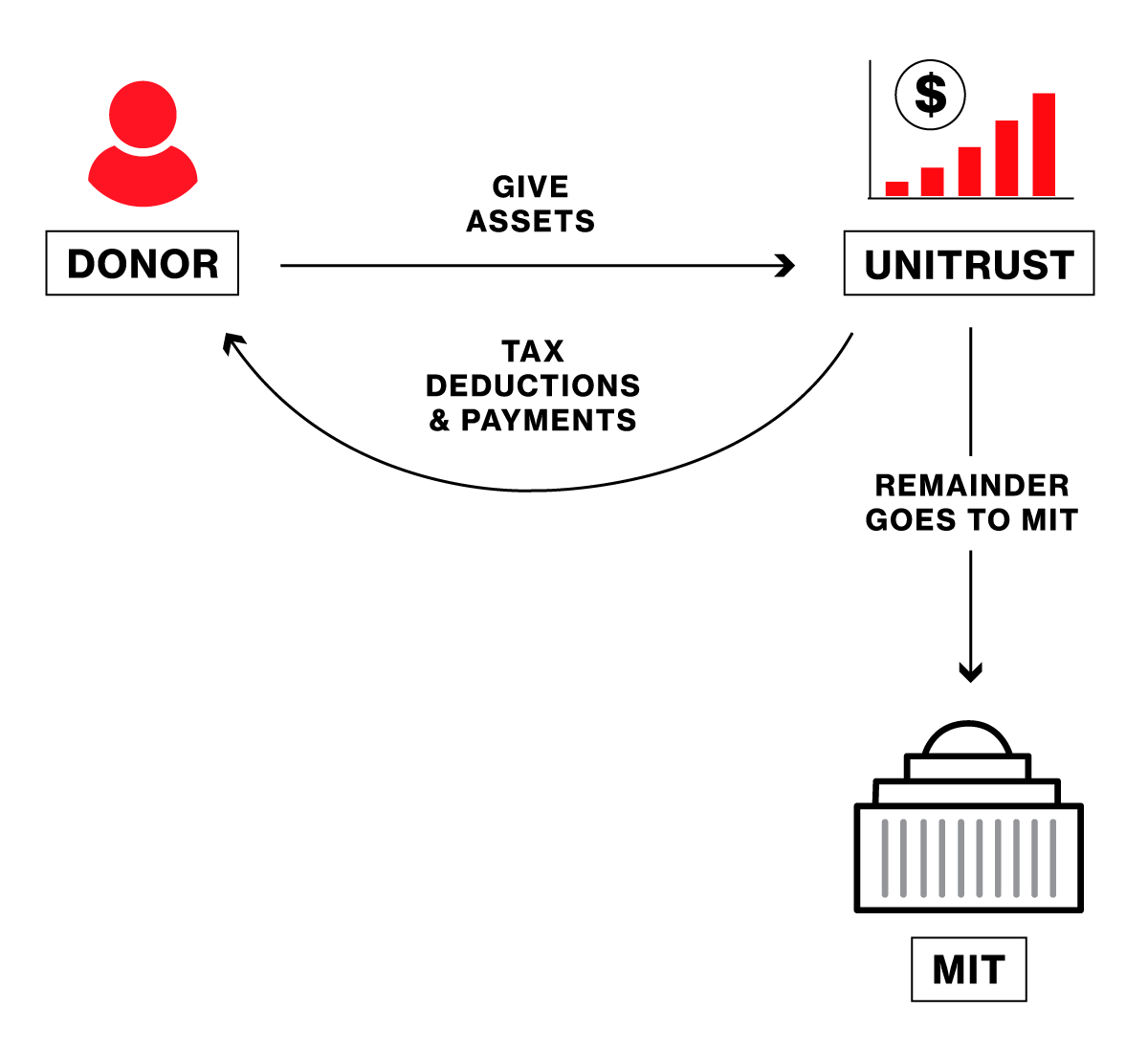
Biafore set up her CRUT so that half of it goes to the general fund, enabling the Institute to use the money where it’s needed most, and half of it supports the work of the MIT Office of Sustainability, which promotes environmentally friendly policies and practices across campus.
The CRUT gave Biafore the flexibility to give to an institution and a cause she cares about, and it makes continuous giving easy. “I like the idea of being able to set something up where I can put money into it. Right now, the money that normally would come back to me, I’m just reinvesting in the CRUT,” she says. Furthermore, she likes that both the CRUT and the DAF offer tax advantages, allowing her to donate otherwise taxable income.
Biafore says she’s thrilled to contribute to the Institute. “When I’m giving money to MIT, I’m comfortable knowing that that money is going toward producing some kind of results,” she says. Even if the results are not immediate, she adds, what’s important is that schools like MIT are the places where people are doing research.
“You know, all the high-tech companies, they’re doing research, but they’re doing it to make money. So that’s why I like donating to MIT, because I know that the objective is ‘let’s make things better,’” she says.