PHOTOS: KEN RICHARDSON
To her, it seemed like the answer to many of the difficulties with cell therapy, a medical approach that involves transferring specialized cells into a patient to target specific problems and requires the skills of a highly trained surgeon.
If such a technology could be developed, it might mean that people with spinal cord injuries could have injections instead of surgeries. Or that more stroke patients could make a full recovery.
“At the time, though, when I would talk to people about building these cell therapies, people were like, ‘that’s crazy,’” says Galloway, now an associate professor of chemical engineering at MIT.
It seemed less far-fetched in 2025, when she won a MIND (Maximizing Innovation in Neuroscience Discovery) Prize from Pershing Square Philanthropies for her work to build cells that can be engineered to home in on damaged areas of the central nervous system and then transform into fresh neurons at the site of injury. The prize-winning project is called Search and Rescue.
“You can harness the immune system to make sure that the cells get to where they need to be. Damage across our bodies triggers an immune response, and if we can wire the cells to search and find those places, and then convert themselves into neurons, we have an entirely different therapy,” Galloway says.
The technology is still in a preclinical phase. Galloway and her students want to make sure it works consistently well in a petri dish, where they can understand what’s happening at the molecular level, before going into the less controlled context of animal experiments.
“The really big goal is not only to have cell therapies that we program ex vivo—but that we could actually program the cells in vivo,” she says.
Currently, cell therapies for spinal cord injuries, for example, need to be delivered directly to the injured site by a spinal surgeon. The number of surgeons who can perform these surgeries is very limited, Galloway says. If there are many injury sites, the operations are even more complicated.
Galloway envisions the therapy, if fully developed, working best for acute injuries that trigger a strong enough immune response for engineered cells to detect. From there, her team wonders if this strategy offers promise for chronic neurodegenerative diseases. “I think we’ll start with the “easier” acute injuries where there’s a stronger immune signal and move up to chronic disorders,” she says.
From Caltech to MIT
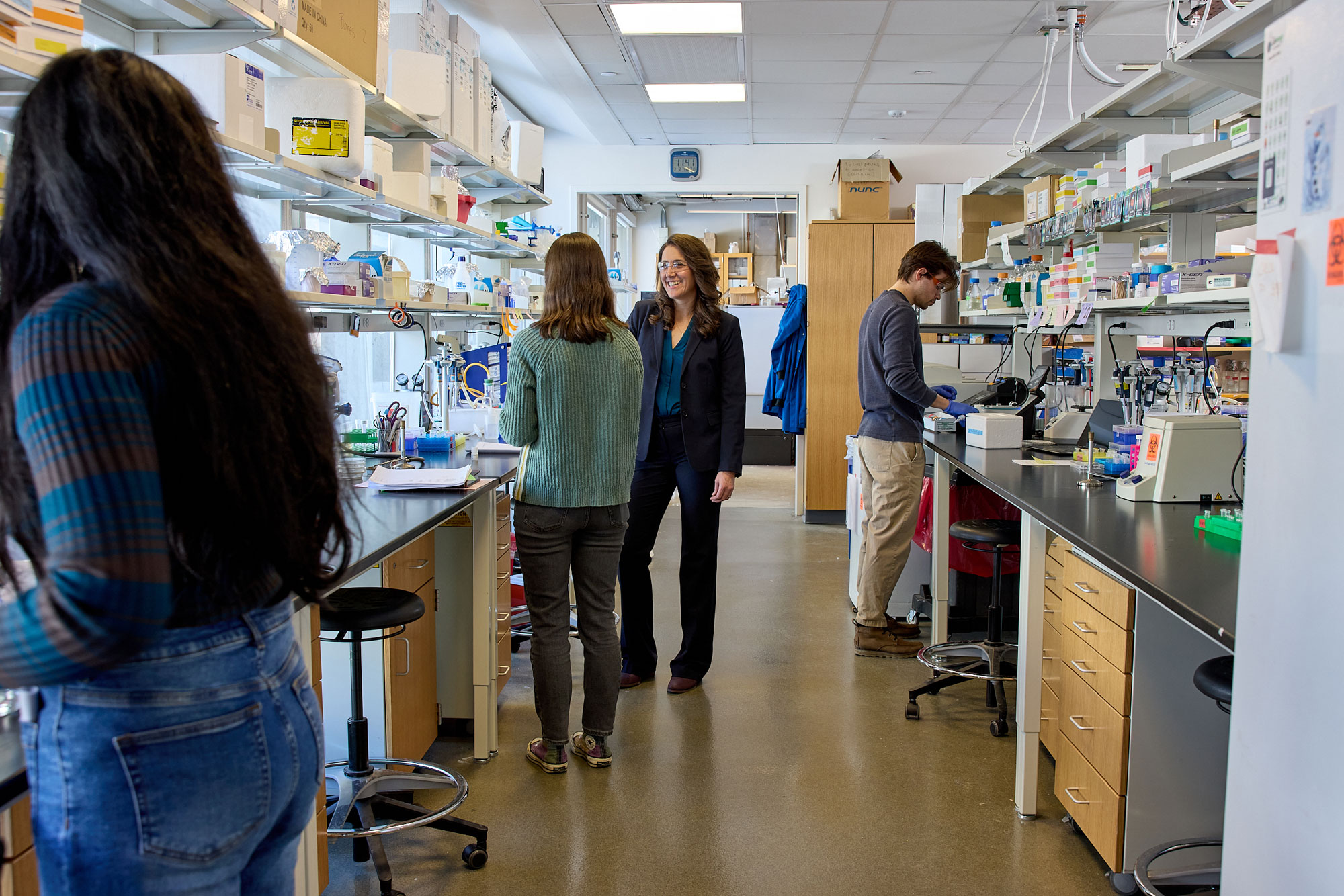
Galloway began exploring how to run these programs in cells while at Caltech, just as synthetic biology was emerging as a discipline. With the power to build programs, she wondered if these programs could change cell identity, allowing her to tap into the therapeutic functions of natural cells. But she needed to learn how to convert one mammalian cell type into another, which led her to postdoctoral research in a stem cell department at the University of Southern California. There, she learned how to convert skin cells into neurons.
“But the really ambitious work is something that started when I got to MIT,” she says, referring to Search and Rescue. “In the environment of MIT, this idea has just flourished wildly, because people are really excited about this vision of programming life.”
She decided on MIT because it seemed that the only limits to her vision at the Institute would be her time and creativity, she says. “That felt very exciting, to really be at this place where if you can imagine it being possible, it will happen,” she adds. Now Galloway leads a robust team comprised of four undergraduates, nine graduate students, and two postdocs. In 2024, she received the C. Michael Mohr Outstanding Faculty Award in 2024 for excellence in undergraduate education.
Search and Rescue is one of several projects in the Galloway Lab aimed at making cell programming faster, more reliable, and more precise. Another, called TANGLES, led to a discovery of how to reliably turn on genetic programs in stem cells—insights that have since underpinned about half of her lab’s published work. Others, such as ComMAND and DIAL, are control systems that enable the lab to fine-tune gene expression levels with precision. And her team is currently submitting a paper on a technology they developed, DASIT, to purify cell populations, thereby eliminating the need to bring samples to a fluorescent sorting facility, and enabling scalable cell manufacturing.
When Galloway arrived at MIT, she had doubts about whether these types of therapies could be built. “I thought it was extremely ambitious and very likely to fail,” she says. But she’s proving herself wrong. “Fortunately, we’ve made progress that, in my mind, was certainly beyond what I had expected, and I think that programming regenerative therapies is far closer to reality.”
SUPPORT CHEMICAL ENGINEERING AT MIT
You can help enable important scientific breakthroughs such as those happening in the Galloway Lab. Make your gift.