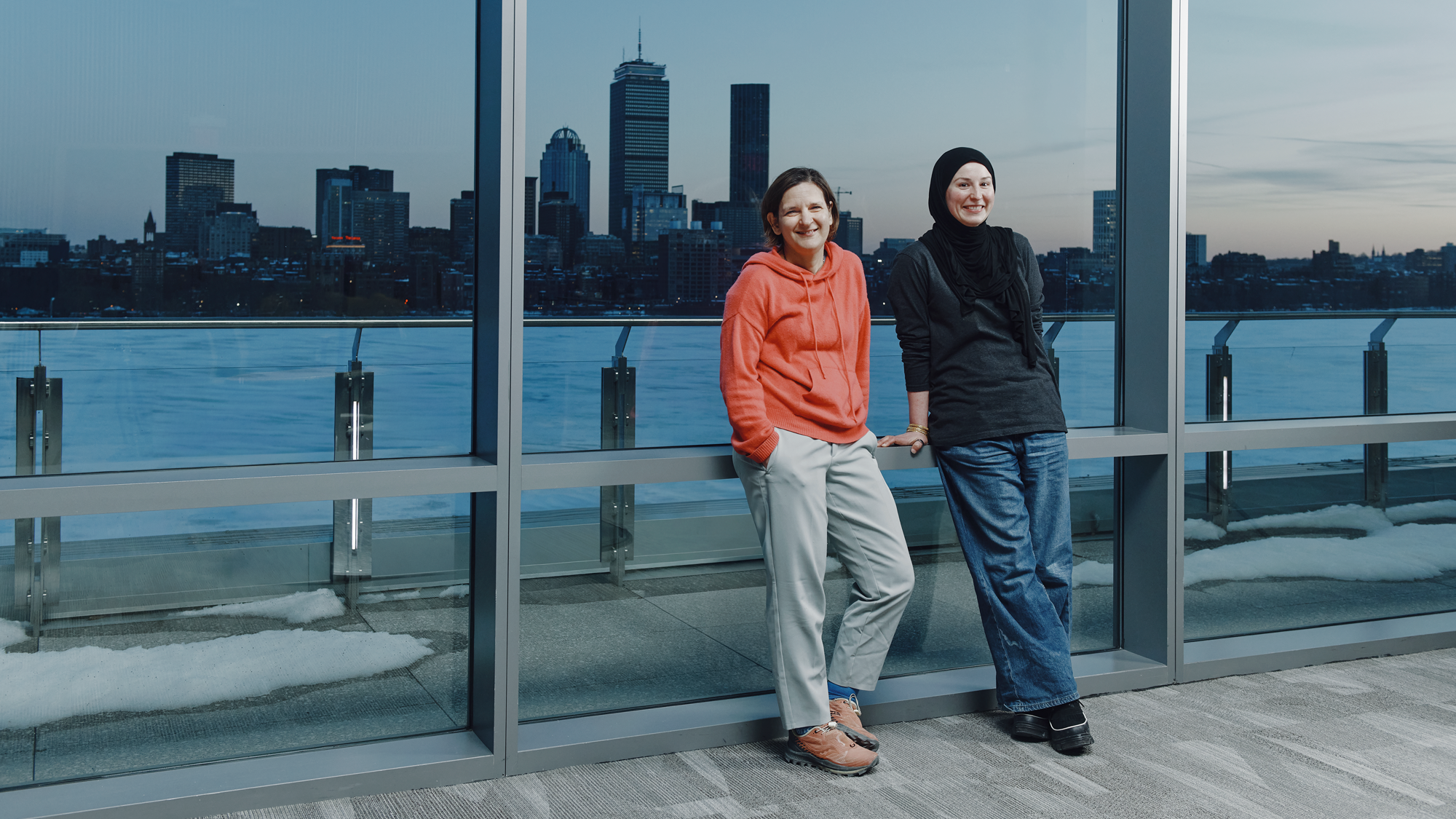
Esther Duflo, left, and Marzyeh Ghassemi are working together to solve public health challenges by harnessing the power of machine learning.
PHOTO: TONY LUONG
Initially working with Ziad Obermeyer, a medical doctor at the University of California, Berkeley, Duflo came up with an innovative solution: using machine learning to analyze results from a simple, low-cost field test to identify patients who might benefit from more expensive follow-up testing. The pair was later joined by Marzyeh Ghassemi PhD ’17, the Germeshausen Career Development Professor and an associate professor in the Department of Electrical Engineering and Computer Science—which is housed jointly in the Schwarzman College of Computing and the School of Engineering—and the Institute for Medical Engineering and Science. Working in the Indian state of Tamil Nadu, Duflo and colleagues have focused on the phenomenon of the latent, or “silent,” heart attack, in which a patient undergoes a mild myocardial infarction but chalks it up to indigestion or fatigue instead.
“A significant number of people might have had a heart attack in the past, but have not been diagnosed,” Duflo says. “It turns out that when you have had a prior heart attack, you are more likely to die of the next one.” The good news is that a simple preventative cocktail of medicines—including baby aspirin and a beta blocker—can cost as little as $10 a year. The bad news is that diagnosis typically requires an expensive ultrasound in a hospital setting, which most people don’t get.
The project received funding from the SHASS+ Connectivity Fund, created as part of the MIT Human Insight Collaborative, a Presidential Strategic Initiative that supports cross-disciplinary collaborations between the disciplines housed in the School of Humanities, Arts, and Social Sciences and other disciplines across MIT.
SUPPORT BOLD, CROSS-DISCIPLINARY COLLABORATIONS THROUGH MITHIC
The work of Esther Duflo and Marzyeh Ghassemi is one example of how MITHIC is fostering a convergence of human-centered and technical expertise by bringing together the School of Humanities, Arts, and Social Sciences and experts from across MIT’s other schools and the college. Make your gift.
“Predicting the past”
“What we’d like to do is use something any field worker can do without expensive equipment or any knowledge and give you a score that says this person should really come in for an ultrasound that will confirm the diagnosis,” Duflo says. To do that, the research team developed an algorithm that uses only information on a participant’s age, sex, and a handheld ECG device, a 30-second noninvasive test that can be read right from a field worker’s phone. Using machine learning, the team first trained the model on data from Sweden, which they used to identify a signature associated with a positive ultrasound result, then further refined it using data collected from individuals in Tamil Nadu at government-run health camps set up to provide public check-ups. “It’s funny because you are predicting the past,” Duflo says, “by predicting whether there might have been a heart attack.”
Initial data, released in a National Bureau of Economic Research working paper in January, found that among those identified by the simple test to have the highest risk scores, 9% also tested positive in the advanced test, compared with 1.8% in the medium-risk group and 0.9% in the bottom half of the sample. This indicates that the algorithm can distinguish high-risk from low-risk cases, identifying a high-risk subgroup with an almost tenfold higher risk of prior heart attack than the lowest-risk groups. What’s more, the ECG test identified patients who would be missed by usual screening methods, which are highly dependent on age, meaning that the technique is more likely to identify younger patients with more years left to live (providing, in economic terms, a higher cost-benefit analysis, says Duflo).
Best-case scenario for AI
Ghassemi, whose Healthy ML Lab applies machine-learning algorithms to improve health, says the project represents the best-case scenario for using artificial intelligence in medicine. “The majority of AI applications I see are motivated by an argument for efficiency, which is often a dog whistle for removal of humans to cut costs,” says Ghassemi. By contrast, this project augments human intelligence to help workers perform better at their jobs. “It’s inverting the paradigm, saying a silent heart attack is a failure of human know-how, and then using machine learning to address a real gap that human health workers cannot do on their own.”
The project is also an example of how disciplines can come together, says Jenny Wang, an MIT economics PhD student who worked with computer science graduate student Alex Schubert to refine, test, and evaluate the model. “Computer scientists have all these ways of evaluating model performance like predictive performance, while economists tend to do things like cost-benefit analysis,” says Wang. “So working together on the process of evaluation had some fun complementarities.”
The project team is now conducting a new round of data collection, focusing on people with the highest risk score, to gather additional data to make the algorithm even more accurate. At the same time, they are exploring other diseases to target. In addition to blood pressure and ECG, they’ve conducted blood tests, lipid panels, and other screens that algorithms might correlate with diabetes or women’s health issues such as endometriosis and polycystic ovarian syndrome. “Even in developed countries like the United States, women’s health—across testing, diagnosis, and treatment – has enormous gaps that can be closed,” Ghassemi says.
Noncommunicable diseases such as diabetes and heart disease, meanwhile, are on the rise in India and other developing countries, where the cost of routine health care testing is often not covered for patients. “If we have low-cost evaluations that are machine-learning based, they could automatically prequalify you for more specific testing that is not normally paid for,” says Ghassemi. “This is a great opportunity to improve overall health, not just treat illnesses.”