ILLUSTRATION: MELANIE LAMBRICK
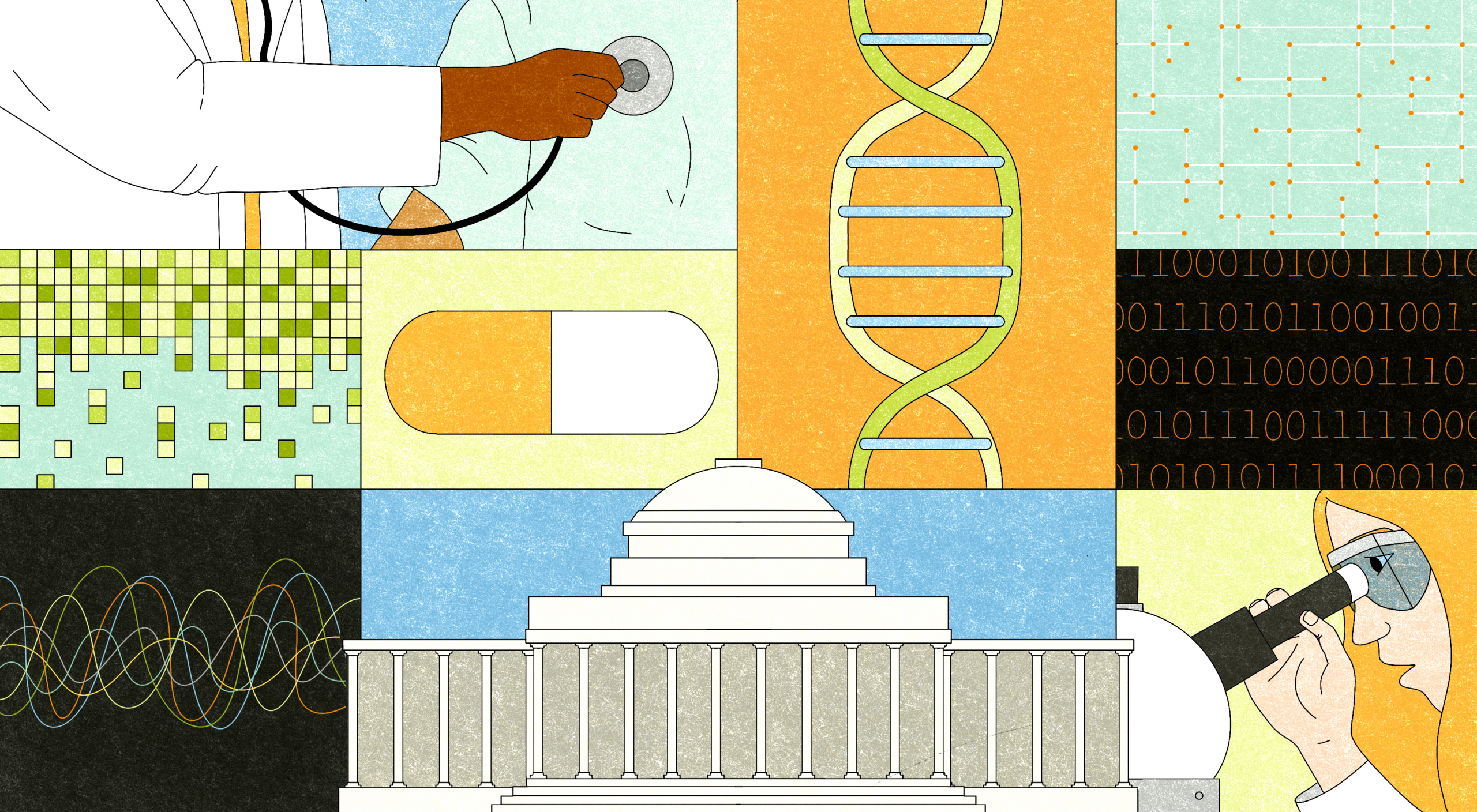
But since the Institute’s start in the 19th century, its innovators have also been making a profound impact on medicine and public health. Partnering with local hospitals and physicians, MIT researchers made X-rays an essential diagnostic tool, helped alleviate illnesses connected to air and water pollution, tracked infectious diseases, and vanquished foodborne illnesses.
MIT and its researchers have plotted a unique path for the Institute, which does not have a formal affiliation with a hospital, by creating relationships with diverse medical and public health institutions.
“The way to have a big, meaningful impact on human health is through deep collaborations with hospital systems and medical researchers,” says Anantha P. Chandrakasan, MIT provost and the Vannevar Bush Professor of electrical engineering and computer science.
In 2024, MIT President Sally Kornbluth launched the Health and Life Sciences Collaborative (MIT HEALS), a Presidential Strategic Initiative to expand and strengthen such collaborations. Chandrakasan is leading the effort.
“What’s exciting about HEALS is that it truly thinks about human health in an integrative way, bringing opportunities not just for cross-cutting research but for amplifying basic science,” says Chandrakasan. The vision, he says, is “to apply multidimensional views and find solutions for some of the most urgent issues in human health.”
MIT HEALS has launched programs to build a dynamic community composed of MIT researchers from its schools and college, clinician-researchers from area hospitals, and innovators across the country. Among its endeavors are the MIT–MGB Seed Program, which is funding joint research projects led by researchers at MIT and Mass General Brigham, and the Hood Pediatric Innovation Hub, which focuses on the future of children’s health care.
There is also the Fairbairn Menstruation Science Fund—established through a gift from Emily and Malcolm Fairbairn, and led by Linda Griffith, the School of Engineering Professor of Teaching Innovation in the departments of Biological Engineering and Mechanical Engineering—seeking to accelerate understanding and treatment of diseases more common in women, and the MIT Program for Health Sciences and Semiconductors, targeting the development of minimally invasive, semiconductor-enabled sensing and actuation technologies, integrated with computational methods, for data-driven prevention, diagnosis, and treatment of disease. Meanwhile, the MIT Medical Imaging Initiative brings together expertise across engineering, AI, medicine, and biology, again in collaboration with hospitals and industry, to accelerate the development and real-world deployment of next-generation medical imaging technologies.

Seeding breakthrough partnerships
The MGB Seed Program is one of HEALS’s flagship initiatives. “The program is meant to bring together engineering, scientific, and computational strengths at MIT with clinical know‑how at MGB to accelerate the development and application of new approaches to transform patient outcomes,” says Alex K. Shalek, program colead, director of the Institute for Medical Engineering and Science (IMES), and the J. W. Kieckhefer Professor in IMES, the Department of Chemistry, and the Koch Institute for Integrative Cancer Research.
Fueled by gifts from Analog Devices and a number of other generous donors, the program has concluded its first round of grant-making, with awards going to 17 MIT–MGB teams. There were 134 applications.
“Some of the projects we funded are tackling key problems that people have wanted to solve for a very long time, like cancer drug selection,” says Shalek. “In this case, could you build a device that gives microdoses of multiple drugs to a tumor to figure out which one is right for the patient?”
The seed grant program also seeks to address “underserved communities and needs,” he says. Shalek highlights a funded project that will use electronic medical record data to enable early diagnosis of endometriosis, a disease that can cause women crippling pain and is usually not caught until the later stages. Other funded proposals focus on better prosthetics and an AI-generated smartphone app to help with early detection of cognitive decline.
“We were really looking for synergistic partnerships, where both sides brought something to the table, where there’s an opportunity to do something incredible,” says Shalek. He points to a project to create portable and relatively inexpensive MRI technology, which unites MIT and MGB experts in signal processing, image analysis, and AI.
Shalek views the seed program as part of a larger effort to expand the community of MIT health care innovators by “strengthening the pipeline” for collaboration across MIT and between the Institute and medical institutions. “At its core, the program is about bringing together people that recognize the unique opportunities enabled by partnering, and making it easier to have the sort of impact and accomplishments we all want.”
A new ecosystem for collaboration
Prior to MIT HEALS, the Institute already had models for productive partnerships with members of the Boston-area medical ecosystem. For instance, the Koch Institute for Integrative Cancer Research and the Dana-Farber Cancer Institute built the Bridge Project in 2012 to accelerate the translation of bench discoveries into bedside applications. And the Harvard-MIT Program in Health Sciences and Technology has been training clinician-scientists for more than 55 years.
Researchers at the MIT Jameel Clinic collaborate extensively with MGB in their pursuit of high-precision, affordable, and scalable machine learning technologies, which have led to the development of cancer risk prediction tools like Mirai and Sybil that are being deployed in the Jameel Clinic Hospital Network to predict breast and lung cancer risk years in advance. MIT’s computational AI expertise and MGB’s clinical datasets have powered translation of AI research into earlier detection of diseases and more effective, targeted treatments.
The time is right, MIT HEALS leaders say, to expand beyond these successful endeavors. “There is a strong push from faculty to get more engaged in this kind of research, and they’re looking for inroads and connections,” says Shalek. This means not just funding innovative ideas, suggests Shalek, but creating an architecture that reduces friction for MIT researchers to find each other and to partner with medical innovators outside the Institute.
MIT researchers have expressed a zeal for addressing neglected, underfunded, and especially challenging areas of health care, says Chandrakasan. “There’s excitement around neglected areas like women’s health and pediatrics,” he says, as well as brain health, rare diseases, and early detection. Chandrakasan flags a coordinated effort between MIT researchers and clinical collaborators to find inroads against a stealthy killer, ovarian cancer, by harnessing novel diagnostics.
Powering breakthroughs in pediatric care
One critically marginalized area is children’s health care. “In the United States, although we feel strongly we should support care for children, we don’t actually deliver that with our dollars,” says Joseph J. Frassica, professor of the practice in IMES and executive director of the Hood Pediatric Innovation Hub. Today, there is far more investment in medical innovation for the elderly than for newborns, even though improvements in a baby’s life could lead to a lifetime of health care savings, he points out. “We now have the opportunity to turn this on its head.”
Frassica is leading the Hood Hub along with Elazer Edelman 78, SM ’79, PhD ’84, the Edward J. Poitras Professor in Medical Engineering and Science and cardiovascular medicine specialist at Brigham and Women’s Hospital. The Hub—funded by the Charles H. Hood Foundation—will enable pediatric innovators to take advantage of advances in AI and machine learning, diagnostics, sensing, telemedicine, and remote monitoring to advance the care of children. Coupling these technologies with “MIT’s expertise in industrialization, public policy, AI and machine learning, and in the development of devices, the Hub will equip small-scale pediatric medical innovators with the kind of infrastructure and expertise that they need to build out and reach markets quickly,” says Frassica.
One of the Hub’s first initiatives is a partnership with the MIT Catalyst program, providing a powerful avenue to identify innovative talent and rigorously developed projects with potential for pediatric impact. Each year, MIT Catalyst selects a cohort of fellows who collaborate with multidisciplinary experts to learn and apply a structured, real-world process for advancing health care solutions. Over the course of the fellowship, participants identify critical unmet needs, develop novel approaches, and iteratively refine their ideas toward implementation.
While most early-stage ventures face significant challenges, MIT Catalyst projects achieve an approximately 50% success rate—an unusually strong outcome in health care innovation. As Frassica notes, “The goal is for Catalyst fellows to develop fundable, high-impact innovations through their work with the program, while gaining a deep, practical understanding of the health care innovation process.”
The Hood Hub will make available to pediatric innovators a novel data set on neonatal care that’s been derived over the last decade. “It has every heartbeat, every measurement, every outcome, every medication, everything that happened to a neonate during their stay in the hospital,” says Frassica. “We want researchers to exploit this high-resolution data set, which has never been touched for the development of predictive algorithms, for the purposes of therapeutic planning.”
Also available is a similar data set for patients from the age of 1 month to 21 years who have been treated in pediatric intensive care units. “There are 14 billion data points of physiology alone, in this data set,” he says. “Being able to predict the course of a patient facing a particular disease would be transformative.”
In addition to AI and machine learning, in its inaugural year the Hood Hub will support projects involving diagnostics and wearables as well as those related to health care access. “This is where we start, because it’s where we know we have strength and capabilities that we can muster immediately,” says Frassica. “We want to focus on innovations that contribute enduring assets for future innovators and have a high impact potential.”
Scaling collaboration and innovation
For Chandrakasan, success for MIT HEALS means the creation of a durable and ever-expanding research force, resting on collaborative foundations that can deliver swift and significant results.
“We have this unique signature of wanting to collaborate; it’s built into our way of thinking and doing things,” he says. As collaborations proliferate between MIT and outside organizations, and within MIT, “we are building community,” says Chandrakasan.
“We’re enabling faculty to work with each other on cross-cutting projects, and we’re bringing undergrads to work with them, as well as cohorts of graduate students and postdoc fellows who are pursuing exciting opportunities in AI, the life sciences, and other fields,” he says.
By funding research on problems conventional funders overlook, and by promoting multidisciplinary alliances among MIT researchers and clinical partners, Chandrakasan believes MIT HEALS will make progress against the most stubborn issues in human health. “Programs with the right infrastructure, mentoring, resources, and community will allow us to make an impact quickly,” he says.
SUPPORT CLINICAL COLLABORATIONS AT MIT
MIT HEALS is building the future of human health by forging powerful industry and hospital partnerships, unlocking bold, cross-cutting research, and uniting brilliant minds. With your help, we can translate discovery into impact. Make your gift.