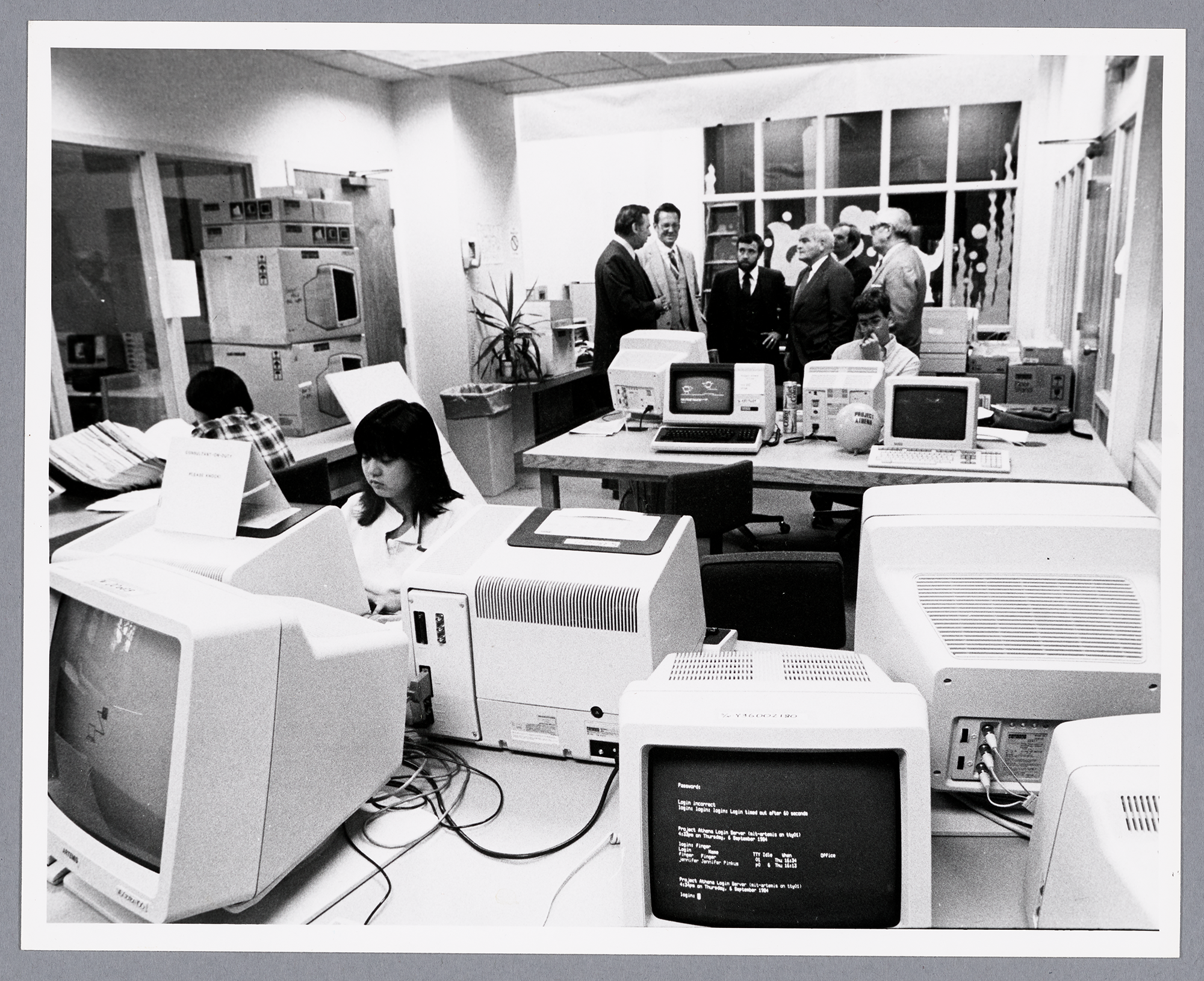
Project Olympia took inspiration from two of MIT’s most influential computing initiatives: Project MAC and Project Athena (pictured above), which redefined campus computing.
PHOTO: COURTESY OF MIT MUSEUM
MIT sought a senior faculty member to help consolidate the Institute’s computational resources, and Fisher, the Thomas A. Frank (1977) Professor of physics, was intimately familiar with the problem at hand. He knew that the research of many people in his department was frequently hampered by limited access to high-level computing. The shortfall was especially acute for researchers—particularly junior faculty—whose demands exceeded the potential of a personal computer but did not warrant time at a national supercomputing center. Moreover, the strain on MIT’s computational infrastructure is becoming increasingly severe as the role of artificial intelligence and machine learning expands.
Fisher knew from conversations with other heads of MIT’s 30-plus departments that this problem extended well beyond the Physics Department. A campuswide solution was needed that would benefit researchers in all areas and at all levels, from first-year undergraduates to tenured professors and everyone in between. Fisher, accordingly, applied for the position informally referred to as “computing czar,” and in 2022 he became head of the newly formed Office of Research Computing and Data (ORCD). Christopher Hill, a principal research scientist and engineer in the Department of Earth, Atmospheric and Planetary Sciences, became ORCD’s executive director two years later.

Peter Fisher
Head of the Office of Research Computing and Data (ORCD) and the Thomas A. Frank Professor of Physics

Christopher Hill
Executive Director of ORCD and principal research scientist and engineer in the Department of Earth, Atmospheric and Planetary Sciences
“ORCD’s mission, simply put, is to make high-performance computing available to all members of MIT’s research community,” says Fisher.
“Providing this access will inevitably boost research in all sorts of areas,” says Hill, leading to advances that cannot possibly be predicted in full.
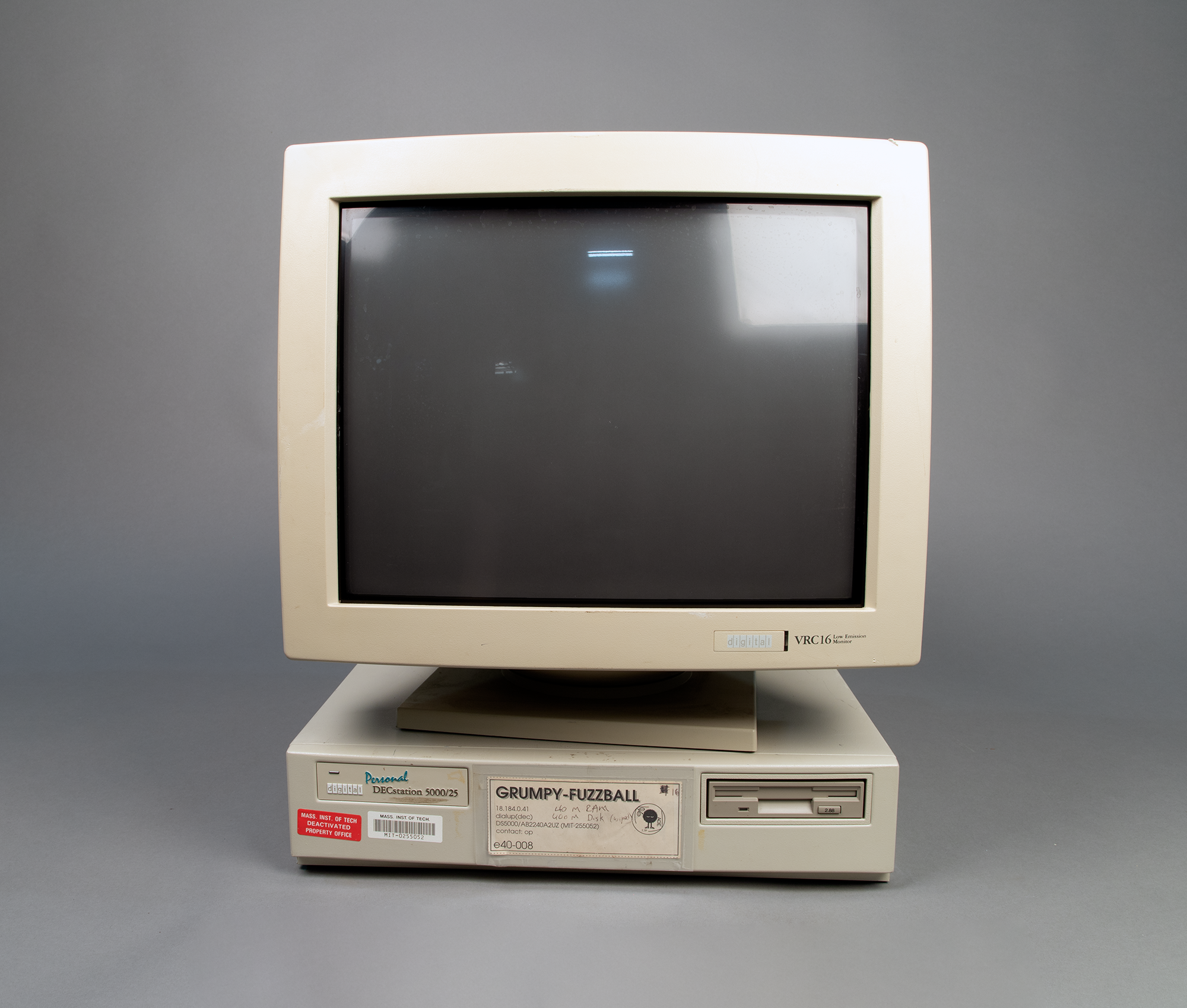
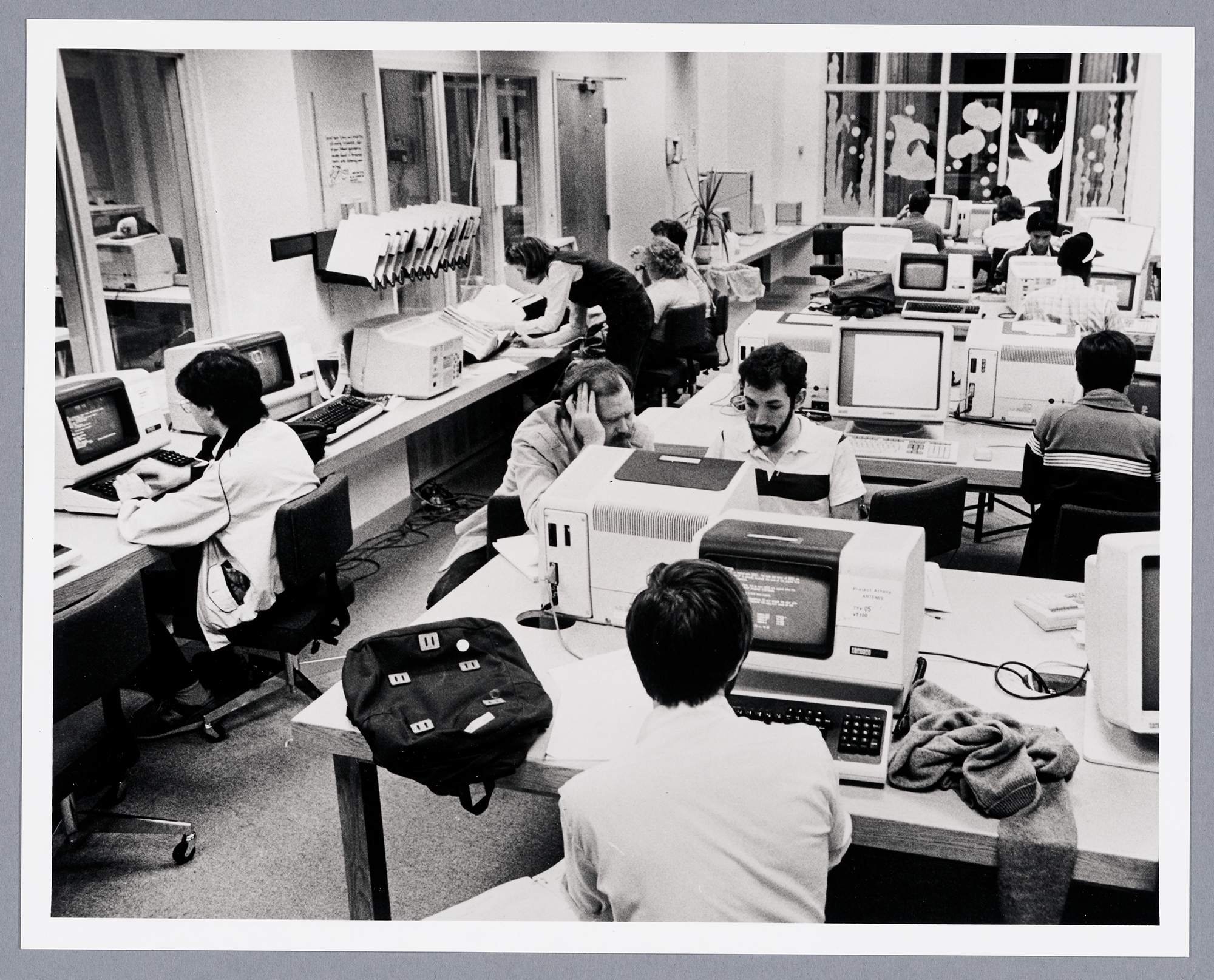
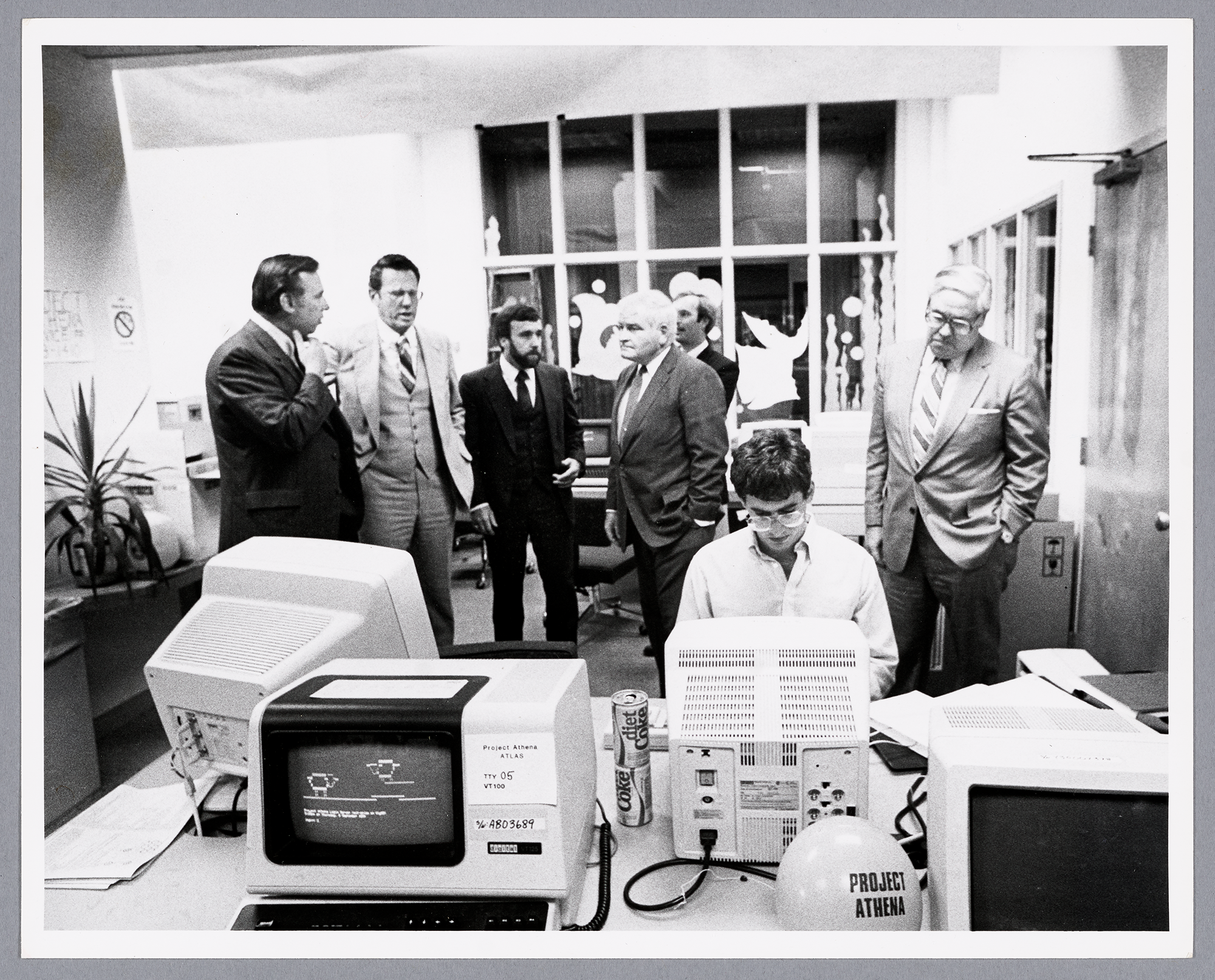
To fulfill these ambitious goals, ORCD introduced Project Olympia in January 2025. Olympia is a model and overarching architecture designed to solve pressing and unmet high-performance computing needs for the whole MIT research community in the AI and machine-learning era. It takes inspiration from two of MIT’s most influential computing initiatives: Project MAC (1963–1976), whose pioneering research helped shape modern computing, and Athena (1983–1991), which redefined campus computing through a shared, networked environment that broadened access to advanced computational resources.
The heart of the project lies in Holyoke, Massachusetts, about 85 miles due west of MIT, at a facility called the Massachusetts Green High Performance Computing Center (MGHPCC). The MGHPCC is a joint venture between Boston University, Harvard, MIT, Northeastern, the University of Massachusetts, and Yale.
Computing infrastructure for a range of disciplines
“If you look at the research of the people using this center, you might think they have nothing in common,” Hill says. “We’ve got one person studying rare insect species in urban environments and another working on next-generation fusion power. Although the scientific domains may not overlap that much, all these users need computational capabilities at a significant scale. We’re creating a foundational environment—an infrastructure like that for electricity and plumbing—which people with diverse interests can take advantage of.”
The biggest winner is likely to be science itself. “If you think of a world in which something like this doesn’t exist at MIT, then researchers would have to build it themselves, which is no small undertaking,” Hill says. With Olympia in place, and growing, researchers can focus on science.
Canal powered
The center draws hydroelectric power from canals of the Connecticut River that flow directly past it. These canals, along with a series of dams on the river, date back to the mid-1800s, when Holyoke was a major producer of textiles and paper.
With the canal system just a few steps away from the MGHPCC, cheap electric power is readily available. “By having our computers out there in Holyoke rather than on campus, we save well over a million dollars in electricity costs each year,” Fisher says. Savings also stem from the fact that computers designed to be installed within a rack that maintains a uniform temperature are much cheaper to manufacture than transportable devices made to operate under variable conditions.
Other benefits come from pooling resources. When a bank of computers dedicated to one MIT research group is not being used, another group can use it for their own project. “There’s kind of a magical scheduling system that makes sure these resources don’t sit idle,” Hill explains.
Having a common computing environment for the whole university can facilitate interdisciplinary studies. Researchers or students can move seamlessly from group to group without having to familiarize themselves with a new computing system each time.
Shared resources, enhanced security
In addition, Fisher says, a centralized computing center offers enhanced protection against external attacks. “If you have computers all over the place that are run by people who are not computing experts, you’re much more vulnerable to cyber threats. By putting everything in the MGHPCC, with one controlled access point—a fiber that runs from campus to Holyoke—we can provide a much higher degree of cybersecurity.”
There are approximately 10,000 researchers at MIT—including faculty, postdoctoral fellows, and graduate students—Hill estimates, and at least one-third of them are using the resources based at the MGHPCC. The total power consumption, at present, is about 1.2 megawatts. The building can provide for about double that usage, up to about 2.5 megawatts, which allows substantial room to grow. Project Olympia has been able to get this far thanks, in part, to a generous contribution from Schmidt Sciences. But additional funding, on the order of at least $20 million per year, is needed to expand and sustain the program, Hill estimates.
The appeal of this effort is clear to Fisher. “This is carbon-free, pollution-free, wholly renewable power,” he says, and a closed-loop cooling system dramatically reduces water consumption. The MGHPCC, moreover, is the first university research data center to achieve LEED Platinum Certification – awarded to buildings with the highest energy efficiency and lowest environmental impacts.
Hill acknowledges that data centers are far from popular at the moment, with complaints frequently raised about noise, pollution, and water waste. “But this facility, around which Project Olympia is built, doesn’t do any of that,” he says. “We’re hoping that Olympia will serve as a model for doing this in a responsible way.”
SUPPORT PROJECT OLYMPIA
If you are interested in learning more about Project Olympia and how to support it, please connect with John Currier at [email protected].