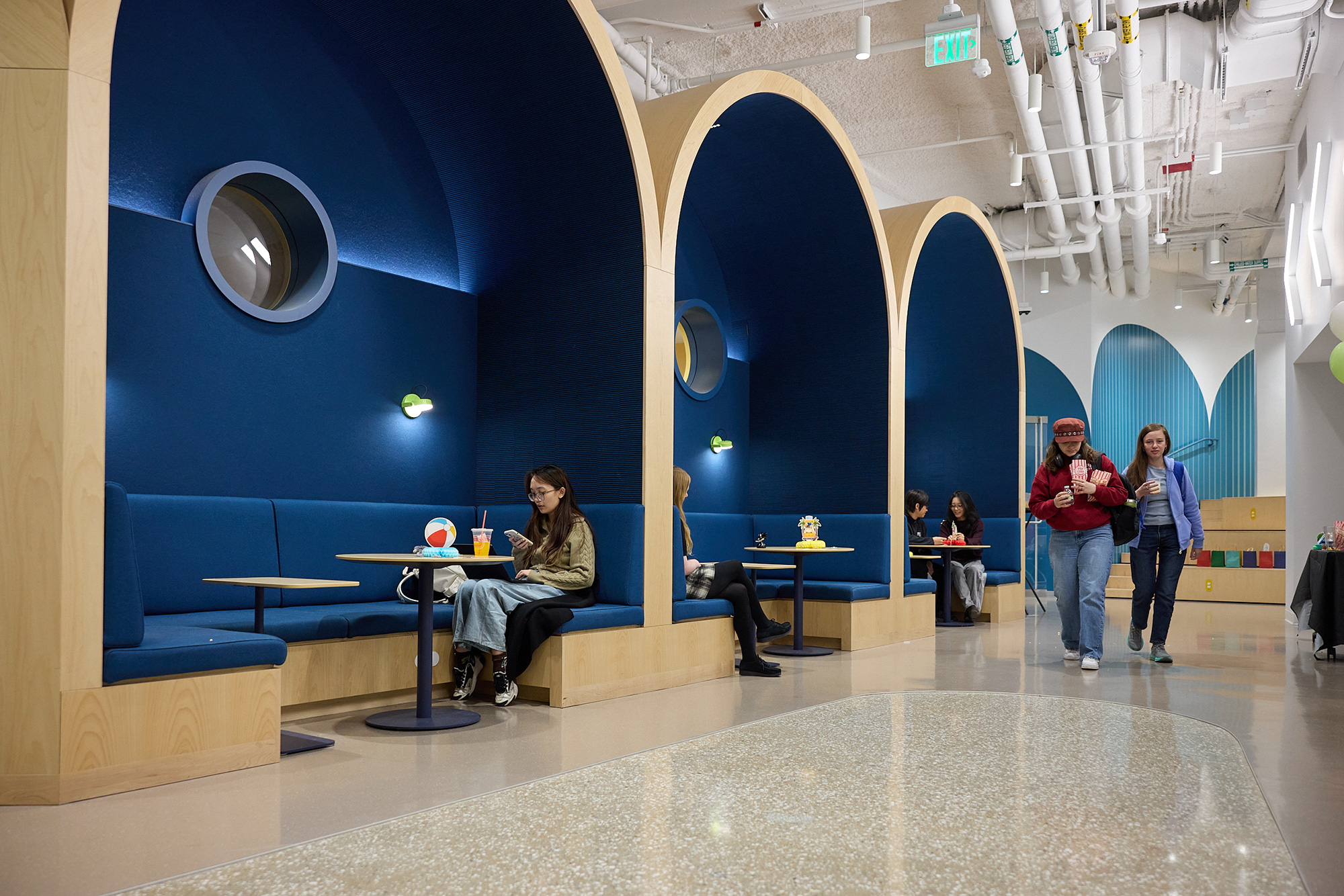
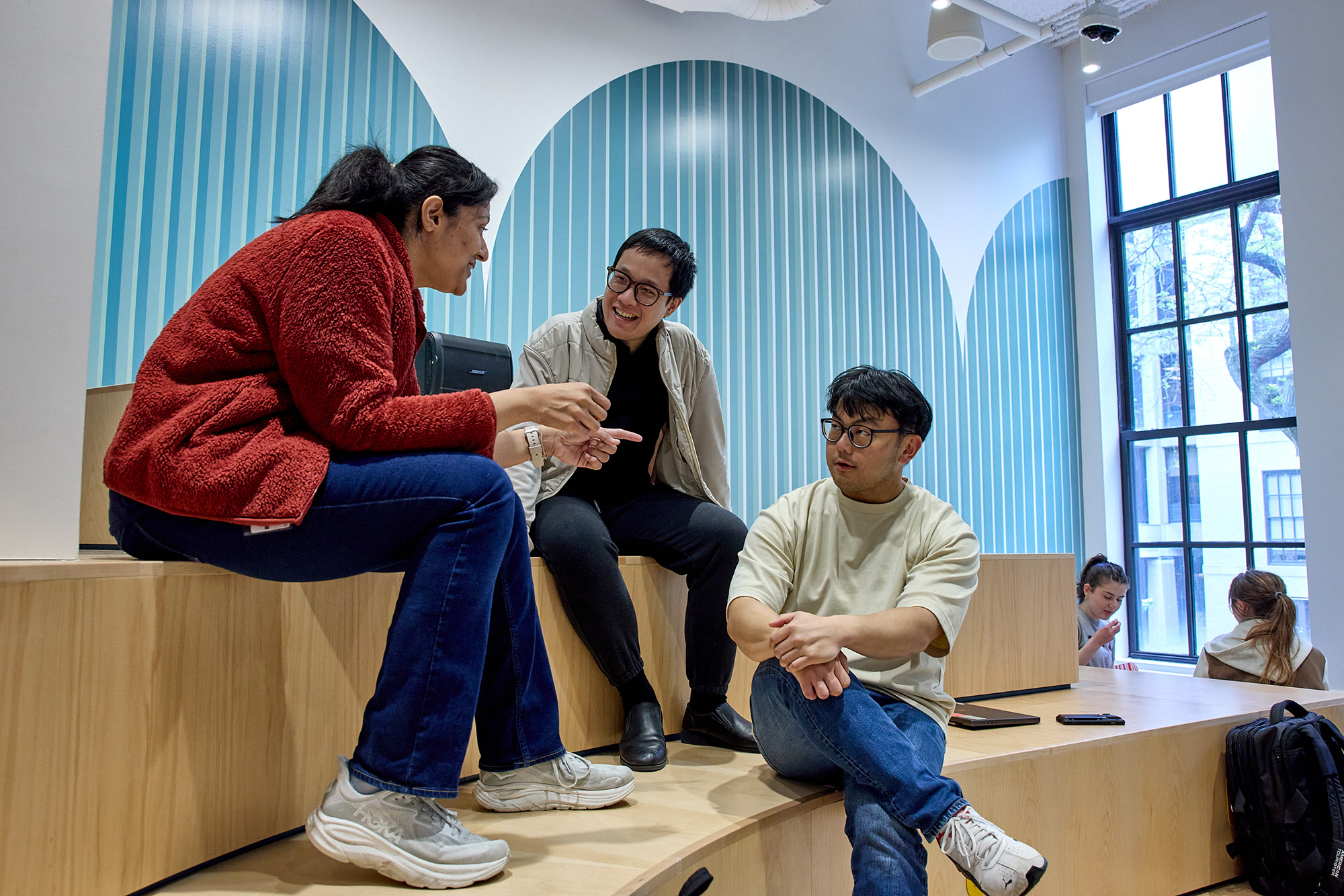
Distinctive pods for study and conversation greet visitors to the Undergraduate Advising Center.
PHOTOS: KEN RICHARDSON
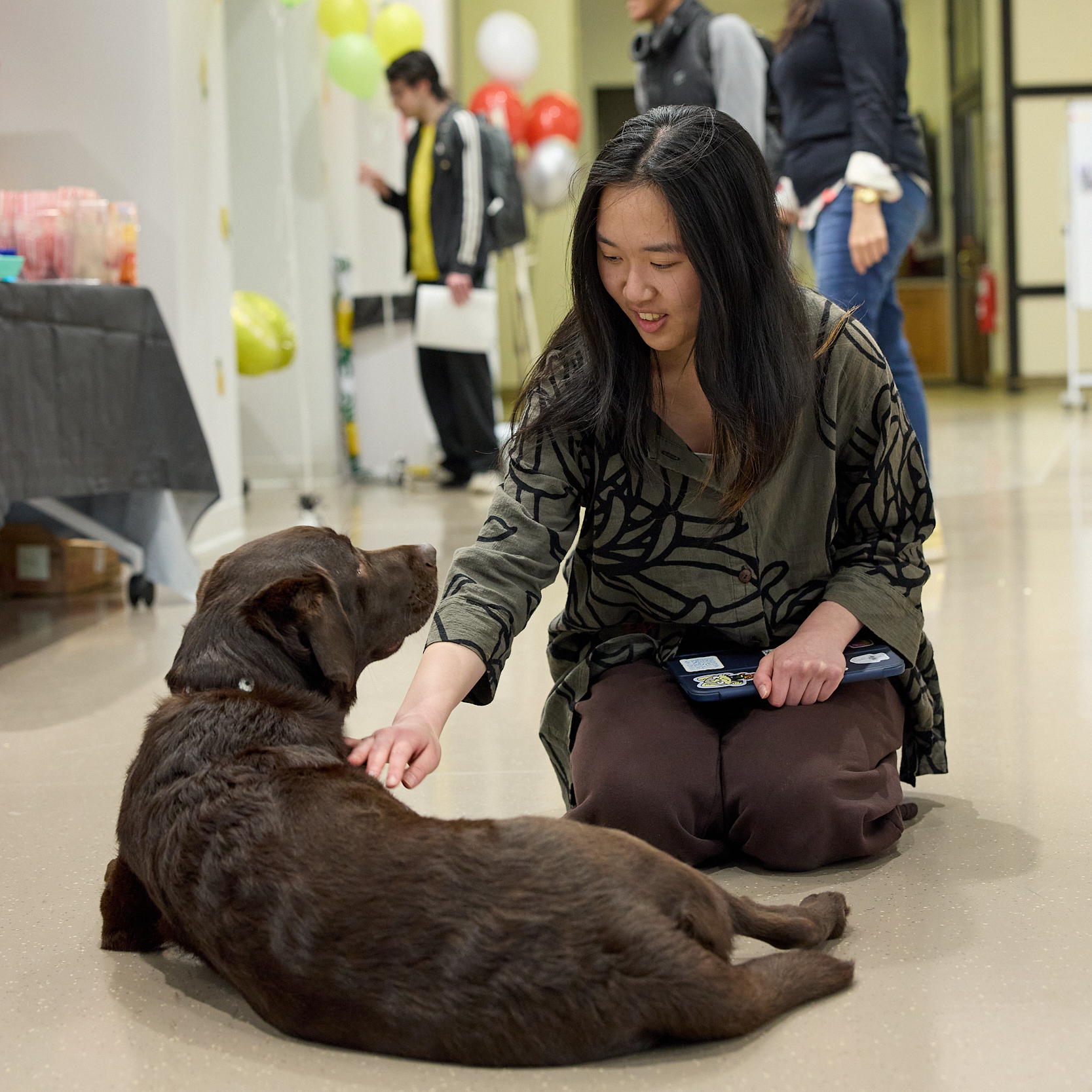
Tail wagging, the five-year-old chocolate English labrador retriever meanders over sociably to greet visitors.
“You wouldn’t believe how many students and staff come in to say hello to the dog,” says Chelsea Longin, UAC managing director and associate dean.
Winni—short for Winnipesaukee—was adopted as a puppy by Alex Hoyt, currently senior assistant dean in the Office of Academic Community, Empowerment, and Success (OACES), mere days before he started his job in the Office of the First Year (OFY) five years ago. He was invited to bring the pup to work with him.
Since then, Winni has become the official greeter at the advising center and, with the landmark free gumball machine by the front door, a signature attraction for students and other visitors stopping by.
Staffers say the aim is to foster a welcoming and inclusive vibe at the UAC, a place that touches the experiences of many undergraduates at MIT, offering advising and programming designed to complement the academic department and help students succeed.
“It’s a room full of opportunities,” says Michael Santoro-Santos, assistant dean for advising and new student programming.
A centralized hub advising and much more
The UAC, which combines the OFY and the OACES, moved into its newly renovated 5,000-square-foot space on the Infinite Corridor in August 2025.
This academic advising hub provides all undergraduates an “anchor” office for their entire time at MIT, building upon the successful model of the OFY, which has been expanded to serve upper-level students.
The OFY is the academic department for all 1,100 first-year students and coordinates first-year advising and the exploration of majors, as well as training for all volunteer first-year advisors.
Once students declare a major at the end of their first year, they are assigned an academic advisor within their department who will serve as their primary advisor. The UAC continues to act as a secondary advisor for upper-level students in every major, providing additional support for students during their tenure at MIT.
“The UAC embodies the Institute’s commitment to guiding every undergraduate toward the intellectually challenging, productive, and personally enriching experience MIT students strive for,” says John E. Fernández ’85, professor of architecture, urbanism, and building technology, who was appointed inaugural faculty director of the UAC in May 2026. “Our staff complement departmental advisors in many ways, across many topics, while connecting students to advising, tutoring, and other resources on campus.”
Additionally, the OFY oversees orientation for incoming first-year and transfer students, pre-orientation programs, and academic year programming, and it helps first-year students who are struggling academically.
“We want first-year students at the start of their MIT career to feel there’s an office they can always come to if they have a problem, or even if it’s just to grab a snack,” says Elizabeth Young, UAC associate dean and director of first-year advising and programming.
OACES has full-time staff dedicated to serving students who have faced challenges on their paths to and through MIT. These include First Generation and/or Low-Income (FLI) students, who are the first in their families to attend college or come from a low-income background. Other OACES programs include Interphase EDGE, a two-year scholar enrichment program that includes an eight-week summer session to help ease the transition to MIT, and Laureates and Leaders, which supports undergraduates preparing for graduate studies in the STEM fields. All UAC programs and activities are open to all MIT undergraduates.
“No matter who you are, there is a space for you here,” says Longin.
“These were people just here to make sure we’re OK”
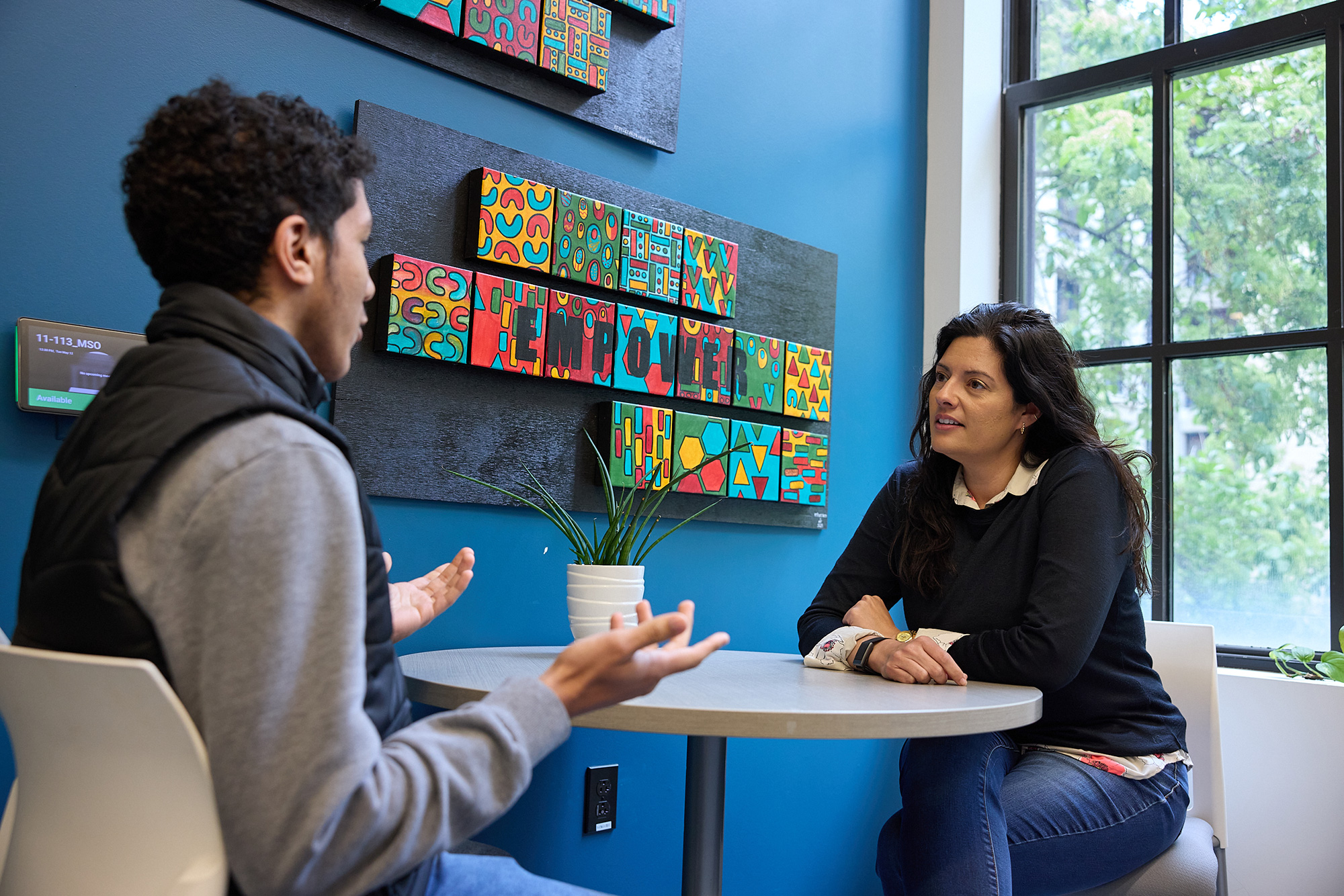
Students active in the UAC—which is a key part of MIT’s Whole Student initiative, championed by Chancellor Melissa Nobles—say they have benefited significantly from the support.
Isaac Manly ’28, majoring in math and computer science, is an Air Force veteran who experienced homelessness in Florida.
“I spent nine months couch surfing, living in my car and sleeping at the homeless shelter, working on a single application—to MIT,” he recalls. Since arriving on campus, Manly has found his experience with the advising center “overwhelmingly positive,” he says.
“In my day-to-day life, it’s nice to have somewhere to relax, grab snacks and decompress between classes,” Manly says. “I think some people misconstrue the UAC and its purpose, seeing it as somewhere that just makes your class schedule for you when, really, it’s for finding resources and information. It’s like a GPT for MIT.”
Tori Sconce ’28, of Cypress, Texas, majoring in chemistry and minoring in film, is a first-generation college student. Her focus, astrochemistry, involves searching for molecules in interstellar dust clouds to understand the chemical evolution of interstellar environments.
“I was very overwhelmed during my freshman fall, as I was the only student from my high school going to MIT and I had no idea what to expect being first-generation,” Sconce writes via email from France, where she is spending the summer on an internship through the MIT International Science & Technology Initiatives (MISTI) program.
“My UAC advisor, Katy Warner Little [assistant dean, advising assessment and communication], was extremely welcoming and kind. I think freshman fall I was very much white-knuckling my way through MIT, and thankfully by freshman spring I sought out more guidance and help, which I felt very comfortable attempting at the UAC. Later, I became a part of Laureates and Leaders, and I have deeply appreciated their guidance as well.
“It’s nice to have a positive space on campus for the challenging moments that still happen every now and then,” says Sconce, who aspires to a PhD in chemistry. “MIT has a reputation for being stressful and definitely earns it. But I’ve also found the difficulty is the point, and it’s shaped how I think and what I believe I’m capable of.”
Ugo Okwuadigbo ’26, of Hampton, Georgia, graduated this spring with degrees in chemical engineering and in biology and life sciences. He is backpacking across Mongolia this summer before pursuing a master’s degree at the University of Oxford in evidence-based health. His future plans include medical school.
“When the transition to OACES happened and the UAC moved into Building 11, it became more of an active space for me,” he says. “I checked in every day before and after classes just to see what’s up and to talk to people.
“It really was a community in which I didn’t have to only think about school, which is odd because it was right there in the middle of campus,” Okwuadigbo says.
“The whole point is to be welcoming”
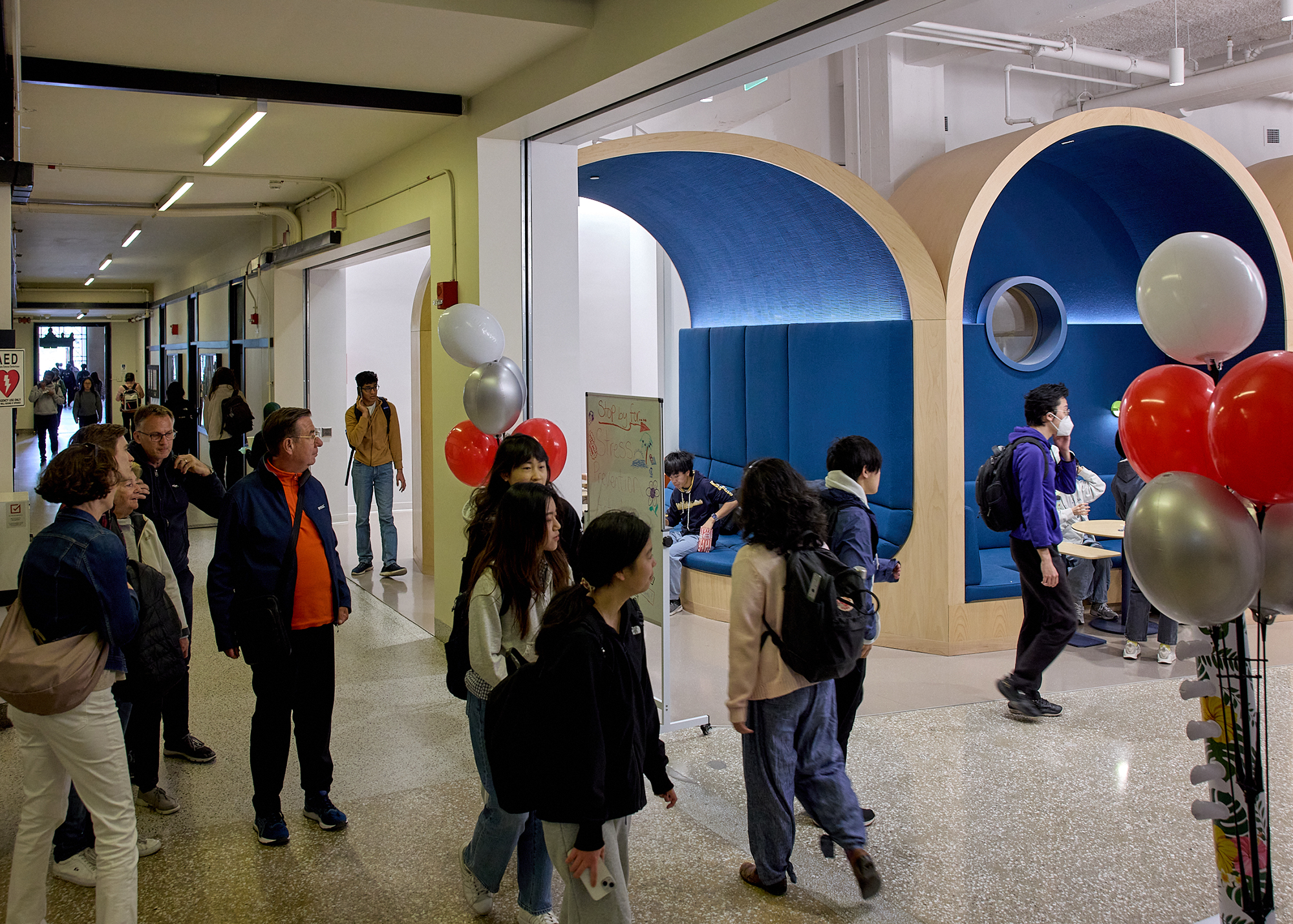
Most days during the school year, the place can get busy indeed, serving perhaps 200 students daily.
“We have a snack station, and some regulars will come in early in the morning to grab snacks on the way to class,” says Cheryl Mottley, OACES administrative assistant.
Among the most recent class of first-years at MIT, 34% come from low-income backgrounds, including 20% who self-identify as first-generation college students, she says. “A lot of times our students are full-need financial aid recipients, but they send money home.
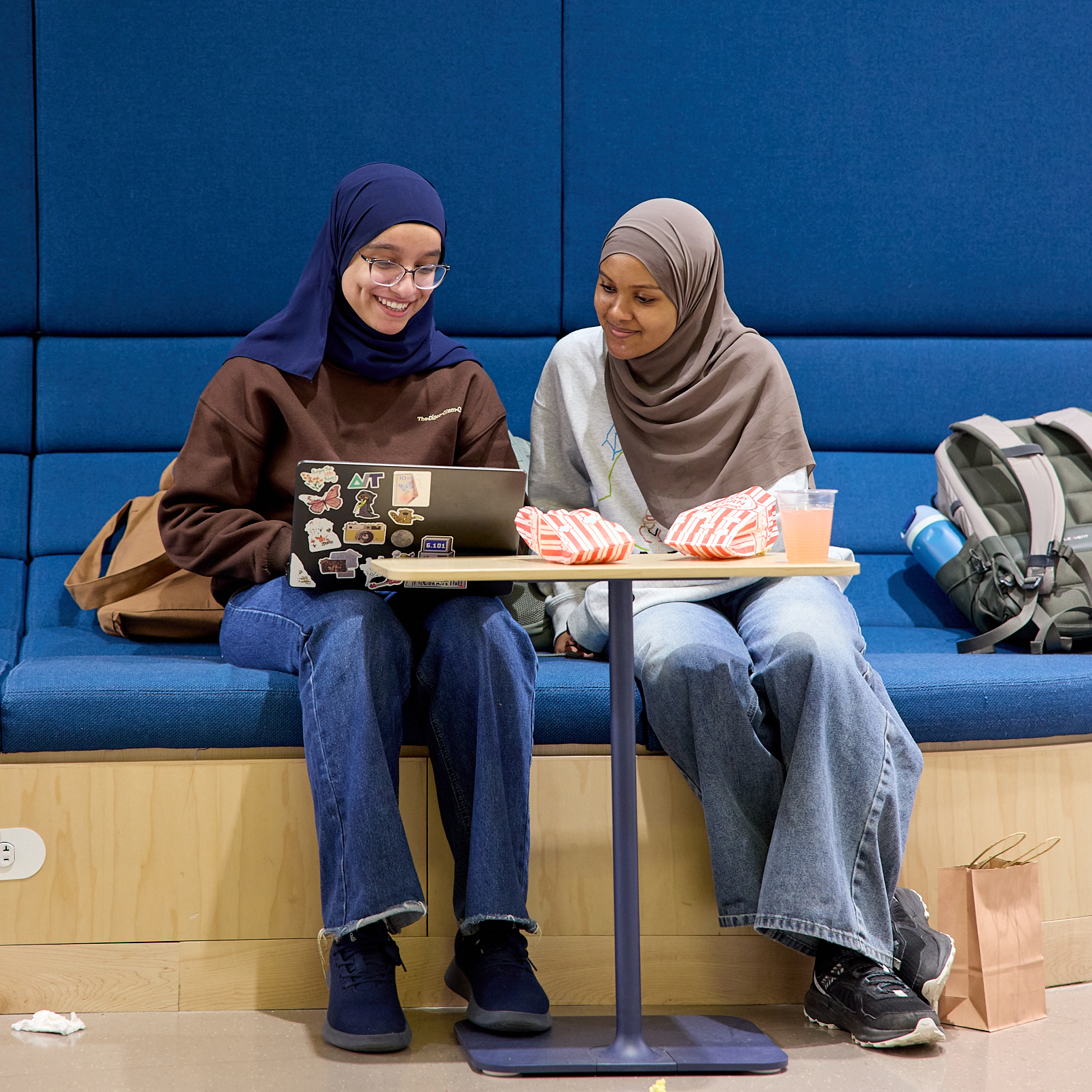
“We always try to have some healthy things for snacks, and in the winter, we have a big teapot with hot water to make hot cider and hot chocolate,” she says. “Later in the day, we have students who regularly come in to do homework. They’re orientation leaders, our associate advisors, FLI students, and transfer students.
“The whole point is to be welcoming,” she says.
Pizza, pi, and peer mentoring
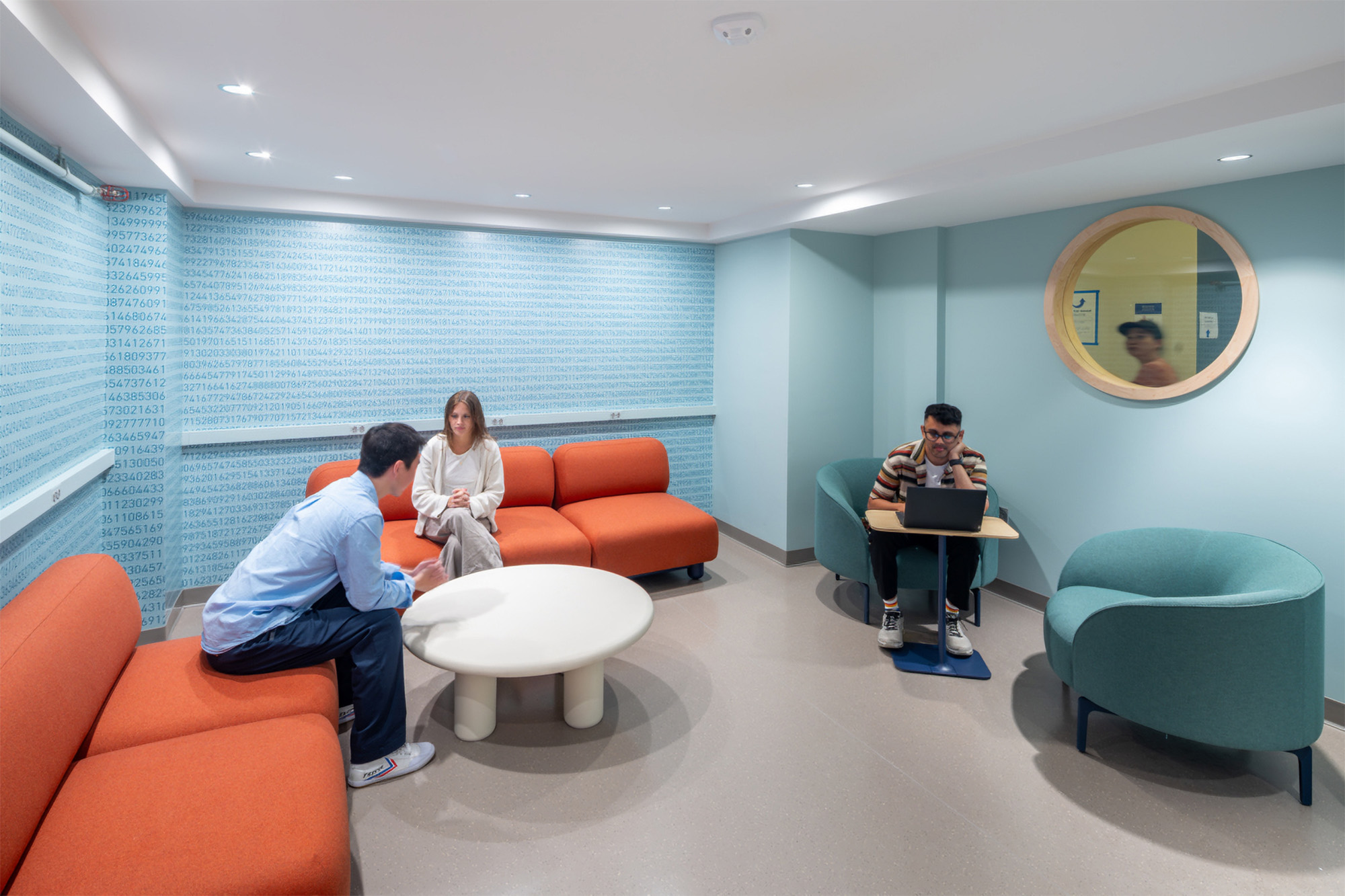
Young leads Spectrum on a tour of the UAC space, with its futuristic-looking pods for study and conversation, and the Pi Lounge, so named for its wallpaper decorated with the digits of the mathematical constant.
“We’ve started to use this space for events,” she says. “We have our own screen, our own sound system. The students can reserve two Zoom rooms.
“The entire month of March we were doing choice-of-major programming. Almost every single day, a different department and some faculty volunteered to present. Materials Science had a huge uptick as a result, getting three times the number of students declaring majors in their department.
“The FLI team hosted headshots here last week, with business shirts and jackets for students. One of the math programs held a pizza party with the faculty. We have big Jenga and Connect 4 games. And during Family Weekend, we hosted reunion events here.
“Every week we do a hub for first-year students and invite an office—mental health, for example, or student support services—to give a presentation. We always have some incentive: ‘Hey, come get a free this or that, spin a wheel.’
“We used to do all this programming in a little office,” she says. “Now we have all this space to move around. We’re figuring out how to use it well.”
“This space is life-changing for people”
How to describe the vibe? “Energetic—it’s a dynamic place, truly inviting,” says Sadé Abraham, associate dean and OACES director.
Says Longin: “It’s as if the Student Center was dropped in the middle of the Infinite, which is always bustling. It’s cool to capitalize on that vibrancy.”
“The breadth of conversations that happen in this space is life-changing for people,” says Santoro-Santos. And every day is different. Every day.
“It’s a fun environment,” he continues. “No one walks in here and leaves in a bad mood.”
“Including us!” interjects Stephanie Hamilton, advising communications specialist.
An effort is now underway to attract a naming gift for the UAC hub that will create a permanent endowment for undergraduate advising, mentoring, recruitment, and admissions programs.
“We have years of exit data of alums saying, ‘I could have used a place that was constant in my academic career, where I knew I could always go and have consistency of support,’” Young says. “I think all alums would say that would have been really helpful. We’re looking to name this place. If there’s an alum out there who wants to make an impression, we can make a dollar go a long way. “
Might the naming opportunities extend to a water dish for Winni?
“That’s such a good idea!” Longin exclaims, with a laugh.
HELP STUDENTS REACH THEIR FULL POTENTIAL WITH A GIFT TO THE UAC
Strengthen the UAC as it supports students through proactive, consistent, and comprehensive advising. This includes guidance on the skills students need to succeed at MIT, as well as opportunities for personal and professional development that help ensure students have the tools to thrive after graduation. Various naming opportunities are available, including interior spaces such as the Community Stairs and Pi Lounge, as well as an overarching naming opportunity of the center. Support for OACES programs, at any level, is also greatly appreciated. Learn more and make your gift.