PHOTO: STEPH STEVENS
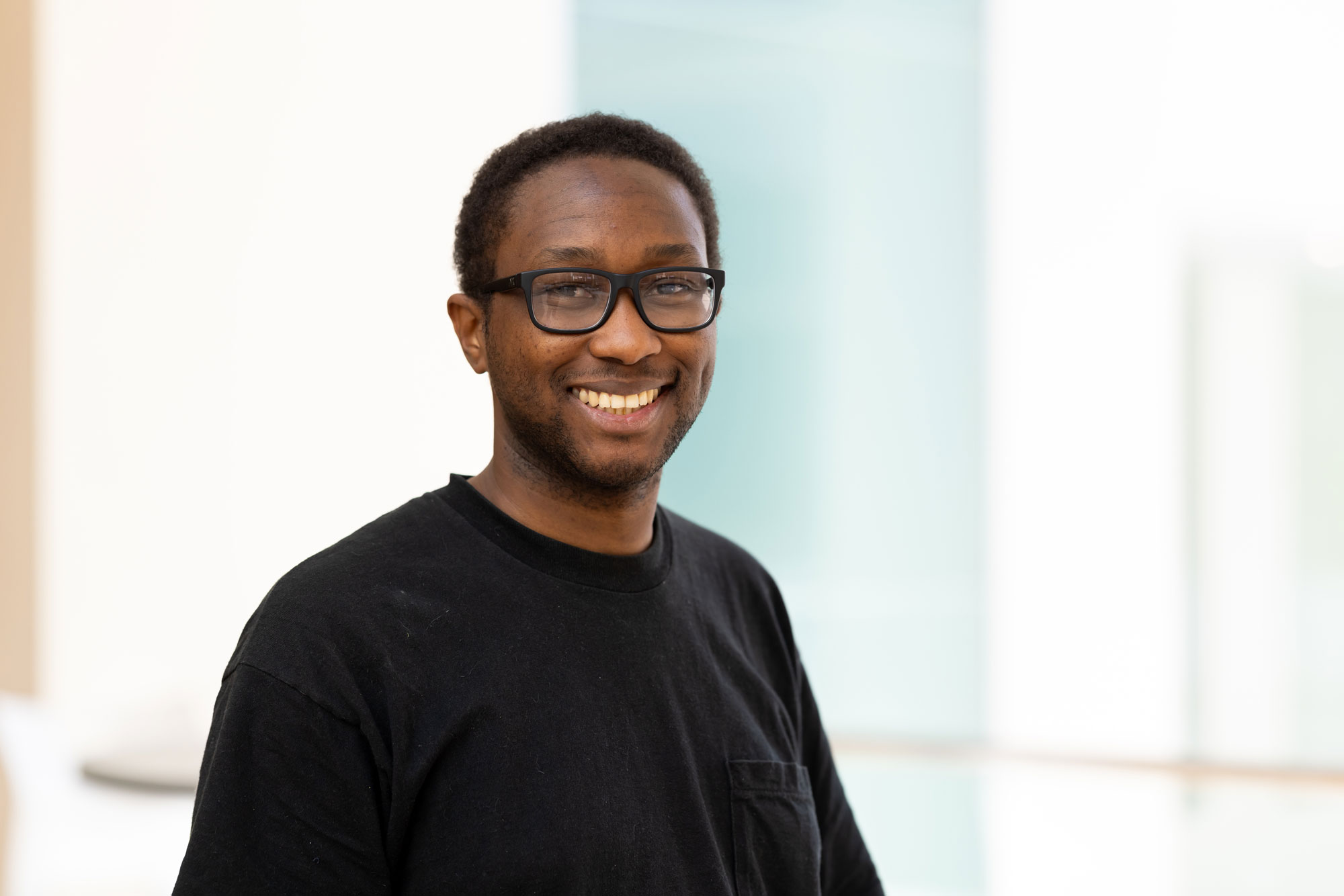
Why AI behaves in these ways is not well understood, but Quilee Simeon ’21, SM ’25 says we might find answers by looking more deeply into another neural network–our own.
“Are we really so different than these AI systems that are seeming to come online and be incredibly capable of doing things that were once thought science fiction?” asks Simeon, a K. Lisa Yang Computational Neuroscience Fellow and PhD student in MIT’s Brain and Cognitive Sciences Department who works in a lab run by Ed Boyden, the Y. Eva Tan Professor in Neurotechnology.
To answer this question and others surrounding animal and artificial cognition, Simeon is using machine learning and AI to simulate the nervous system of small model organisms as part of his doctoral research at MIT’s McGovern Institute for Brain Research. The goal is to use those simulations as a window into understanding how an animal’s nervous system executes other tasks, such as processing information or controlling the body. In other words, he’s using AI to learn more about biological brains—and hoping those insights will unlock the mysteries of AI itself.
Understanding signals from the brain
“Neuroscience is all about trying to interpret how brain signals relate to the behaviors that humans exhibit, especially when they’re really amazing behaviors that we may want to replicate in machines,” he says.
Early in his PhD program, Simeon focused on studying the nervous system of the worm C. elegans, which has only 302 neurons. Now he’s looking to model the nervous system of a zebrafish, which has more than 100,000. Using the data he collects, he plans to apply computational techniques to try to understand, in a fine-grained way, how a brain behaves when an animal is conscious versus unconscious.
He says that getting to the root of these questions, or starting to come up with techniques that can potentially answer them, could help us navigate the world to come.
“It’s important for making policy decisions, because if we’re going to skirt the question of ‘what is consciousness?’ then we avoid it when it comes up in policy discussions for AI systems,” Simeon says.
He wants to understand how human intelligence differs from AI, even as those distinctions could become less clear as technology advances. “I think one of the goals of the research I’m doing is to really try to help us understand ourselves a little bit more, and sort of understand our place in terms of how it connects to some of the major advances that we’re seeing now with artificial intelligence,” he says.
From St. Lucia to MIT
Simeon’s interest in biology started at a young age, spurred in part by growing up around “a lot of nature” on St. Lucia, an ecologically diverse Caribbean island. After graduating high school, he began an associate’s degree program in natural sciences at a community college, at one point taking a gap year to work in rum distilleries at home and in Barbados.
In the summer before his last year of community college, he enrolled in the Student Program in Innovation and Science for Engineering (SPISE), designed for talented students in the Caribbean who have an interest in science and engineering. It was cofounded by Cardinal Warde, professor of electrical engineering and faculty director of the long-running MIT Introduction to Technology, Engineering, and Science (MITES), which provides the blueprint for SPISE.
It was through SPISE that Simeon learned about MIT. In addition to intensive science instruction, it provides students with guidance about college applications and potential careers in STEM—careers through which they could “potentially change the landscape in the Caribbean and give back through engineering or entrepreneurship,” Simeon says.
As he learned more about MIT, his interest in it deepened. “I read a lot of articles in MIT magazines that talked about these really futuristic things, and I wrote some of my college application essays about that sort of research, and that’s kind of what got me into neuroscience,” he says.
Simeon came to MIT with support from the Linde Family Fund, established by the late Edward ’62 and Joyce Linde and their family, to provide support for undergraduates at the Institute. He says he is grateful for the funding that enabled his studies and helps to foster a rich environment for learning and research. “Part of the reason MIT is such an amazing place is because they’re able to get talent from throughout the world and provide the support needed to focus on your studies,” he says.
As an undergraduate, he took several computer science and neuroscience classes, designing his own version of what is now Course 6-9 Computation and Cognition, a major offered jointly by the Department of Electrical Engineering and Computer Science and the Department of Brain and Cognitive Sciences. Simeon then completed a master’s degree in neuroscience and is now a Yang Computational Neuroscience Fellow, a graduate fellowship given out by the K. Lisa Yang Integrative Computational Neuroscience (ICoN) Center.
“I’m really grateful to my current fellowship sponsor, Lisa Yang, who allows us to do amazing research in the Boyden Lab, the Synthetic Neurobiology Lab—really ask some of the hard questions,” he says.
After finishing his doctorate, Simeon hopes to work in either the biotechnology or artificial intelligence industries as a researcher so he can keep asking the hard questions and use his findings to create useful products.
But for now, he’s got a nervous system to decode.
SUPPORT GRADUATE FELLOWSHIPS
Simeon is receiving support through the K. Lisa Yang ICoN Center Graduate Fellowship, a highly selective fellowship program supporting exceptional graduate students for an academic year. Fellows become part of an intellectually vibrant and interdisciplinary cohort, with structured opportunities to collaborate, exchange ideas, and refine their scientific vision. You can help develop the next generation of neuroscience leaders at MIT. Make your gift.