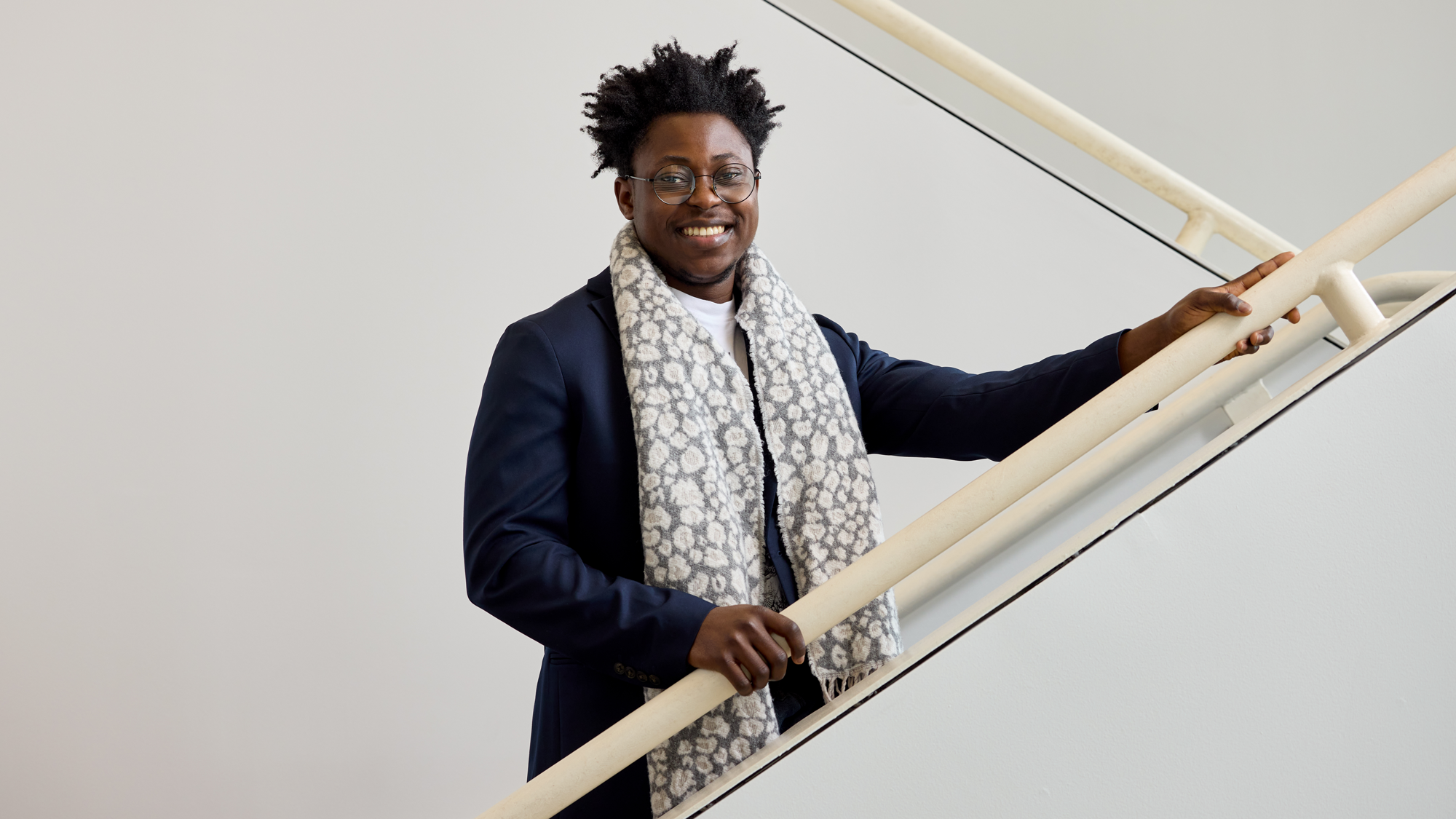
PHOTO: KEN RICHARDSON
“Like every other war,” he says, “this one had public health implications, one of which was the widespread outbreak of kwashiorkor, an acute protein- and calorie-deficiency disease.” Deaths from starvation and disease during the three-year conflict may have exceeded one million.
Born more than two decades later, Eze and his five siblings grew up with constant admonitions to eat healthfully, punctuated by horrifying stories of starvation and death. “That story hits deeply when your grandmother shows you pictures taken in the aftermath,” he remarks.
Lingering damage of war
When he was old enough to attend the University of Nigeria, the impact of the conflict was still evident. “In my university, the chemical engineering department had been locked since after the war, so we were constantly reminded,” he recalls.
Eze was born in the state of Biafra, which seceded from Nigeria in 1967 and was reintegrated in 1970. The university’s chemical engineering department, he says, had been used to manufacture ammunition. After the war, it remained shuttered for many years because the Nigerian government wanted to guard against a resurgence of weapons production.
“That war created this disjuncture between the first generation of Nigerian-educated citizens and then what happened subsequently,” he says. “Before the war, there were scholarships given to many Nigerians to travel abroad and acquire an education to help develop the country.” Some returned to Nigeria after the war, while others remained abroad. “Many scientists who had had a hand in the war left the country out of fear,” he added.
Eventually, Nigerian doctors living permanently in the United States founded the Association of Nigerian Physicians in the Americas (ANPA). “Most of them are now naturalized US citizens and are reimagining primary health care in Nigeria.”
Community and global health
“I have been looking at how to translate community health into practice,” says Eze, a doctoral student in the History, Anthropology, and Science, Technology, and Society (HASTS) program in the School of Humanities, Arts, and Social Sciences and one of the inaugural graduate fellows of the MIT Health and Life Sciences Collaborative (MIT HEALS). “I started with lessons learned from the work that ANPA in the diaspora has done during their yearly medical missions to Nigeria and to other parts of the world. I knew from my interaction with so many members of the association that we needed to reimagine global health.” This was the language he used to apply for the HEALS fellowship, he explains.
Eze is working in partnership with ANPA and with four cofounders of a startup, Homnics, to build digital infrastructure that will strengthen global health systems through electronic record management and telemedicine. “There is a disparity in terms of how many doctors or health care workers are on the ground versus the patients that they need to attend to. And in the diaspora, we have so many people who are willing to do this work that might not be disposed to travel,” he says. “This is an attempt to reverse ‘brain drain’ in the Nigerian medical sector.”
Prioritizing education
After graduating from the University of Nigeria, Eze relocated to the United States and earned a master’s degree from the University of Mississippi, Oxford, where he researched responses to leprosy eradication campaigns in colonial Nigeria.
Eze traces his unflagging curiosity about public and global health challenges and solutions to a family that prioritized education. “My dad is a self-educated man. He didn’t complete high school, but he is a voracious reader. My mom also was going to school when I was seven or eight. I grew up in an environment where my dad would force us to read history books before afternoon siestas.”
Noting that his late aunt pursued a master’s and PhD, Eze remarks, “At that time, it was not popular to invest in educating women. I grew up in a family that loves education, that cared for books, and that has really affected my development.”
SUPPORT GRADUATE FELLOWSHIPS IN MIT HEALS AND HASTS
Eze is receiving support through the MIT HEALS Graduate Fellowships, a highly selective program supporting exceptional graduate students for an academic year. Fellows become part of an intellectually vibrant and interdisciplinary cohort, with structured opportunities to collaborate, exchange ideas, and refine their scientific vision. To help develop the next generation of life science leaders at MIT, make your gift to MIT HEALS. You can also support graduate students in the History, Anthropology, and Science, Technology, and Society (HASTS) program in the School of Humanities, Arts, and Social Sciences. Make your gift to MIT HASTS.
Looking ahead
Eze’s research also explores climate justice, particularly in oil-producing regions. “In thinking about science and technological innovation during the Nigerian Civil War, I examine the role of oil production. The Biafran state refined its own oil because it was blockaded during the war and couldn’t import fuel. One of the things they did was to invent a mobile refining vehicle.”
He wants to better understand the environmental impact of multinational companies that extract oil and mine natural resources such as granite and cobalt in African nations. “Now that I’m settling in and trying to write my dissertation, I envision working broadly with many institutions at MIT that are working on health care, global health, and economics.”