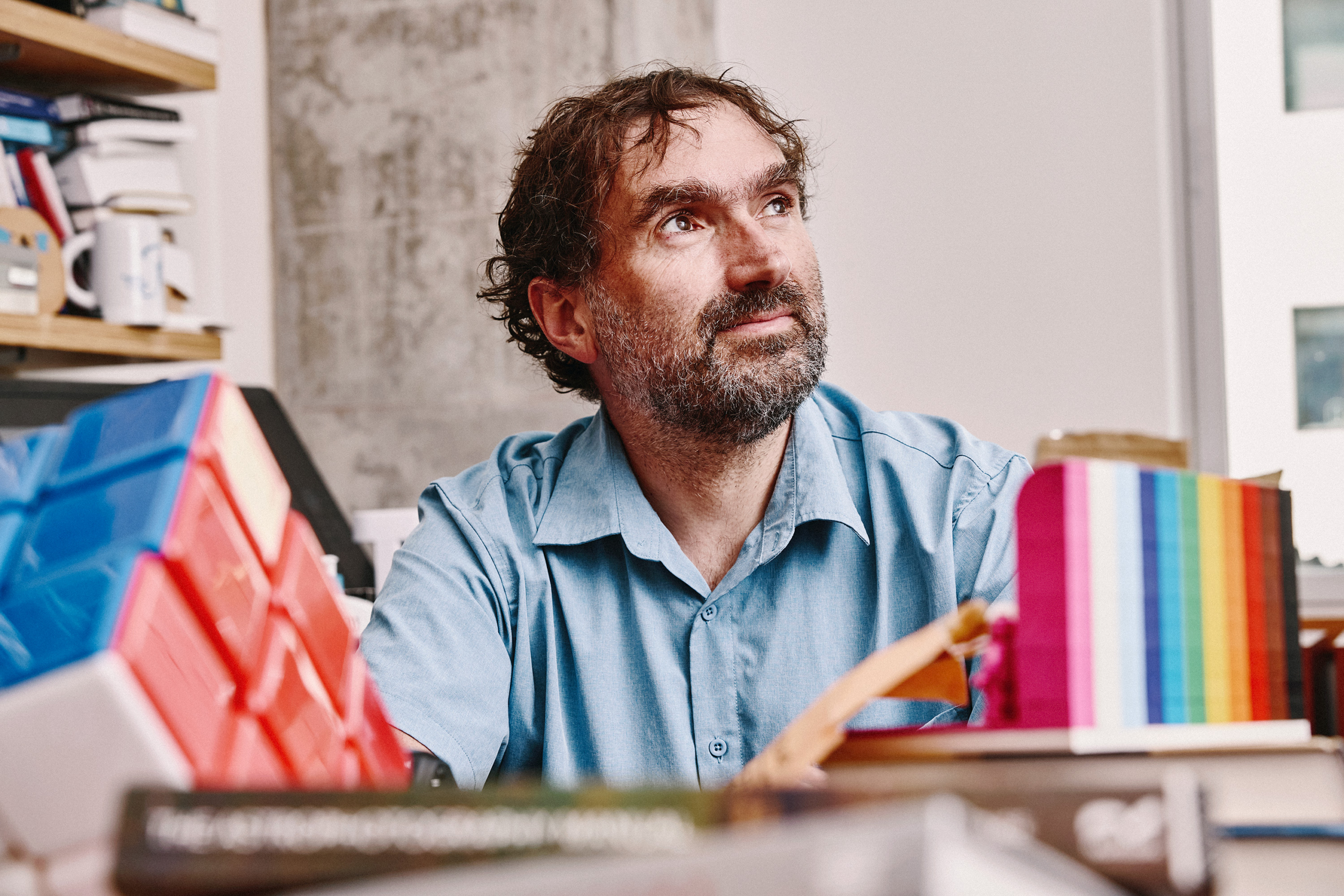
PHOTOS: SIMON SIMARD
The article, titled “Computer Software for Graphics,” began with an alluring statement that described a computer display as a “window into Alice’s Wonderland,” where one could either obey natural laws or follow a programmer’s imagination and whims. Durand was already interested in computers and had even done some elementary programming, but this article got him hooked on computer graphics. He has held fast to that resolve ever since.
He studied computer science as an undergraduate at the École normale supérieure of Paris and earned a PhD from the University of Grenoble in 1999. Arriving at MIT as a postdoctoral researcher that year, Durand joined the faculty in 2002 and now serves as the Amar Bose Professor of Computing in MIT’s Department of Electrical Engineering and Computer Science (EECS), which is jointly housed in the School of Engineering and the Stephen A. Schwarzman College of Computing. “My original plan was to be at MIT for a couple of years and then go back to France, but 27 years later, I’m still here,” Durand says. He found it hard to leave because “MIT is an incredibly stimulating place. And it’s not just MIT. It’s the whole Cambridge–Boston ecosystem; the intellectual power around here is just astounding. There’s no place like it in the world in terms of the density of people doing amazing science and engineering.”
Durand’s initial focus upon arriving at MIT was on images that are generated entirely by machine. But he soon extended his interests to include photography, and he’s continued to expand his horizons from there. “I’d been building tools to make synthetic images and realized I could apply some of the lessons from that experience to photography,” he explains. “There are scenes in the world, for example, where the difference between the brightest and darkest elements is too great to capture within a single image, but there are computational ways of alleviating this issue that cannot be done in the darkroom.” The blurring of images, due to the motion of the camera or of the object being photographed, is another common problem that can be remedied computationally.
But computational photography offers more than just an assortment of tricks for manipulating images. “Once the image becomes a grid of numbers rather than a pattern of silver grains on film,” Durand says, the possibilities are virtually unlimited.
Interdisciplinary opportunities and support from professorship
Owing to “the abundance of smart people at MIT in every field,” Durand has gotten involved in interesting, interdisciplinary collaborations that he never would have predicted. Around 2012, for instance, he teamed up with his EECS colleague William Freeman PhD ’92 to see whether a person’s heart rate could be tracked by video alone. With each heartbeat, as a little more blood flows to a person’s head, the face reddens slightly—an effect too small to be seen by the naked eye, but one that can be amplified by computer vision techniques to create what Durand calls a “motion microscope.” A few years later, he and Freeman joined forces with Oral Buyukozturk, a post-tenure MIT professor of civil and environmental engineering, to use their motion-magnification method to reveal previously imperceptible vibrations in buildings and bridges—an approach relying on video cameras that is cheaper and easier to implement than installing arrays of motion sensors. In a related project, Durand and colleagues utilized this same motion-enhancement technology to monitor the respiration rates of infants.
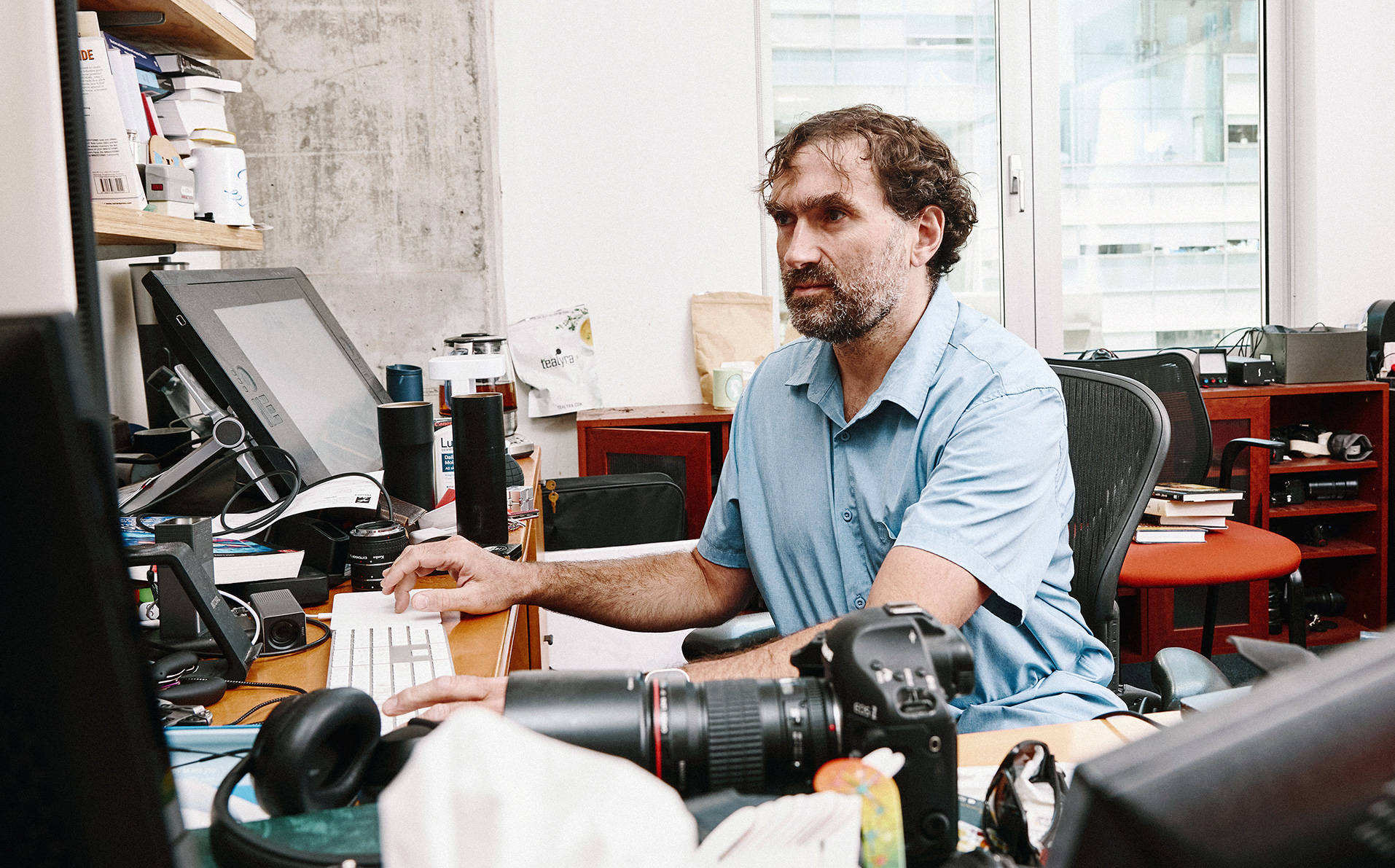
Durand is grateful for the Bose Professorship, which he says has given him the freedom to explore wide-ranging ideas, some of which lie well outside his normal range of expertise. Taking advantage of the discretionary funding available through the professorship has enabled him to participate in projects “in areas where I have no track record that would make it easy for me to apply for regular grants.”
In a paper published in 2025, for example, he and a group of researchers at MIT and other institutions reported on a bioengineering project to store important medical information in invisible tattoos on a patient’s skin—an idea that could be useful in places where the medical record infrastructure is weak or nonexistent. Were it not for the professorship support, Durand might not have been able to take part in this study.
Teaching and learning in the age of AI
He’s also relying on these discretionary funds to support his work in education, which he takes very seriously, having won several teaching awards at MIT. In particular, he’s developing AI tools that can “help students learn rather than just give them the answer.” Durand’s book on AI photography—a portion of which can be read online—has built-in AI tutors that are, he says, “pedagogical” by nature. The agents can help students work through problems and otherwise guide them toward comprehension “without predigesting everything for them.”
Even though they never met, he feels a special kinship with Bose, in whose memory Durand’s professorship is endowed. Bose not only got his bachelor’s, master’s, and doctoral degrees from MIT but also served on the faculty from 1956 to 2001. “His work was largely related to sound,” Durand says, “whereas mine is more on the visual side of things. But a lot of what he did lies at the intersection of signal processing and human perception.” For Durand, that too is a stimulating place to be, and he’s eager to pursue this line of research as long and as far as he can.
SUPPORT PROFESSORSHIPS AT MIT
Endowed professorships provide support and flexibility, making it possible for faculty like Fredo Durand to take their research in exciting, untested directions. History has shown us that MIT faculty members can, and do, change the world. Make your professorship gift.