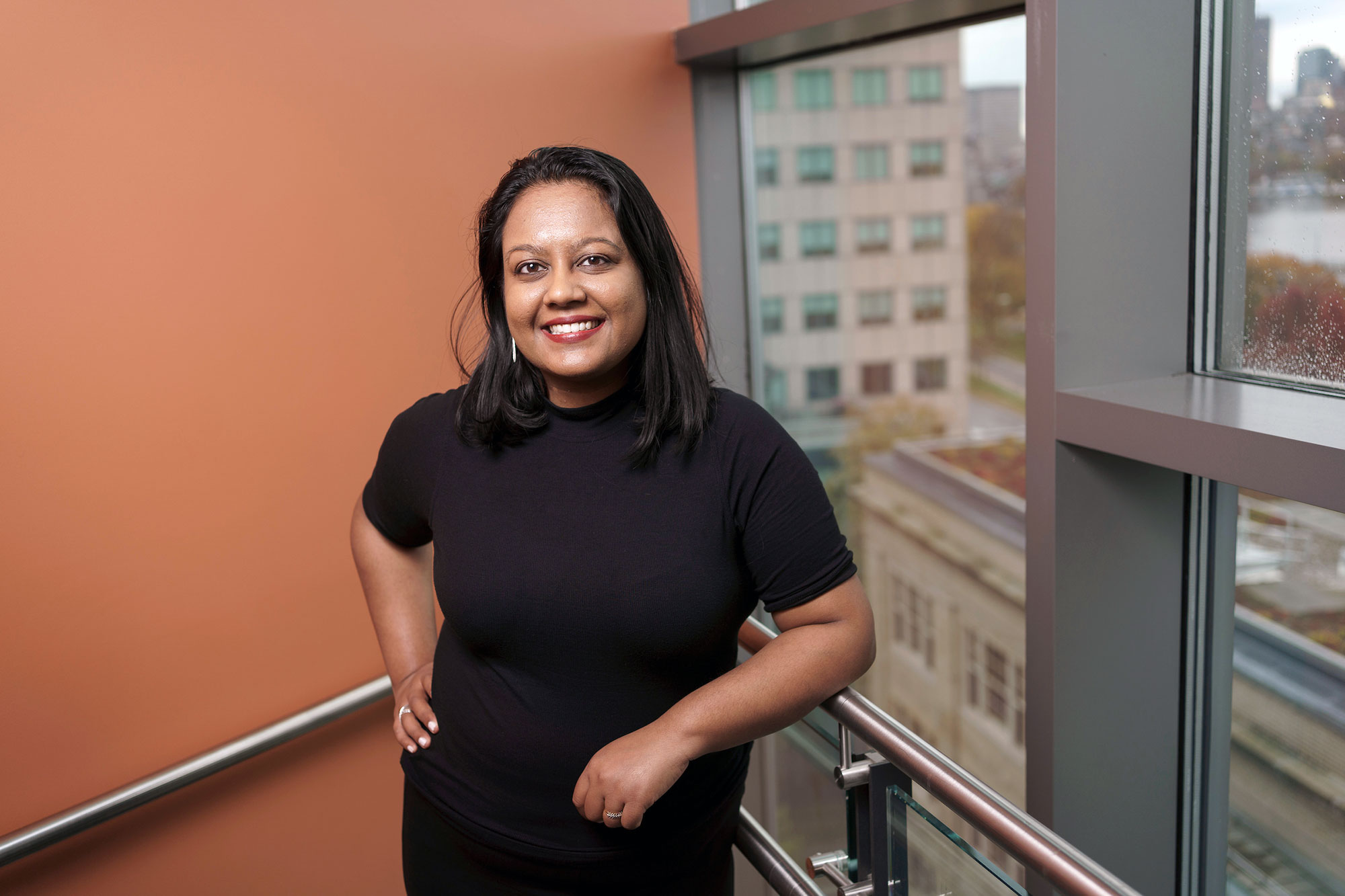
PHOTO: JODI HILTON
“I work on algorithms to make the world a better place,” Gupta says. “AI shouldn’t have discriminatory impacts based on people’s backgrounds or socioeconomic status.”
Gupta, who is the Class of 1947 Career Development Associate Professor and associate professor at the MIT Sloan School of Management in the Operations Research and Statistics Group, develops algorithms that recognize uncertainty, expanding the kinds of real-world problems AI can solve.
For example, she developed methods to improve predictions of sepsis, a life-threatening condition that can lead to rapid organ failure. Electronic health records capture enormous amounts of patient information, but the data are often incomplete. Physicians know that factors such as skin color influence diagnostic accuracy of image-based methods. Partnering with clinicians, Gupta’s team incorporated physicians’ insights into AI models. The models’ predictions of sepsis roughly six hours before onset improved by about 15%—potentially giving providers valuable time to intervene.
“For me, the reward is in the moment everything connects: understanding the societal context, identifying how current technology treats people, and developing technical solutions that move the needle toward ethical decisions,” Gupta says.
Professorship enables promising research
Pursuing these bold ideas requires flexibility, which is what the Class of 1947 Career Development Professorship helps provide recipients.
After changes in federal priorities led to the loss of funding for her National Science Foundation CAREER Award, the professorship enabled Gupta to support her research group. Gupta’s graduate students, from postdoctoral researchers to MBAs, tackle high-stakes problems across industries. They’re united by a shared belief in AI’s potential for public good.
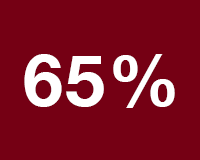
Percentage of MIT’s 1078 faculty members, as of August 2026, who hold a named professorship
“Though my PhD was in combinatorial optimization, when I became faculty, I expanded into algorithmic fairness and social impact. Not all problems can be solved with math, but there’s still a lot we can do in this world with technical solutions. Actually, it’s not a matter of “can.” We must do more, given the amount of proliferation of AI and the way people view it as an all-knowing entity,” she explains. “How can we make sure that the impact of AI is still positive?”
Her students answer this question in their work every day.
Madeleine Pollack, a PhD student at the Operations Research Center, and Lauren Zhang, a student in MIT Sloan’s Master of Business Analytics program, for example, are working with doctors at the Massachusetts General Hospital to develop better algorithms to place more donor kidneys before they expire. Now, roughly one in five recovered organs goes unused because it isn’t matched to a recipient in time.
With smarter AI, “Organ transplantation patients could receive out-of-sequence offers, receiving organs much faster than waiting on the transplant list for six months or dying while waiting,” Gupta says. However, like every technology, AI has measurement error and some uncertainty in its predictions. Pollack is developing policies that can take risk-averseness into account when making rerouting decisions.
One of Gupta’s postdoctoral researchers, Tianjiao Li, is studying bias and errors across large language models and developing new optimization methods that can switch models based on their cost and types of errors. He will be joining University of Wisconsin–Madison’s Industrial and Systems Engineering Department as a tenure-track faculty member in 2027.
Mission-driven research
Gupta’s socially minded research reflects a personal evolution. Growing up in India, Gupta was fascinated by mathematics, but she also questioned the gender norms that hindered many women in STEM. She came to MIT to earn her PhD in operations research. Along the way, her ambitions evolved from proving abstract mathematical theorems to asking how mathematics could improve society.
“I started being more drawn to NGOs, social problems, trying to find meaning,” she says. “I wondered: ‘If I prove this theorem, is this going to improve the state of the world?’”
Her work isn’t abstract. It’s channeled by human need and social interaction. She learns from the community as well as in the classroom, pursuing new ideas through real-world interactions.
“Sometimes, an idea is sparked by a conversation at a dinner party with doctors. I’m curious about their work, they’re curious about mine, and we get to talking,” she says. “Other times, there are people out in the streets, protesting about reduced access to emergency rooms, and this gets me fired up about equitable access in facility placement.”
Across industries, her work is driven by a conviction that the mathematical foundations underpinning today’s algorithms need to evolve alongside—and reflect—society itself. Classical optimization, the branch of mathematics that helps computers make decisions, was developed for problems with clean, reliable information. Today’s AI uses human-generated data, which bakes in a lot of our behaviors, biases, and stereotypes.
“Optimization was built for a world that no longer exists,” Gupta says. “Our world is rapidly evolving.”
Student research with real-world impact
Her research reflects that evolution. For instance, Gupta is collaborating with Diego Martinez Duvall MBA ’25, who used predictive models to improve call center operations for a class project. Together, they began to develop algorithms that recognize an often-overlooked reality: human-generated data often doesn’t tell the whole story. A customer who declines a credit card offer, for example, might not want the card. On the other hand, a salesperson may have failed to make a compelling case. Most AI systems treat those outcomes equally, but Gupta’s work aims to tell the difference.
The breakthrough was revelatory. “Diego said, ‘I’m just so excited about the techniques we learned in our analytics edge class (15.071 15.071 The AI Edge) that I want to completely change my career path and do more AI work.’ Their curiosity energizes me,” she says.
Gupta also recognizes the responsibility that comes with shaping the future of AI. As the world relies on it more heavily, she has an obligation to ensure its accuracy. Her work with students at MIT—an atmosphere that she calls a “ball of energy”—reflects that urgency, she says.
“These professorships are really valuable to faculty who are working in high-risk, high-reward areas,” she says. “We’re trying to push boundaries, and every support helps us make exciting discoveries and also train the future scientists.”
SUPPORT PROFESSORSHIPS AT MIT
Endowed professorships provide support and flexibility, making it possible for faculty like Swati Gupta to take their research in exciting, untested directions. History has shown us that MIT faculty members can, and do, change the world. To learn about establishing an endowed professorship at MIT Sloan, please email Dena Patterson at [email protected].