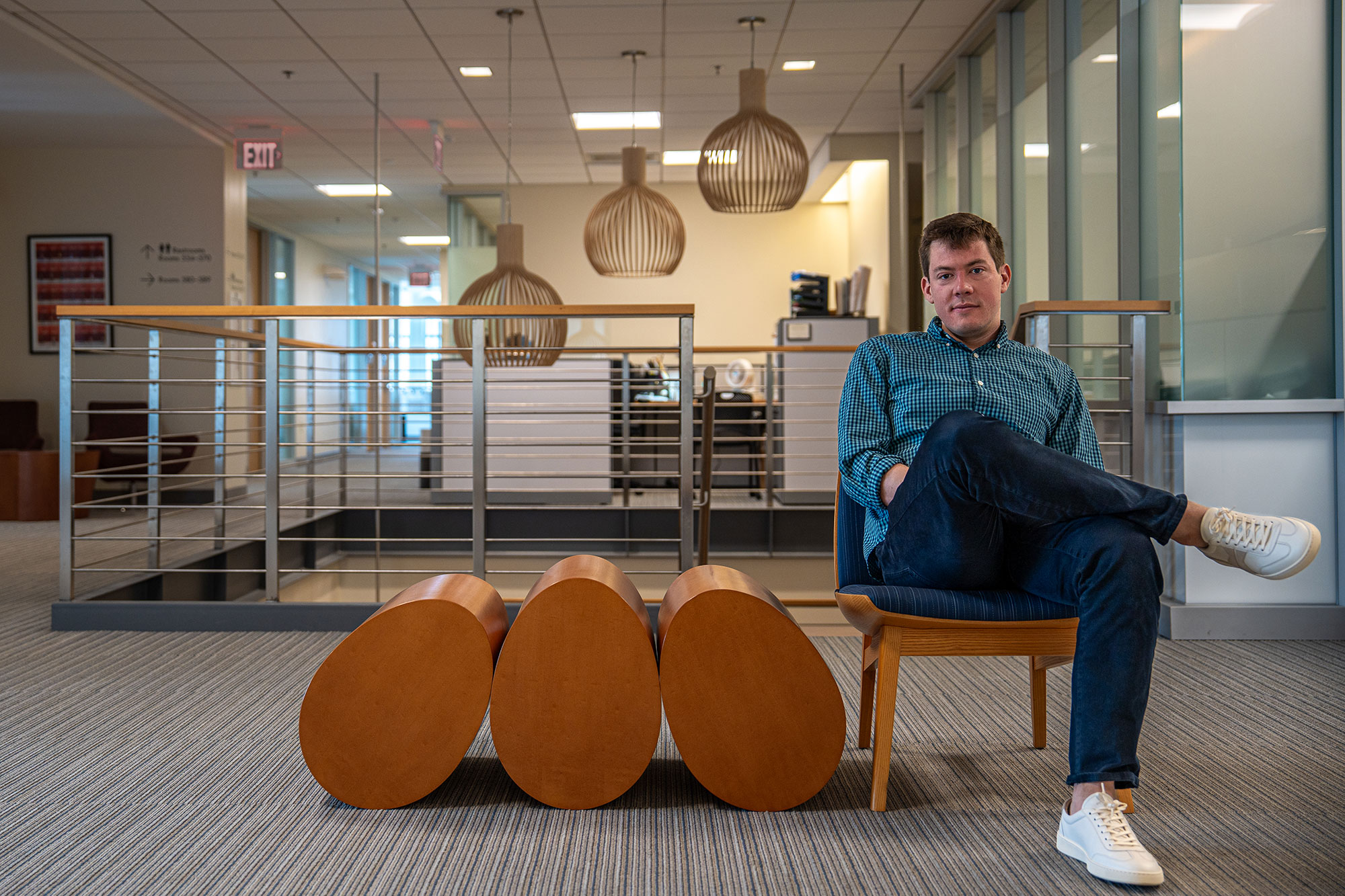
PHOTO: HANLEY VALENTIN
While such a cap seems to solve the problem, it introduces an obvious new one: What if more students honestly deserve As for their work?
That’s just the kind of question Ian Ball, associate professor in the Department of Economics in the School of Humanities, Arts, and Social Sciences, loves to tackle. “The issue with quota mechanisms is that the designer of the mechanism doesn’t have access to all the information,” Ball says. “In this case, the university can’t assign grades because they don’t know how the students did—only the instructor knows.” Therein lies the problem. While some students might honestly deserve higher grades, instructors might also grade more leniently to hedge against bad student evaluations or complaints, leading to grade inflation. “It’s not clear the university and the instructor have the same interests,” Ball says.
Ball specializes in mechanism design, an offshoot of game theory that examines how the rules are set up in complex economic systems. “Game theory essentially studies strategic situations where I’m making a choice and someone else is making a choice, and the best choice for me depends on the choice other people make,” Ball explains. While game theory has been around more than half a century, mechanism design takes it a step further: “What if you get to design the rules of the game, and then you anticipate how the game you design will be played according to game theory?” he asks.
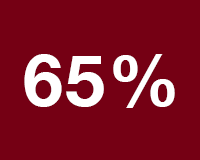
Percentage of MIT’s 1,078 faculty members who hold a named professorship as of August 2026
In a forthcoming paper in the Journal of Political Economy, Ball and University College of London economist Deniz Kattwinkel look at grade inflation as one example in of quota systems. They apply a complex economic model to examine the circumstances in which such a system would work well and the circumstances in which it may not. For example, they determine that the more times decisions are made—in this case, the more graded assignments in a semester—the more accurate the system. At the same time, the more distinct options for grades, the more students will be necessary to make it work. “We precisely quantify that relationship,” Ball says, “so as the number of distinct decisions you can make increases, how many more copies of the problem do you need in order for the system to work well?”
Using economics in the real world
Ball gets excited about applying such economic models to real-world problems. “There are two ways you can do research in economic theory,” he says. On the one hand, researchers can read the academic literature and answer questions based on that. On the other, they can think about how models might be applied to entirely new problems. “I’ve always found it particularly exciting to think about my life experiences, or things I read about in The New York Times where there isn’t a model but maybe it’s something we could try to understand better.” Ball discovered game theory as an undergraduate at Stanford, inspired by a class taught by matching theory expert Fuhito Kojimo; he, in turn, was a student of Alvin Roth’s, who won a Nobel Prize in Economics for developing the National Resident Matching Program through which tens of thousands of medical school graduates are matched with hospital residency programs.
For his dissertation at Yale, Ball examined credit scores. While countless companies rely on credit scores to make decisions about customers, customers can game the system by taking actions that can artificially increase their scores. Again, the problem is one of information: How can the credit score designers ensure the score will be accurate when they don’t know who is gaming the system and who isn’t? “How do we score agents who are themselves behaving strategically?” he asks. “While you can’t completely eliminate the effects of this strategic behavior, there are ways you might be able to adjust the weighting of your score to potentially do better.” (He published work on this topic last year in the American Economic Journal: Microeconomics.)
Since coming to MIT in 2020, Ball has applied models to situations including auctions and procurement, designing systems for bidding to achieve the best possible outcomes. Recently, he has been examining how decision-makers can design better mechanisms in the face of uncertainty and has submitted a paper on the topic, cowritten with Kattwinkel. “Sometimes we make decisions where we know the risk, like a roulette wheel where we know red and black will each come up 50% of the time,” he says. “Then there are decisions that are qualitatively different, like global warming policy, where we don’t even know the probability of different events. We’re thinking about how to confront those kinds of problems to ensure you’re making decisions in the face of this fundamental uncertainty that will still do well.”
Support from the Loveman professorship
Ball came up with the idea for that research while at a conference with colleagues in Berlin, supported by funds from his named professorship as the Gary Loveman Career Development Associate Professor. He often gets ideas from such in-person conversations, he says. “When you travel, you enter a different community of scholars, which can give you a new perspective,” he says. “I’m glad that I have the resources to visit colleagues around the world and keep ideas fresh.” He’s also used funding from the professorship to hire PhD students as research assistants—which both helps him with proofreading and literature searches and helps students as well. “I remember being hired as a research assistant in graduate school,” he says. “It was really helpful to see firsthand how more experienced researchers approach the paper-writing process.
Ball faces no end to the types of real-world problems to which he can apply models to improve decisions people make. While sometimes intuition about how a system will play out proves correct, oftentimes the models reveal surprises. “That’s the value of formal analysis,” he says. “You write down a model to explain your gut feeling and then find out the world is a little bit more complicated than you thought.”
SUPPORT PROFESSORSHIPS AT MIT
Endowed professorships provide support and flexibility, making it possible for faculty like Ian Ball to take their research in exciting, untested directions. History has shown us that MIT faculty members can, and do, change the world. Make your professorship gift.