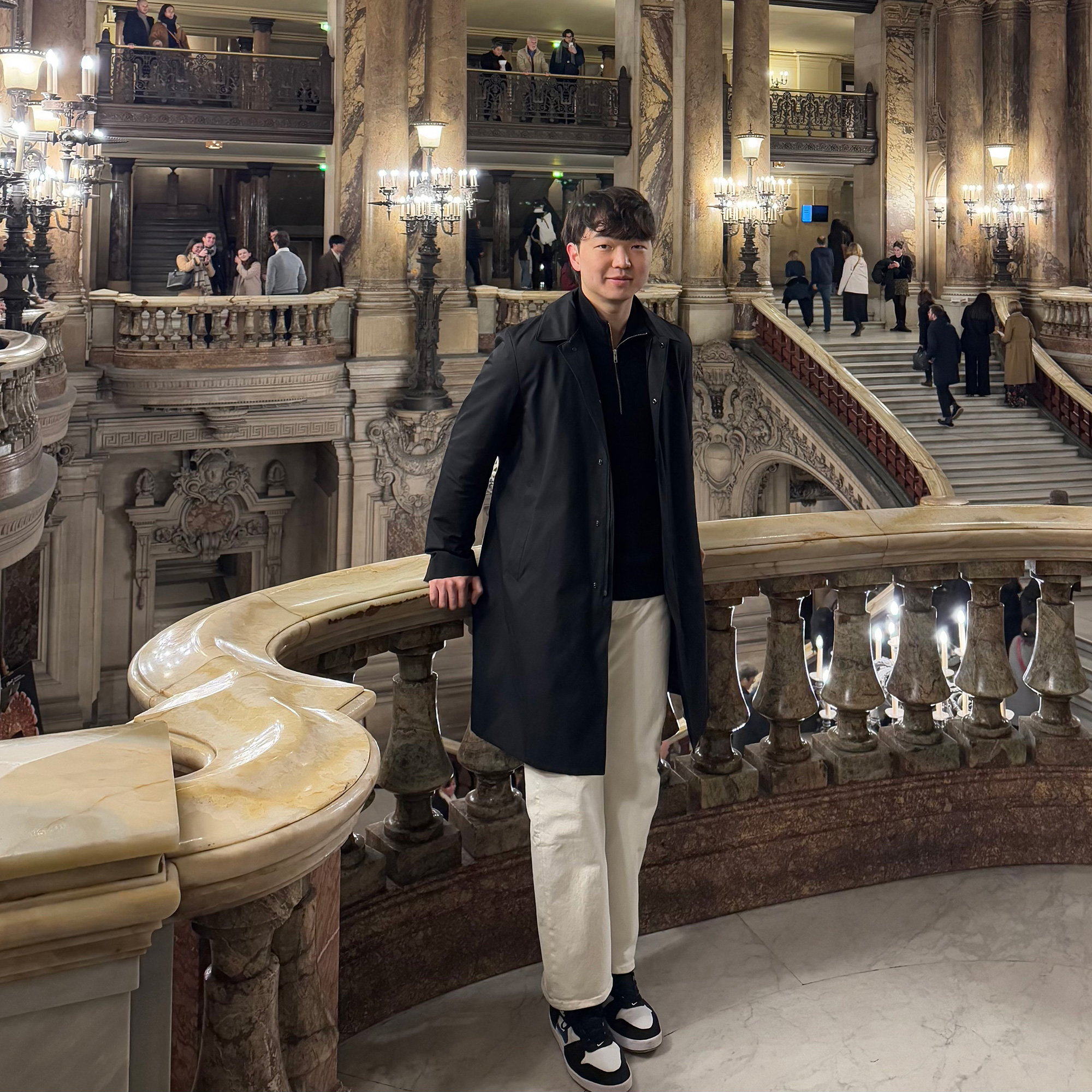
Eunsu Hur at the Palais Garnier in Paris.
PHOTO: COURTESY OF EUNSU HUR
The Langlands program, a set of conjectures linking many seemingly unrelated corners of mathematics, fascinated him, and MIT is home to some of the world’s leading faculty in the field. That put the Institute at the top of his list, and he was thrilled to be admitted and awarded the Arthur J. Samberg (1962) Scholarship. The fund was established by the late Arthur Samberg, the founder of Pequot Capital and a longtime member of the MIT Corporation, with his wife, Rebecca Samberg. Hur is proud to be among the more than 200 MIT students to receive the Samberg Scholarship.
“My parents are both pastors at a small church,” Hur says. While his family might have managed the cost of a university education in his native South Korea, he explains, MIT was far beyond their means. Receiving the Samberg Scholarship put an MIT education within his reach.
Hur spent his first two and a half years at MIT following his interests in mathematics and learning more about the Langlands program. Through the MIT International Science and Technology Initiatives (MISTI) program, he worked with mathematicians at Imperial College London; the Max Planck Institute for Mathematics in Bonn, Germany; and the Institut des hautes études scientifiques outside Paris. While he loved mathematics, he wanted a closer connection to the world outside his field. “When people asked me about my research, I had no idea how to explain it to them,” he says. Referring to an idea often attributed to Albert Einstein, he adds, “If you really understand your field, you should be able to explain it to your grandmother. I never could, and that felt a little isolating.”
New directions
In early 2025, Hur decided to try new directions, through two Undergraduate Research Opportunity Program projects. At the MIT Computer Science and Artificial Intelligence Laboratory, he began studying machine learning and helped build BoltzGen, a protein-design model for drug discovery. That fall, at the Whitehead Institute, he worked alongside biologists who are using these kinds of models to advance their research. Watching computer scientists and biologists bring two different kinds of expertise to the same challenge was a revelatory experience, Hur says. “Creativity always arises when you try to merge two different things.” He uses a cooking analogy to describe interdisciplinary research. “When you fuse different cuisines, something amazing happens.”
Discovery happened outside the lab, too. Through the School of Humanities, Arts, and Social Sciences, he completed a concentration in French and traveled to Paris in January through the France Scholars program. In the MIT LIVE club, Hur performed regularly with friends who shared his love of music. He also joined the MIT Gymnastics Club, taking up a sport he’d never tried, and traveled with the team to a meet in Alabama.
Though he graduated with a BS in mathematics, he’s found physics to be the perfect middle ground between the abstract and the applied. This fall, Hur begins a PhD in electrical engineering and computer science with Vivishek Sudhir, the Esther and Harold E. Edgerton Associate Professor of mechanical engineering, as his advisor. Sudhir’s Quantum and Precision Measurements Group uses quantum optics to measure motion at very small scales with the ultimate goal of understanding whether gravity itself is quantum. His spring graduation felt strange because, as Hur puts it, “I’m going to walk out and walk right back in,” but he’s happy to be returning to a place that has come to feel like home.
During his MIT undergraduate years, Hur’s personal growth came from classes and research, as well as friendships, conversations, and even books he picked up. Reading Sapiens: A Brief History of Humankind, by Yuval Noah Harari, he was struck by how much of the human story is defined by violence, and it made him think about the responsibilities of those who develop new technologies. “Whatever we develop, it should benefit mankind,” not harm it, he says.
Above all, Hur has learned to expect the unexpected. “I’m not afraid anymore of learning something completely new,” he says. As he delves into his PhD, he has a running list of what he calls “side quests,” which includes studying German. “That’s what MIT students do,” he says. “We tackle a problem, no matter how hard it is.”
Although Hur isn’t sure what his future may bring, he hopes to repay the gift of the Samberg Scholarship by supporting MIT students like himself. As for what a scholarship has meant in his own life, his answer is simple: “It means everything,” he says. “I’ve received so much. I’d love to give back what I received.”
SUPPORT SCHOLARSHIPS AT MIT
At MIT, impact begins with people—and recent graduates like Eunsu Hur are an integral part of that story. MIT graduates go on to make a difference in every field, applying the Institute’s hands-on approach to solving problems that matter. By supporting scholarships, you help ensure that every student who accepts an offer of admission has the resources and support to thrive at MIT and contribute their talents wherever they can have the greatest impact. Make your scholarship gift.