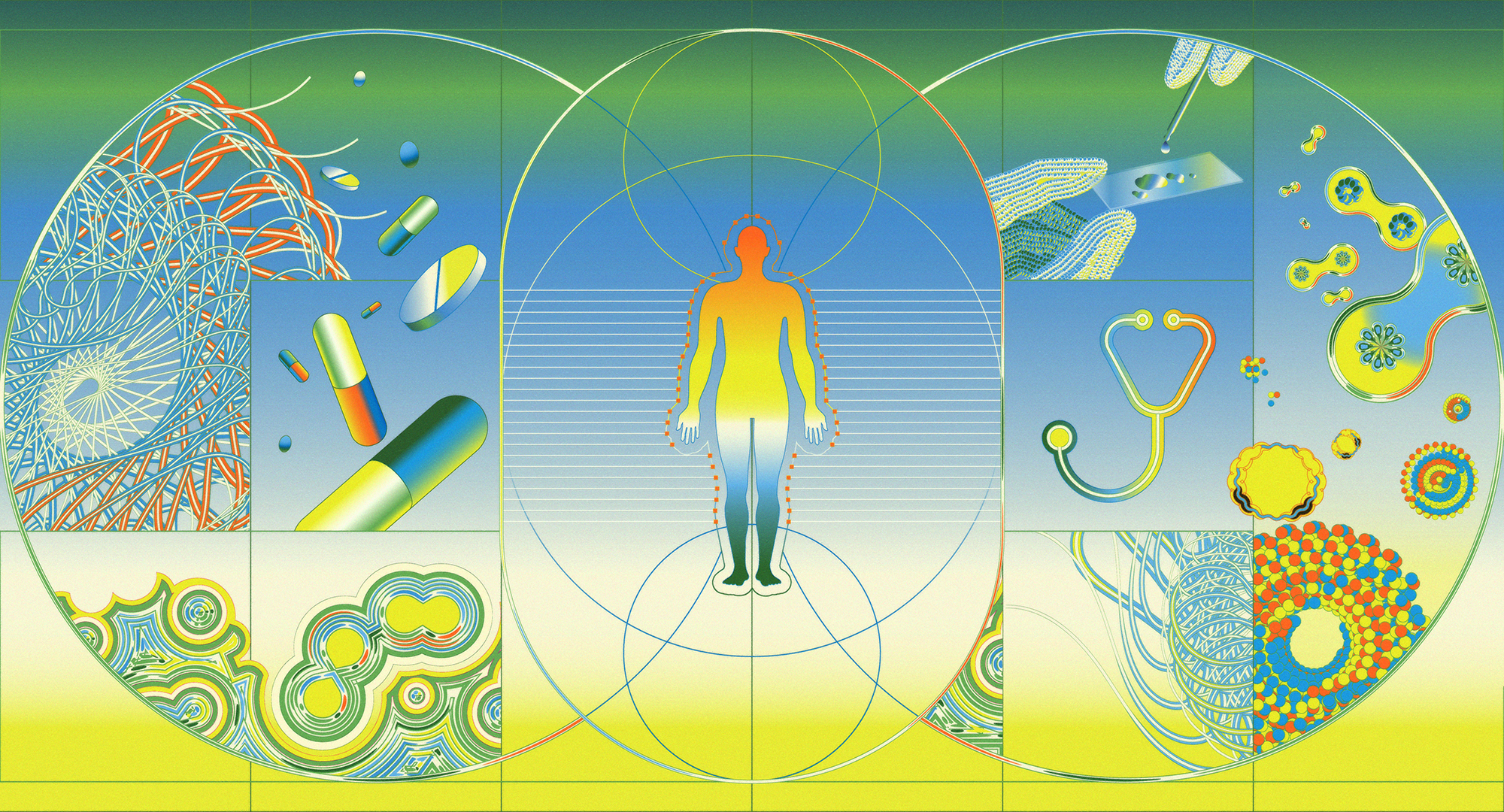
ILLUSTRATION: PETRA PETERFFY
“In the Greater Boston area, we have many of the leading universities, hospitals, biotech, and pharmaceutical research headquarters. It is the most concentrated biomedical community in the world.”
Researchers all over campus work tirelessly on projects that have the potential to improve human health, and many transformative discoveries—including key contributions to the creation of the Human Genome Project and development of lipid nanoparticles to enhance mRNA vaccine effectiveness—have been made by MIT faculty and students.
The establishment in 2024 of the MIT Health and Life Sciences Collaborative (MIT HEALS), a Presidential Strategic Initiative, signals the Institute’s response to a new era in life sciences and health care. “Health care is undergoing a transformation due to AI, nano, genomics, and all the technologies that are bringing better health outcomes to patients,” says Sharp. “HEALS represents MIT’s commitment to be a university fully engaged in transforming health care.”
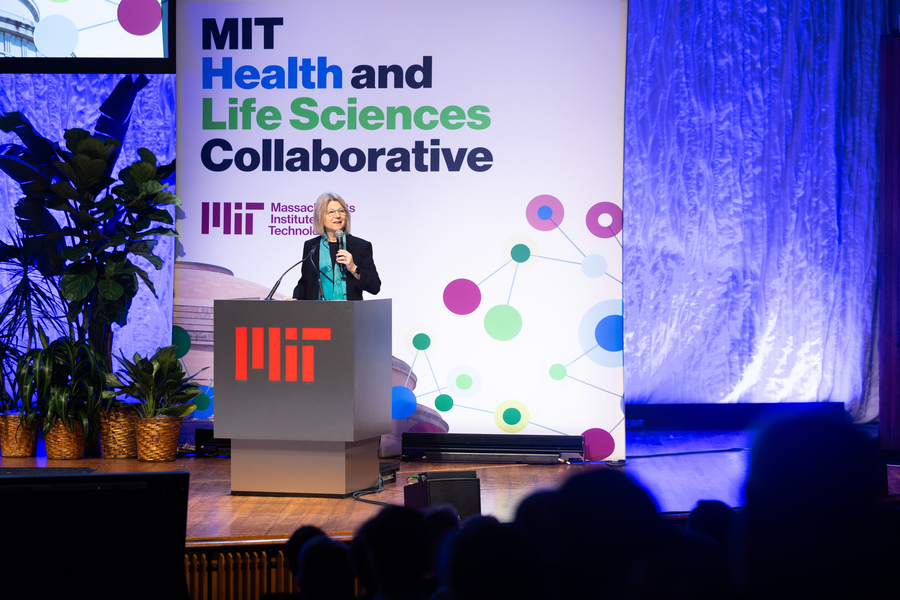
PHOTO: JAKE BELCHER
“Vital” information gathering
In 2020, the deans of the MIT School of Science and the School of Engineering—Nergis Mavalvala PhD ’97, the Curtis (1963) and Kathleen Marble Professor in Astrophysics, and current MIT Provost Anantha Chandrakasan, the Vannevar Bush Professor of electrical engineering and computer science—launched a new effort to define a vision for the life sciences at the Institute, observing that MIT could engage more deeply with the biotech ecosystem and medical centers in the Boston area. “There were existing connections, to be sure,” says Tyler Jacks, the David H. Koch Professor of Biology and Daniel K. Ludwig Scholar, who was the director of the Koch Institute for Integrative Cancer Research at MIT (and its predecessor, the MIT Center for Cancer Research) from 2001 to 2021, “but those connections could be deepened and enhanced and facilitated. That would be important for MIT research, and it would be important for MIT’s impact on life science and health more broadly.”
A faculty committee called VITALS (Vision to Integrate, Translate, and Advance Life Sciences), cochaired by Jacks and Kristala Jones Prather ’94, the Arthur Dehon Little Professor and head of MIT’s Department of Chemical Engineering, distributed a faculty survey to gauge interest in a new way forward. They were impressed with the response. “The level of interest in endorsing a new emphasis on life science and health was very high,” recalls Jacks. “We had a lot of the core components here: expertise in life science, in science and technology, and in computation. We had all the raw materials, and with this effort, we could connect faculty even more effectively across campus and to our neighbors in the medical centers and the biotech companies.”
The committee also surveyed nearby companies in the biotech and pharmaceutical industries, as well as area hospitals. “We discovered that industry wanted to be more engaged as partners with MIT,” recalls Jacks. “They had areas of interest and need, and they wanted to match those with areas of interest on the MIT side and really engage on those projects.”
“They didn’t just want to toss the ball over the fence,” Prather says. “They wanted to walk around the fence and be involved in playing the game. We did hear from a lot of people that they found it difficult to find the right entry point into MIT,” she continues. “One thing that creating HEALS has done is to provide a focal point.”
Putting different skill sets in the same room
Bringing people with different skill sets together to solve problems is something MIT does well, says Angela Koehler, the Charles W. and Jennifer C. Johnson Professor of Biological Engineering and faculty lead of MIT HEALS. She cites the Broad Institute of MIT and Harvard and the Koch Institute both places where she has worked, as examples. “At the Koch Institute, the goal was to put engineers, biologists, and chemists into the same building and to think about how you can impact cancer. It’s worked fabulously both at the Broad Institute and the Koch Institute, but it’s never been done at capacity across MIT.”
From colleagues she often heard that MIT should “invest significantly in collaborative biomedical science and think about how to optimize our interactions with the amazing, rich, deep industrial entities off our campus.” In this way, Koehler explains, MIT could take on “truly transformative and audacious problems in biomedicine.” It seemed to her that many faculty were working on important research but did not feel engaged with the community outside of their departments. “Years later, when the notion for HEALS was more real and tangible, those conversations stuck in my mind.”
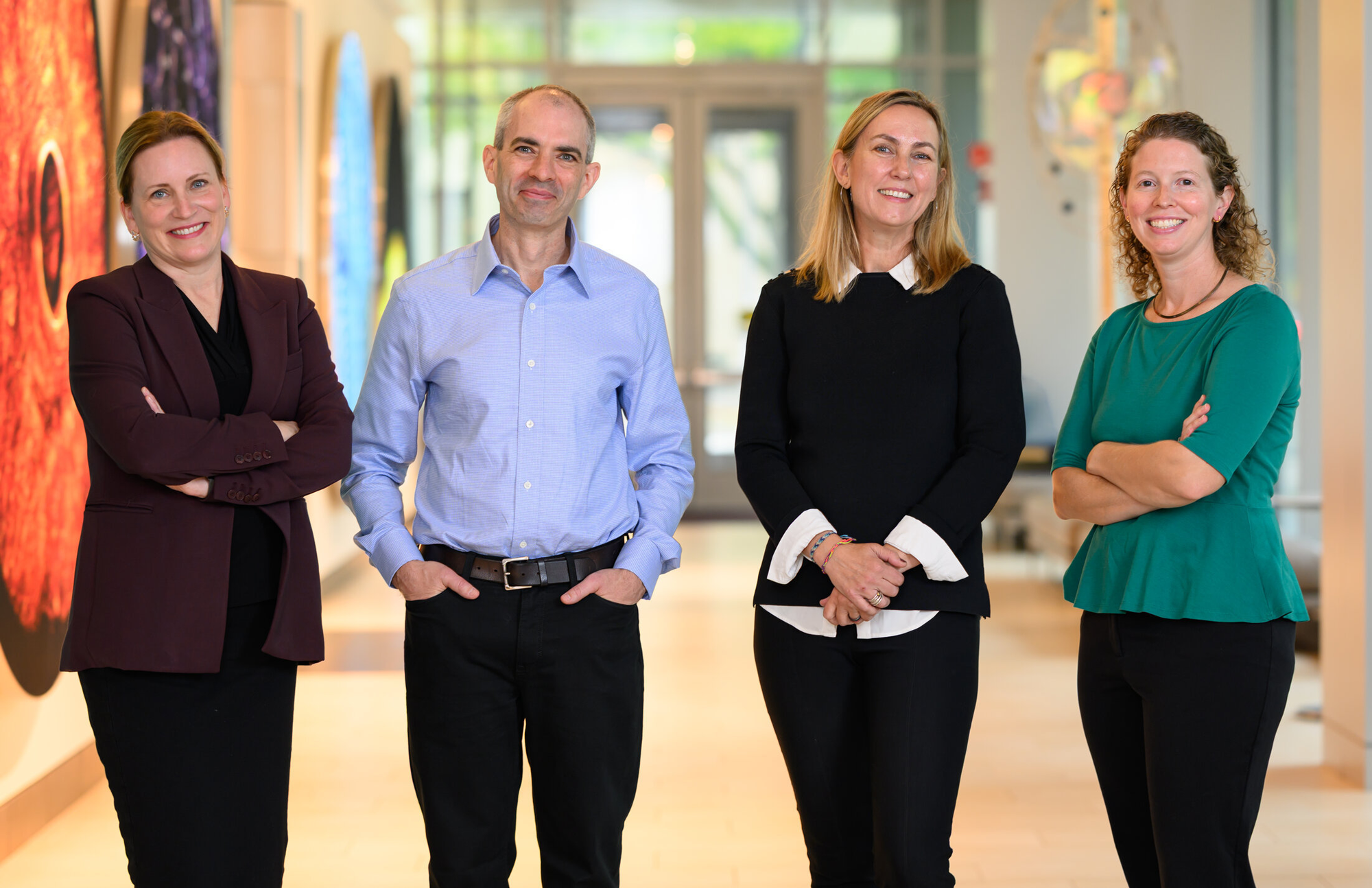
PHOTO: GRETCHEN ERTL
Koehler continues, “We were thinking about how you bring those colleagues on campus who care about life sciences innovation and biomedical innovation into spaces where they can collaborate with others, where they feel like there could be common convenings, where they could have funding to write joint seed grants, where their trainees would actually feel like part of a community. HEALS is really an umbrella to bring anyone who cares about health and life sciences to the table and to try to build teams and communities to drive some of the most impactful science.”
Powering promising research on campus
Financing high-risk, potentially high-impact research is critical, but early career faculty are in a difficult position, observes Sharp: “They are competing for research support with people in China, people in Europe, people everywhere.” Health care around the world needs scientific advancement, he says. “Now we have an initiative that recognizes that and tries to accelerate it.”
Funding for cross-disciplinary collaboration can be particularly hard to find, Sharp and Prather point out. If a graduate student’s research spans two or three departments with different funding structures, for example, which department foots the bill? One way that MIT HEALS seeks to address that problem is through the creation of HEALS graduate fellowships, which were designed to fund exceptional graduate students conducting discipline-spanning health and life sciences research for an entire academic year. The graduate fellows have regular cohort meetings to present their research, receive peer feedback, and engage with faculty from multiple disciplines.
In the same vein, the Biswas Postdoctoral Fellowship Program, established by Sanjit and Hope Biswas through the Biswas Family Foundation, supports exceptional early-career researchers focused on high-impact, interdisciplinary research in the health and life sciences for four years. Biswas Fellows benefit from faculty mentorship, a multidisciplinary cohort of peers, and community events.
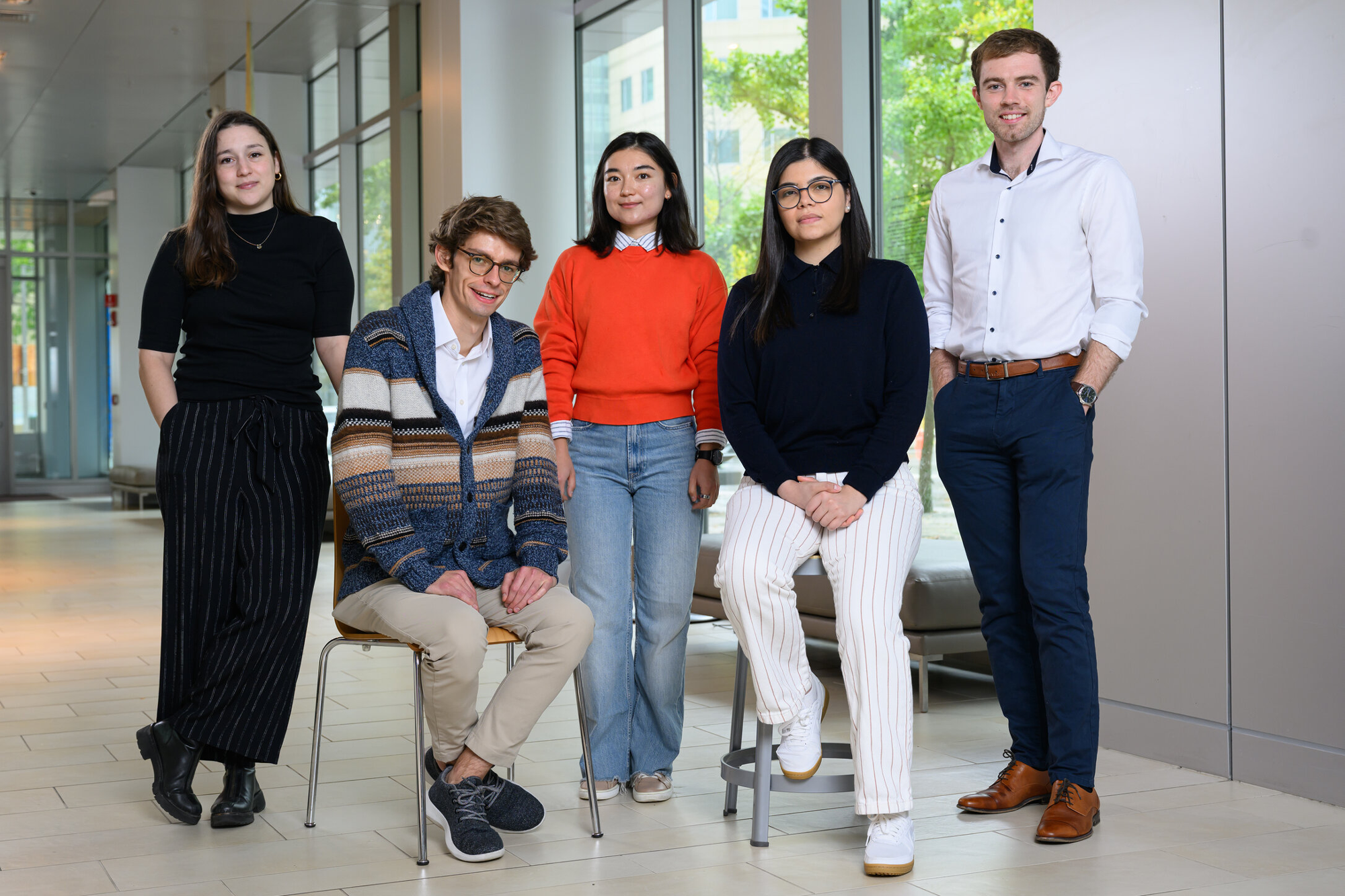
PHOTO: GRETCHEN ERTL
As for undergraduates, most of whom participate in the Undergraduate Research Opportunity Program (UROP) during their years at MIT, they now have access to the HEALS UROPs and SuperUROPs. During a yearlong SuperUROP research experience, students are supervised by a faculty mentor and receive classroom instruction in skills such as scientific communication and research presentation.

Almost as soon as MIT HEALS launched, faculty were invited to apply for MIT HEALS seed grants, which provide funding to support collaborative projects at the cutting edge of health and life sciences. These grants were specifically designed to support teams of researchers whose work crosses traditional disciplinary boundaries and integrates diverse approaches to develop bold, paradigm-shifting ideas. The response was enthusiastic, and 19 projects were funded in the initiative’s inaugural year.
Emphasizing translation
The HEALS emphasis on collaborations with off-campus partners enormously benefits both students and faculty, Prather explains. “We emphasize translation at MIT, and our students and postdocs are interested in understanding how to go from what they are doing as very fundamental basic science into something that will translate, and many of them also are looking for connections for their future employment as well. We certainly have an opportunity to have real partnerships as we work with people outside of MIT.”
One such outside partner is the health care system Mass General Brigham (MGB), which includes Massachusetts General Hospital and Brigham and Women’s Hospital. In 2025, MIT and MGB jointly launched the MIT–MGB Seed Program, which will fund collaborative projects, led by MIT and MGB researchers, that advance research in human health.
As for working with industry, Prather says, she finds it “very natural to think about getting that outside input to make sure that the work that we’re doing can be as useful as possible. It helps to make sure that our work is being informed by people who are focused on new products and new processes—and making things scale.”
Fundraising priority
As a Presidential Strategic Initiative, MIT HEALS is a top fundraising priority for the Institute. Funds to support highly impactful graduate fellowships into the future are critical, as are resources to ensure that seed grants can be directed to the most promising research (such as a Breakthrough Grant recipient focused on maternal health). “This year, MIT HEALS was able to fund only a small number of the highly deserving research proposals that were submitted,” says Iain Cheeseman, the Herman and Margaret Sokol Professor of Biology and associate director of MIT HEALS. “To unlock ideas that cannot yet be funded elsewhere but that often define what comes next in health and life sciences, we need sustained support.”
Other priorities include the MIT–MGB Seed Program, the Hood Pediatric Innovation Hub, the Fairbairn Menstruation Science Fund, and the Undergraduate Research Opportunities Program (UROP) and SuperUROP for undergraduates. Also important, says Koehler, are “world-class core facilities that undergird the kind of technology and application of technology that we want to be able to do here.”
“MIT HEALS has demonstrated an institutional commitment to life sciences and health research, and funds are critical to allowing important projects to move forward,” says Jacks. “You can’t just do it on a dream—it actually costs money. We will take a set of impressive raw materials at MIT and create a real jewel.”
EMPOWER THE FUTURE OF HEALTH INNOVATION
MIT HEALS is building the future of human health—by uniting brilliant minds across disciplines, forging powerful industry and hospital partnerships, and unlocking bold, cross-cutting research. Your support can accelerate breakthroughs, empower rising talent and translate discovery into impact. Make your gift.