PHOTO: LILLIE PAQUETTE
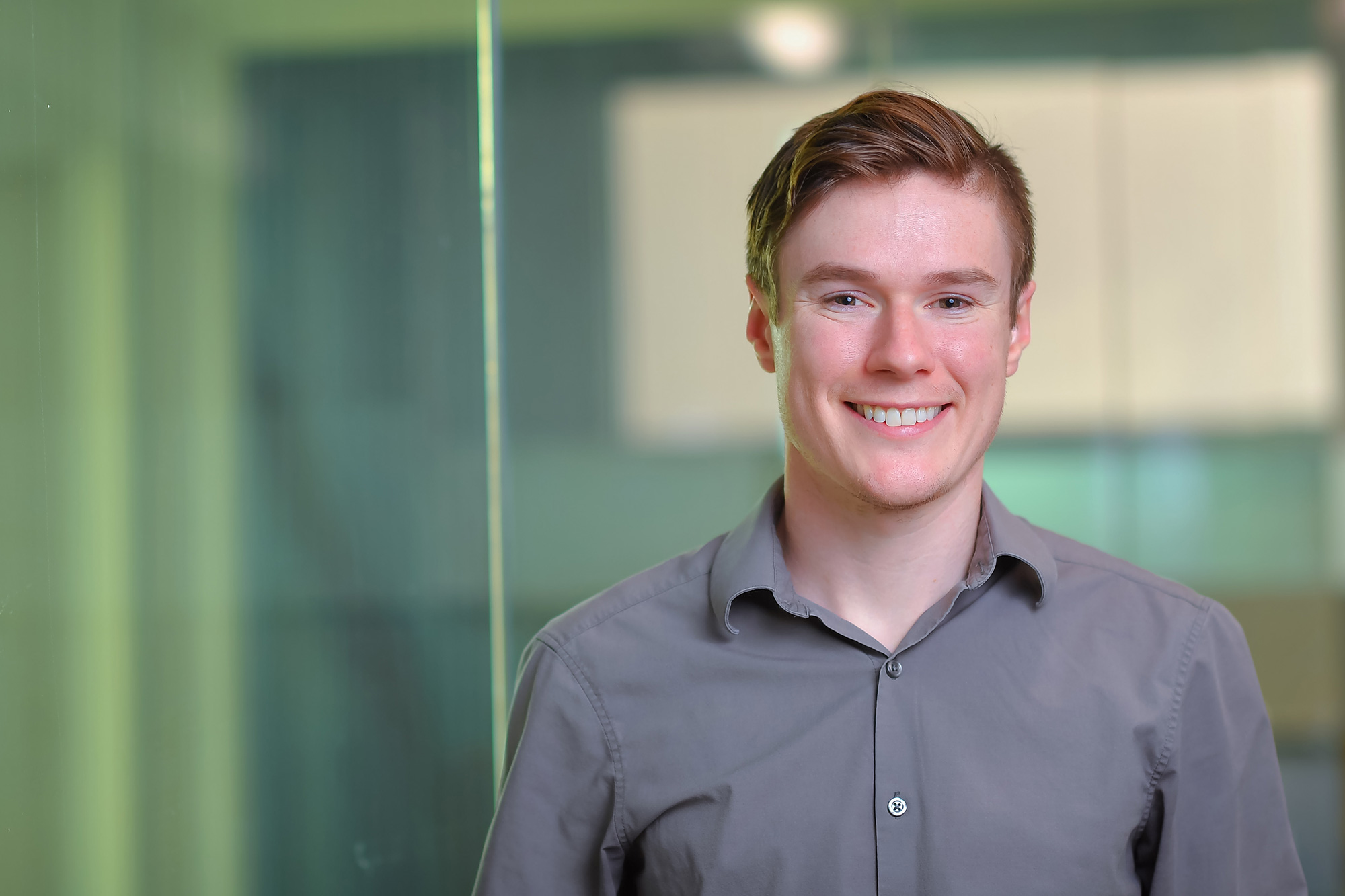
“I wanted to work on solving climate change with renewable energy. I was growing up at a time where most of the public discussion was debating whether climate change was happening or not,” he explains. This seemed to miss the key point, Howland points out: “Climate change is a measurable thing, so we know it is happening, and the evidence for anthropogenic contributions are conclusive.”
As the son of two biochemists who met in graduate school and now study neurodegenerative disorders, Howland understood that research was the solution: “We know climate change is a problem. So how do I solve it?”
Impact of mentorship
Approaching college armed with knowledge of scientific methods and a clear mission, Howland chose Johns Hopkins for its strong undergraduate research program. He was fortunate to encounter positive mentors almost immediately. “I learned so much from the faculty there about both the technical aspects of research, but also how to be leaders and also mentors.” His first advisor was the energy optimization and economics specialist Professor Benjamin Hobbs. “I worked with him on understanding how integrating more renewable energy, whose power production tends to vary in time, impacts the need for backup generation and storage to ensure the reliability of the power grid.” Next, Howland worked under the supervision of Professor Charles Meneveau, who, he explains, is known for pioneering work “translating foundational research in fluid mechanics and turbulence to renewable energy applications, specifically wind power.” During that time, Meneveau closely collaborated with a fluid mechanics, controls, and energy expert, Professor Dennice Gayme, on renewable energy research. “When I joined the lab, I couldn’t even tell who was advised by who, because it was just so collaborative,” Howland recalls.
At Stanford, where he undertook graduate work, Howland found another pair of generous and collaborative mentors in Professor Sanjiva Lele, a leader in computational fluid dynamics, and Professor John Dabiri, a pioneering experimental fluid dynamicist. “We found an opportunity working in partnership with energy companies to try out some of the technologies we were developing in full-scale, real wind-power systems. Currently, wind turbines are operated greedily and independently. Our idea was to control wind turbines collectively to try and mitigate the negative aerodynamic wake interactions between the turbines and maximize the production of the farm as a whole,” says Howland. He has continued working in this area, and in 2022 had his findings published in a cover story for Nature Energy.
Leading a team at MIT
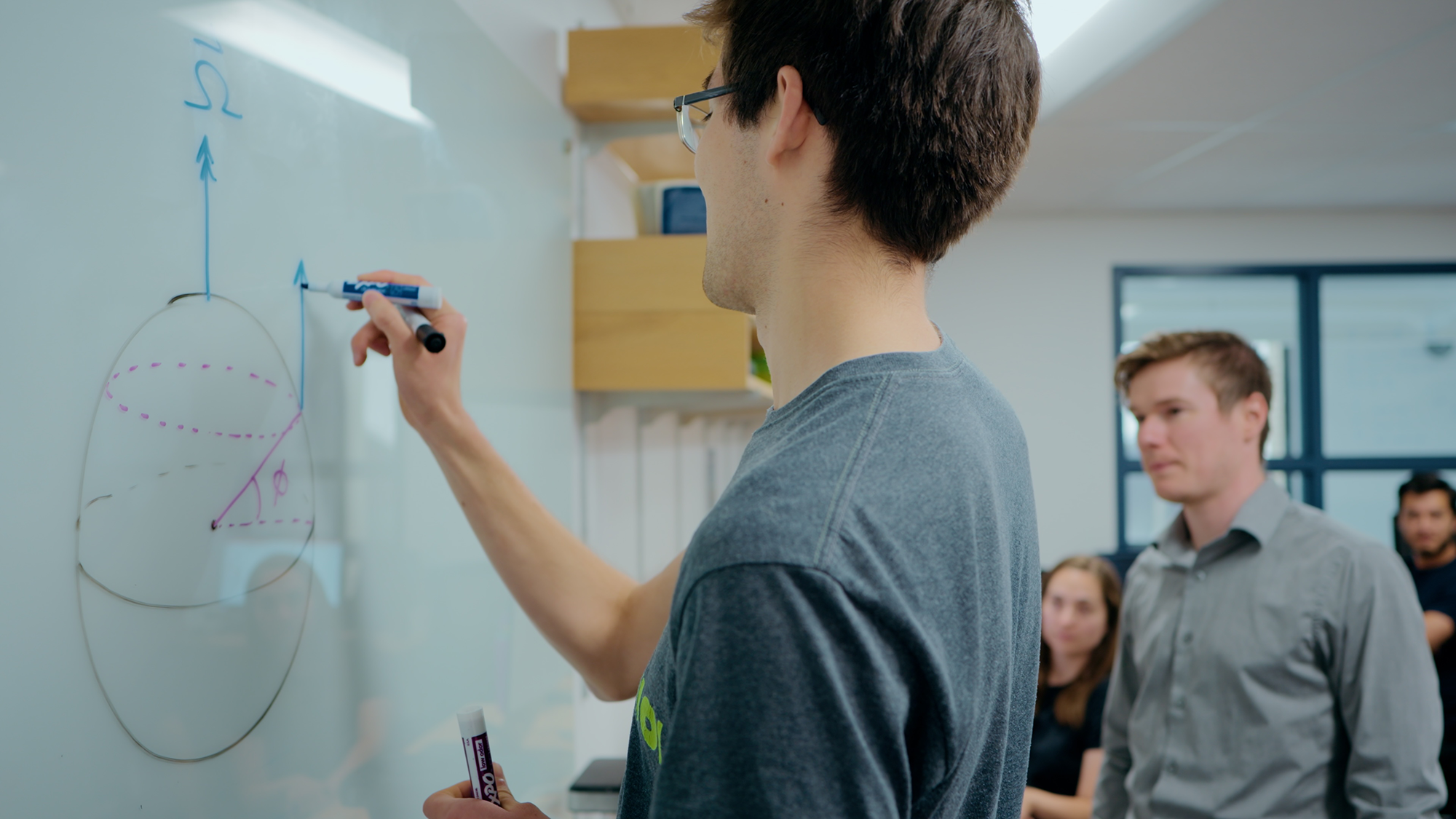
Today, Howland aspires to recreate in his own lab at MIT the positive learning environment provided by his mentors. leading a group focused on environmental fluid mechanics and renewable energy systems. “I do my best to emulate that level of collaboration and feedback within the group,” he says. “We still do lots of wind energy work, but we also study other fluid mechanics and energy contexts such as: How do we improve predictions from weather models and how should we design decarbonized energy systems? As we decarbonize energy generation with technologies including renewables, and as we electrify energy demand, we’re simultaneously reshaping and becoming more dependent on the electrical power system. The key challenge is: How do we ensure that the grid is reliable, that supply equals demand at every timescale while also keeping costs low and decarbonizing as fast as possible?”
What a professorship makes possible
Howland is currently the Jeffrey Cheah Career Development Professor at MIT, which was endowed by a gift from Tan Sri Jeffrey Cheah, founder and chairman of the Sunway Group, a Malaysian conglomerate. Cheah also founded Sunway University and the Jeffrey Cheah Foundation, which he created to fund educational causes that cultivate research collaboration and excellence across institutions worldwide. “The professorship was established to empower exceptional young scholars at a pivotal stage of their careers, enabling them to pursue research and solutions to address some of the world’s most pressing challenges,” says Cheah.
In Howland’s lab, where his team includes graduate students, postdocs, and the occasional “passionate undergraduate,” he says, the professorship provides the ability to follow promising leads. “It means being able to respond to opportunities that can come up at any moment. That could be when a really outstanding postdoc finishes their PhD and wants to join my lab; it allows me to get them in the door because I have funding that is not tied to a particular project. It also allows us to travel to conferences to present our findings to the academic community. And finally, it’s very helpful as additional support for equipment and computing costs. By enabling both preliminary work and sustained work in the blind spots of federal funding, the professorship enables my lab to build the foundation for urgently needed energy and climate breakthroughs.”
Interdisciplinary climate work
Working with other disciplines is critical, he says. “We’ve had some really excellent collaborations, and my team and I are looking forward to more in the future.” The Howland Lab participates in the MIT Climate Grand Challenges project, preparing for a new world of weather and climate extremes. “That project has brought together the climate scientists and engineers like me so we can learn from each other. An extreme event from a climate scientist’s standpoint is not the same necessarily as an extreme event from the energy system’s standpoint. And that’s also not the same as an extreme event from an urban environment standpoint. You can only understand these interactions beyond the surface level by integrating models and getting people in the same room and learning from each other.”
Howland is living his childhood dream of working on climate mitigation, calling the Institute, “a great place to be for this. MIT has had a historical leadership role in energy, and I hope to see that only growing as we focus on more and more innovative energy technologies that are going to transform the energy of the future.”
A brighter energy future
“What gives me hope,” he says, “is the quiet revolution of technologies like renewable wind and solar energy and energy storage—and other kinds of energy-efficiency technologies that perhaps don’t get as much media coverage. They have transformed our future already and will do so even more because of the progress and advances that have improved their efficiency and also their economic prospects.”
Noting that some of these new energy technologies have already become “no-brainer economic prospects,” Howland says, “Once that happens, then the momentum is there for us to keep further accelerating the efficiency and reliability to another level. The critical and urgent need for this acceleration is why we need fundamental research in science and engineering supported at places like MIT.”
Cheah agrees. “MIT has long stood at the forefront of scientific excellence and technological innovation,” he says. “It is deeply rewarding to witness Professor Howland advancing that tradition through his pioneering work in renewable energy systems and environmental fluid mechanics. I am grateful that this endowment continues to nurture outstanding academics whose discoveries contribute to a more sustainable, resilient, and prosperous future for humanity.”
SUPPORT PROFESSORSHIPS AT MIT
Endowed professorships provide support and flexibility, making it possible for faculty like Michael Howland to take their research in exciting, untested directions. History has shown us that MIT faculty members can, and do, change the world. Make your professorship gift.