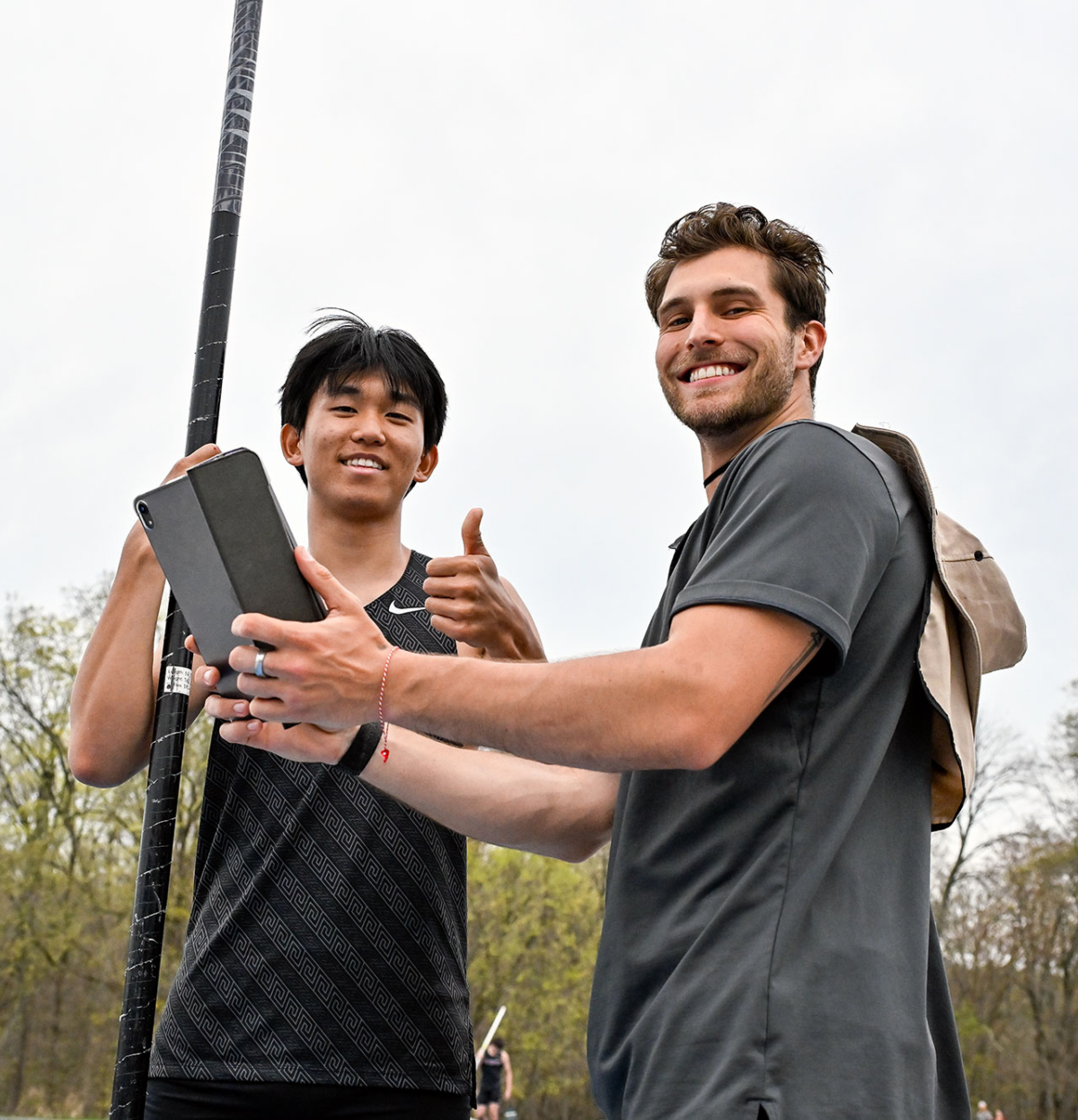
Liam Ackerman (right) is an assistant track and field coach at MIT.
PHOTO: COURTESY OF BOB BLANCHARD/RJB SPORTS PHOTOGRAPHY
In 2021, we spoke to Liam Ackerman ’21, MNG ’22—along with several other MIT scholarship recipients—about his undergraduate journey. Five years later, we caught up with Ackerman to see what he’s been doing since.
At the Institute, he learned the benefit of rejecting that advice.
A former team captain for the MIT Engineers, Ackerman finished his undergraduate career as a four-time NCAA national qualifier and a two-time NCAA All-American in the pole vault. As a graduate student, he earned USTFCCCA All-Region honors in both indoor and outdoor pole vault.
Reflecting on the MIT motto, “mens et manus,” Ackerman says that in the past, “all the mens was in the classroom and all the manus was on the field. I learned here that my mind and hand could be powerful partners—that training my mind was a better solution than trying to shut it down.”
Now an assistant track and field coach at the Institute, he works with athletes in the same sport at which he excelled. “Every day as a coach, I use the movement-learning fundamentals I studied as a master’s student, and my experience as a software engineer, to simplify the vault.” As for thinking during performance, “I pass along the same message my coaches gave to me: Use your exceptional minds to understand and master your own movement. I tell them to be professors of their event.”
While earning a master’s in electrical engineering in 2022, Ackerman worked in the MIT Biomimetic Robotics Laboratory, the groundbreaking lab behind the Mini Cheetah, a small quadrupedal robot, and the MIT Humanoid, which takes the dynamic, agile locomotion of the cheetah and applies it to a bipedal robot. Under the leadership of Sangbae Kim, the Jerry McAfee (1940) Professor in Engineering, Ackerman says, “people were starting to figure out how to make robots really walk and run with reinforcement learning, but average training times were anywhere between two days and three weeks. I’m impatient, so I thought, ‘Can better hints help the robot learn faster?’ That became my thesis. I learned that the right information structure and progression could produce high-quality movement much faster than simply dropping the robot into the deep end.”
Post-MIT career
After graduate school, Ackerman worked at Google as a software engineer for two years and was pleased to encounter a large contingent of MIT alumni in Los Angeles. He worked on the YouTube Ads forecasting system. “If you’re going to buy an ad campaign, you need to know if it’s going to reach the right customers. Our system provided these estimates to our partners.” He says, “Many of my teammates had PhDs, and some had previously been professors. I was grateful to see how they kept their solutions simple despite working on a really complex system. The same engineering principles apply whether your budget has two zeros or nine.”
Although he enjoyed the work and experienced “great mentorship” at Google, Ackerman longed for a different professional life. When his MIT track coach—also a friend and mentor—left the Institute to relocate, he recommended that his former student apply to succeed him as vault squad coach. “It felt like the perfect balance for me,” Ackerman remarks. “I’m social. I love to engineer. Coaching the vault is a great mix of technical thinking and relationship building.”
“During my first year,” he continues, “I got to contribute and also see how the work of different coaches built over time turned into something really special: The women’s team won three national championships that year. My women vaulters scored at the indoor and outdoor meets. I’m really proud of them.”
In addition to his coaching work, Ackerman subsequently became a technical instructor in the Department of Electrical Engineering and Computer Science (EECS). “I spend my days in two places: in the Engineering Design Studio helping folks out, prototyping personal and class projects, and in lectures delivering demos to EE courses with Dave Otten ’73, SM ’74, the resident ‘Bill Nye the Science Guy’ for the department. I love this role,” he says, “and I remember how much value this studio space and the demos gave me as an undergraduate.”
Building a new system
In fact, he has been developing a project of his own: technology to help athletes get better movement data. “I built an app called TrackTech that serves as a platform for distributing film from coaches’ phones to athletes’ devices. We’ve used it for film review all year, and I recently deployed a wireless version for the championship season. I think this is going to help athletes have much better access to their film, giving them the resources to take ownership of their growth.”
Outside MIT, TrackTech is now in beta testing at a few club and collegiate athletic programs. “MIT’s Venture Mentoring Service,” says Ackerman, “has been an excellent guide as I figure out which directions to take. I’m moving on to more quantitative measures of the athlete’s performance, including runway velocities and postural analysis.”

Back where he belongs
Ackerman often reflects on a career path made possible by the undergraduate scholarship he received from the Ashar Aziz (1981) Mens et Manus Scholarship Fund. Aziz, founder and former CEO of the cybersecurity company FireEye, established this fund to help low-income students afford an MIT education. “I wouldn’t have been able to make any of the career moves I’ve made without his generosity,” says Ackerman. He was thrilled to meet Aziz during a recent visit to the Institute; when members of the EECS Visiting Committee toured the learning facilities, Ackerman and fellow EECS technical instructors served as their guides and hosts.
Ackerman is enthusiastic about the different facets of his professional life at the Institute. “Since MIT’s motto helped shape my worldview and toolbox, I now get to pass it forward with coaching and technical instruction. In class, I get to be a bridge between theoretical content and application before students go off and build projects on their own.” He always hoped, he recalls, for his MIT degrees “to be a great toolbox that I could take with me wherever I wanted and use them to build the world up.”
SUPPORT SCHOLARSHIPS AT MIT
Liam Ackerman is a powerful example of how scholarships open the door to an MIT education for extraordinary talent, granting access to a life-changing education, regardless of a student’s ability to pay. At MIT and beyond, these students will join their fellow alumni—like Ackerman—in making an outsized impact on the world, wherever their future takes them. You can play an integral role in this journey. Make your scholarship gift.