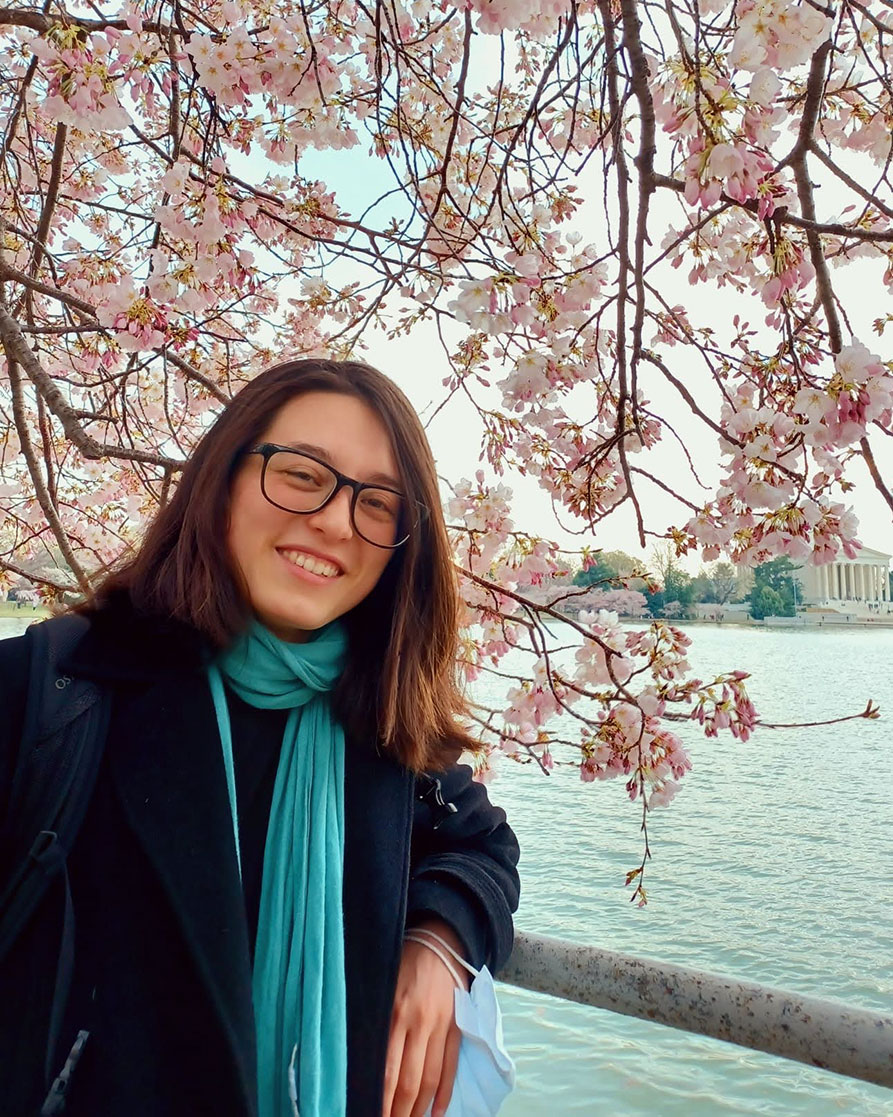
PHOTOS: COURTESY OF SHEILA BABER
In 2021, we spoke to Sheila Baber ’21—along with several other MIT scholarship recipients—about her undergraduate journey. Five years later, we caught up with Baber to see what she’s been doing since.
Today, the University of Maryland doctoral student is active in NASA Harvest, the National Aeronautics and Space Administration’s food security and agriculture consortium, which uses satellites and other forms of Earth observation to monitor agricultural production and food security around the globe.
NASA Harvest has given her the opportunity to combine two parallel passions, in agriculture and in space. “My undergraduate degree was in physics and planetary science, with evenings spent freezing by a telescope or designing satellite missions with engineering students,” she says. “I’ve always had an interest in agriculture, stemming from childhood stints at my grandparents’ farm in South Korea.”
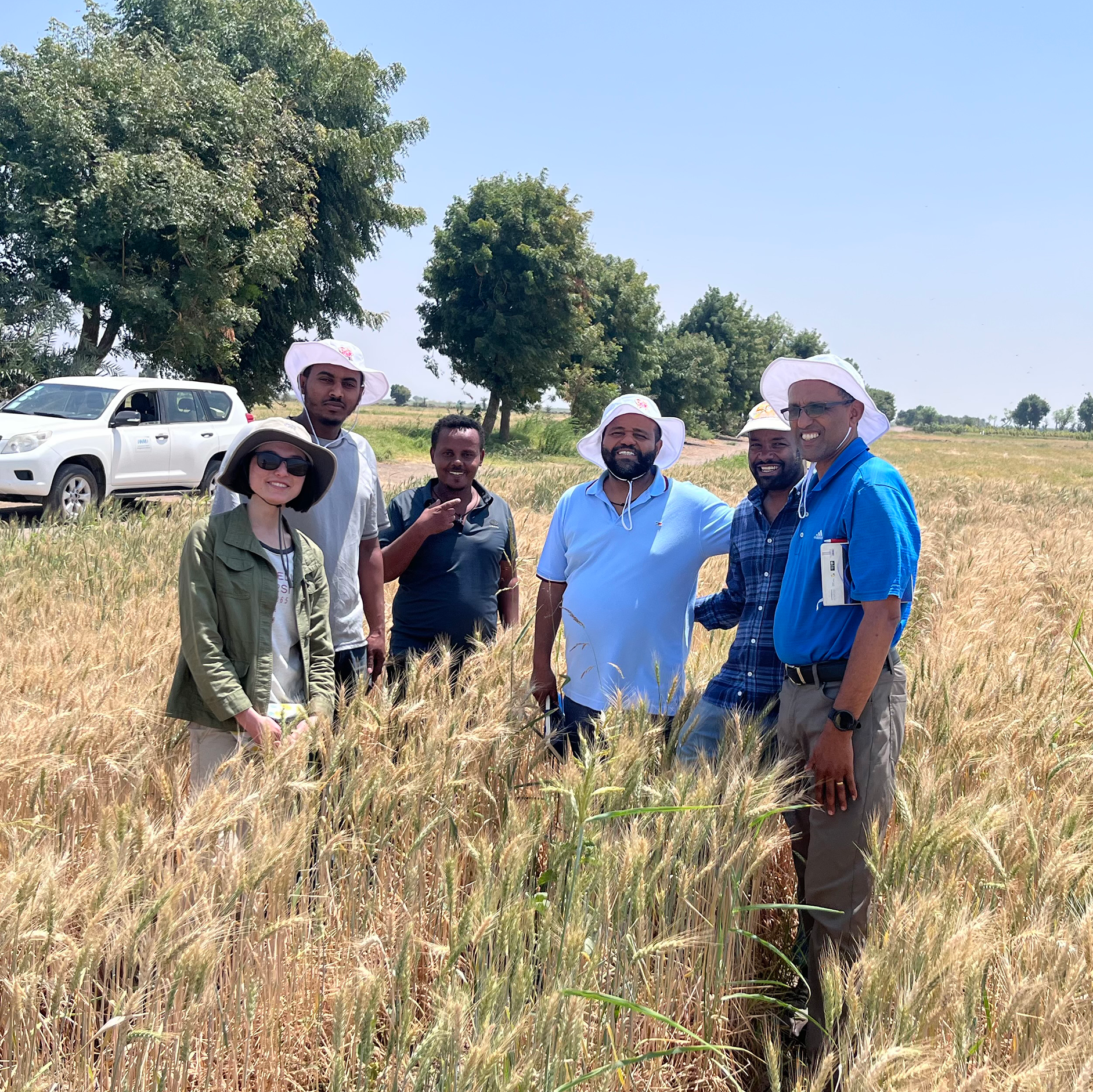
Her projects have included cropland mapping at the start of the war in Ukraine and yield prediction in smallholder settings in Ethiopia.
“NASA Harvest looks at agriculture worldwide, at the amounts of different crops that have been planted, and what the yield might be,” Baber says. “In recent decades, we’ve been using machine-learning-type approaches to assess planted area and yield, which informs food production and affects commodity prices.”
Using satellite data to gauge effects of war on food production
After Russia invaded Ukraine in 2022, Baber was part of an international team that mapped winter wheat crops in Ukraine to assess the impact of the conflict on agriculture in the region. “Most of the wheat that is consumed in the world is winter wheat, which is planted in the fall and re-emerges again early in the spring,” she says. “At the start of the war, we could tell how much winter wheat was going to be affected, because these crops had been planted before the invasion.
“We mapped out winter wheat using an array of different satellites. As the seasons progressed, and the front lines changed, we looked at other crops, like rapeseed, known in the United States as canola, and at summer crops like maize and soy.” The research team’s findings were reported in a paper published in January 2026 in the journal npj Sustainable Agriculture.
“In 2023, the Nova Kakhovka dam on the Dnipro River was blown up,” she says. “Most people agree it was destroyed by the Russians to stop Ukrainian forces trying to reclaim the dam. That reservoir had been supporting an irrigation scheme in southeastern Ukraine. My task was to map irrigation in the region using satellite data to see what the change in the irrigation looked like after the destruction of this reservoir.” Her work is currently under review for publication, she says.
Baber says she’s learned more about current events when it comes to food security and production. “Ukraine is one example. I’ve also been involved with a project on Ethiopian food production. The country is particularly challenging to analyze with satellites given the highly fragmented, smallholder landscape spanning the lowlands near sea level to almost 4 kilometers in altitude. My role is to map irrigation there, which can expand the growing season to the drier months to boost production.
“There is also a concern, within the food security community, about this year’s El Niño, and the impact of the Strait of Hormuz situation on fertilizer prices and the implications for farmers getting ready to plant their crops. Satellite data is among the suite of tools being used to monitor global agricultural production.
“Being part of this research group, I’ve learned more about the food security system that we take for granted. When we go to the grocery store, sometimes a package will say it’s from Mexico, or from Chile, or from South America. But how did it get to us, and what about the farmers? It’s fascinating to me.”

Advocating for science
Baber expects to complete her PhD in geographical sciences this fall. She is considering a career in science policy. “A year and a half ago, I would have said I wanted to become a research scientist and focus on doing science research for the sake of science,” she says. “But I think the past year and a half has shown there is so much translation that needs to be done between scientists and the public and the decision-makers on why we’re doing this science. A lot of early-career scientists have been exposed to the idea that we can’t take public support for granted.
“Being so close to DC, there have been opportunities to do science advocacy, talking to congresspeople on Capitol Hill about the sort of research that’s being funded by the National Science Foundation and by NASA. I think when it comes to agriculture and satellites, there is still public support for this. And I think that decision-makers at the federal level understand the utility of this, especially when incorporating geospatial AI or AI-derived insights on agriculture.”
How MIT shaped her path
It was at MIT that Baber “fell in love with space and satellites,” she says, crediting a class on Earth observation taught by Kerri Cahoy, the Sheila Evans Widnall (1960) Professor and Space Sector head in the Department of Aeronautics and Astronautics. “Combining my love for agriculture with space seemed to happen very naturally,” she says.
“My degree in Earth, atmospheric, and planetary science—which is such a mouthful—gave me a holistic view of how the different systems interact with each other,” Baber says. A class on international development taught by Wesley Harris, the Charles Stark Draper Professor of Aeronautics and Astronautics, “was really crucial in thinking about food security,” she adds.
Danielle Wood, associate professor in the Program in Media Arts and Sciences who holds a joint appointment in the Department of Aeronautics and Astronautics, provided Baber an Undergraduate Research Opportunity (UROP) in the Space Enabled lab to apply satellites in addressing development challenges, Baber notes. In AeroAstro’s Engineering Systems Lab, where she pursued another UROP, research scientist Afreen Siddiqi and lab director Olivier de Weck, the Apollo Program Professor of astronautics, cemented her interest in Earth observation, she says.
“And the conversations with my friends in my iHouse living group and across classes—I think I miss the conversations I had at MIT most of all.”
She is active in the MIT Club of Washington, DC. “When I go to those events, I feel reconnected to the community at MIT,” she says.
Over her four years at MIT, Baber was the recipient of a scholarship established by Natalie Lorenz Anderson ’84, of Great Falls, Virginia. She has had the opportunity to meet with her benefactor, who is a past president of the MIT Alumni Association and a past director of the Washington alumni club.
“Natalie supported my education through the scholarship, and when we catch up, it’s quite lovely,” Baber says.
“I wouldn’t be the person I am today without an MIT education.”
SUPPORT SCHOLARSHIPS AT MIT
Sheila Baber is a powerful example of how scholarships open the door to an MIT education for extraordinary talent, granting access to a life-changing education, regardless of a student’s ability to pay. At MIT and beyond, these students will join their fellow alumni—like Baber—in making an outsized impact on the world, wherever their future takes them. You can play in integral role in this journey. Make your scholarship gift.